By Jim Garamone DoD News, Defense Media Activity
WASHINGTON, March 29, 2018 — A new Army formation deployed
to Afghanistan is dedicated to focusing the power of the Afghan military and
government on taking the fight to the Taliban to convince the group to
reconcile.
The 1st Security Force Assistance Brigade will help the
Afghan national security apparatus to increase its effectiveness. Members of
the unit will advise down to the brigade and kandak level. A kandak is roughly
the size of a battalion. There is a mix of advisers and self-protection forces
in the unit.
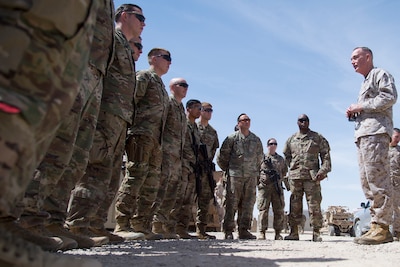
Army Col. Scott Jackson, the commander of the brigade, spoke
to reporters traveling with Marine Corps Gen. Joe Dunford, the chairman of the
Joint Chiefs of Staff, last week. Jackson spoke via phone from his headquarters
at Advising Platform Lightning near Gardez, Afghanistan.
Purpose-Built Brigade
The brigade is a purpose-built organization designed,
selected, trained and equipped specifically for this mission. Every individual
is a volunteer.
Jackson deployed numerous times to Iraq and advised Iraqi
troops. He said the changes in Afghan forces over the last eight years have
been incredible. In 2010, U.S. forces were in the lead, partnering with Afghan
forces in the fight against the Taliban and al-Qaida. Afghan soldiers
accompanied Americans on combat patrols.
It is an Afghan battle now, Jackson said. They are in the
lead, they decide the goals and they assign the resources. Afghans are the ones
who gather the information and launch the strikes.
The 1st SFAB is falling in on established advisers at the train,
advise and assist commands in Afghanistan. Those commands work at the
corps-level and higher. Jackson’s command will advise six brigades and up to 36
maneuver battalions.
Each Afghan brigade has roughly 3,000 to 5,000 soldiers and
is led by a brigadier general. “Then I have various types of battalion-level
advising teams largely focused on advising the maneuver forces -- the infantry
battalions in the Afghan army,” Jackson said.
The brigade also has specialty advising teams that can cover
down on everything from military intelligence to signal to engineers to field
artillery and logistics.
“We cover all the functions that a regular U.S. Army brigade
does,” Jackson said. The brigade, he said, will be advising units all over the
country from the German-led Train Advise Assist Command – North in
Mazar-e-Sharif to the [train, advise and assist commands] in Helmand and
Kandahar in the south.
Training Afghan Forces
While the teams are going to partner with Afghan battalions,
a good bit of the brigade force structure will engage with Afghan forces on the
institutional training side. Each of the Afghan corps have a regional military
training center and Afghan units use these to maintain their proficiency.
“We’re going to apply some of our advising skills to those
training academies, too,” Jackson said.
This arrangement allows the Afghans to employ forces and
build readiness at the same time.
Army Lt. Col. Jason Sabat, a battalion commander in the
brigade based at Train, Advise, Assist Command South, has 14 teams advising
units in the Afghan 205th Corps. “We fill the gap from brigade and below,” he
said. “So of the four brigades that make up the 205th Corps, we are trying to
align -- at a minimum -- a team that can persistently advise that brigade
commander and staff.”
But the brigades are separated and that may not always be
the case, he said. If so Sabat’s unit has a periodic advisory capacity to go
out to those brigade headquarters to advise them.
About half of Sabat’s unit has been deployed to Afghanistan
in the past. This familiarity with the region and the culture is allowing his
personnel to move quickly into place.
With the introduction of the SFAB, U.S. advisors have the
capability to accompany kandaks on operations, but that will only happen after
a rigorous examination of the risk/reward ratio, Sabat said. “There is a
[concept of operations] process that we will work through before we embed,” he
said. “That takes under consideration the risks involved in the mission, the
duration we’ve been with the unit, how well we know them, how long we’ve been
in theater.”
The examination is a very deliberate process for all the
right reasons. “We haven’t been [advising] at these levels for quite some time,”
Sabat said. “Approval authority for accompanying a unit runs the gamut from the
train, advise [and] assist commander to the commander of the Resolute Support
Mission.”
Sabat and his advisors will be co-located with many of the
units they advise in Kandahar. “This will allow the advisors to do their jobs,
and since they will walk into the compound, advisors can assess what the
maintenance picture is like in the unit, how many forces are assigned and how
many are present for duty,” he said.
‘You See an Increased Bravado’
The Afghans are pleased to see American forces advising them
once again. “In some of the initial engagements you see an increased bravado --
sense of intestinal fortitude in the Afghans seeing a physical commitment
standing there in front of them,” Sabat said.
But the reappearance of American advisers does not mean a
shift to Americans doing the fighting. “The first tool you reach for should be
an Afghan tool,” said Army Capt. Kristopher Farrar, an SFAB team leader who
will be advising the 3rd Kandak, 4th Brigade on Tactical Base Gamberi in Train,
Advise, Assist Command East. “We make sure that we use their soldiers, their
weapons, their procedures and we are just helping refine that. In the past,
where we may have tried to have the Afghans mirror the U.S. way of doing
things, we’re trying to help them make their processes work smoother.”
Afghan forces have made great strides and have been
conducting operations on their own. “We don’t want to re-impose that
dependence,” Farrar said. “They’ve been fighting, they’ve been winning. We just
want to help with those small adjustments that maybe they don’t see. An outside
set of eyes is always good for any formation, and that’s what we are providing
to these kandaks.”
Afghan forces are working to perfect intelligence sharing
among the various entities that make up the security forces and the operations
that result. Advisers help with that and the various corps in the country are
working to gather and disperse intelligence, working with army, police, special
operations forces and other entities to handle complex operations.
A recent operation in the eastern part of the country points
to the progress made. Afghan commanders used intelligence from the National
Directorate of Security to develop an operation plan to move into population
centers. Special operations forces -- the famed Afghan commandoes -- led the
way with shaping operations. Conventional forces interspersed with police
followed. The corps used ScanEagle drones for intelligence, reconnaissance and
surveillance, and then used MD-530 helicopters and A-29 Super Turcano
fixed-wing attack aircraft to hit enemy positions.
Successful Operation
All aspects of the military participated, all pillars of the
Afghan government melded for the operation. The operation was a success.
“You can fight battles nose-to-nose -- anybody can do that,”
Jackson said. “But if we do our jobs right, the Afghans are not getting into a
nose-to-nose street fight.”
Afghan forces need to use their all aspects of the nation’s
power against the Taliban to convince the group that it is not worth continuing
the fight. “That means effectively using intelligence, air power, ground
forces, artillery -- the whole bit,” the colonel said.
The advisers have just hit the ground, and Jackson insists
they will be deliberate in their actions.
“We are not going to run out beyond our headlights,” he
said. The teams will understand the environment, understand the risks and
understand the missions.




 Posts
Posts

