Sunday, September 28, 2025

Left-Wing Terrorism Surges: Is America’s Extremism Landscape Shifting?

For most of the past three decades, U.S. domestic-terrorism conversations have been framed by two patterns: the long, deadly arc of far-right violence and the episodic but devastating mass-casualty plots associated with jihadist inspiration. In 2025, that familiar mental map hit an unexpected jolt. A new, data-driven assessment from researchers at the Center for Strategic & International Studies (CSIS) indicates that left-wing terrorism incidents have climbed sharply—enough that, for the first time in more than 30 years, left-wing attacks and plots are outnumbering those from the violent far right. This reversal is not a declaration of “new normal” so much as a flashing indicator on the dashboard: the underlying engine of American extremism is responsive to political context, grievance cycles, and the oxygen we give to narratives of existential threat. 

The claim deserves careful handling. “Left-wing terrorism is rising” can be instantly weaponized in partisan discourse, either to minimize years of far-right lethality or to score a rhetorical win in a news cycle shaped by high-profile political violence. CSIS’s researchers, however, place the surge in context. Their longitudinal dataset—about 750 attacks and plots from 1994 through mid-2025—shows that left-wing incidents are indeed elevated this year, but from historically low levels. In absolute terms, far-right violence over the past decade remains far more lethal. The point, then, is not to flip a hierarchy of danger but to recognize that opportunity structures for political violence shift, and that the U.S. counterterrorism posture must be nimble enough to track those shifts without losing perspective. 

A Reversal With History

The CSIS finding matters because it jars our assumptions. Since the Oklahoma City bombing and through waves of militia resurgence, anti-government, white supremacist, and accelerationist currents have accounted for the preponderance of deadly violence on U.S. soil. Even after 9/11 redirected national security toward jihadist threats, domestic-terror fatalities in the 2010s and early 2020s disproportionately stemmed from far-right actors. In the first half of 2025, though, CSIS charts a spike in far-left incidents tied to sabotage, arson, property destruction, and targeted, smaller-scale assaults—tactics that prioritize disruption and symbolism over mass casualties. The pattern echoes earlier U.S. eras (e.g., 1970s political violence) in methods, even if the modern ideological cocktail differs. 

Several contextual notes keep this from being misread. First, incident counts (attacks and plots) are not the same as lethality. A year with numerous non-fatal sabotage attempts can eclipse a period with fewer but deadlier shootings. Second, “left-wing” is a heterogeneous bucket: eco-sabotage, anti-fascist vigilantism, anarchist direct action, and anti-police militancy often mingle tactics while diverging on ultimate aims. Third, CSIS is explicit that the reversal could be temporary: a contraction in far-right plots during 2025 could snap back, particularly in a charged election environment, as grievance entrepreneurs pivot strategies. The picture is dynamic, not deterministic. 

Political Context and Narrative Fuel

Why now? Analysts point to a confluence of narrative, policy, and policing dynamics. The White House’s posture toward political violence, the rhetorical elevation of certain threats, and episodic shocks (including a prominent conservative political figure’s assassination, which supercharged media frames) all reconfigure the incentive landscape for fringe actors. The Trump administration’s declaration that “antifa” constitutes a domestic terrorist organization—despite the term’s nebulous, non-hierarchical reality—also altered how incidents are labeled, policed, and reported. That combination can both chill and provoke: it deters some actors while galvanizing others who interpret the designation as proof of encroaching authoritarianism. 

Meanwhile, the years-long discourse about far-right violence has had twin effects. On one hand, it drove serious investments into monitoring and interdicting plots linked to white supremacists, militias, and accelerationists, potentially depressing incident counts in early 2025. On the other hand, it fostered a mirror-narrative among radical left currents that “the state protects fascism,” a justification used to escalate from protest and civil disobedience to direct action targeting infrastructure, political offices, or perceived collaborators. The result is not moral equivalence but a reminder that counterterrorism is a system of interacting narratives: the story each side tells about the other can function as recruitment material. 

Method Mix: Sabotage Over Slaughter

Methodology differentiates the current far-left spike from prior far-right surges. Where far-right violence in recent years often sought body counts (e.g., mass shootings targeting synagogues, Black churches, immigrant communities), the contemporary far-left profile skews toward property destruction, arson, and intimidation—tactics that create fear and signal capacity while stopping short of indiscriminate killing. In CSIS’s coding, these are still terrorism if they aim to coerce broader populations or governments for political ends. But the risk curve is different: a campaign of infrastructure sabotage produces cumulative societal costs and psychological pressure without necessarily triggering the acute, front-page horror of a mass-casualty event. This complicates media coverage, policing priorities, and public risk perception alike.

What follows from that method mix is a policy conundrum. Traditional counterterrorism has grown adept at thwarting catastrophic plots—especially those leaving digital trails, supply-chain footprints, or large conspiratorial chatter. Dispersed sabotage by loosely affiliated actors is harder to detect because it demands little coordination, requires modest resources, and can be framed (internally) as morally bounded: “We hit property, not people.” The difficulty is that escalation pathways exist. “Non-lethal” tactics can bleed into assaults, boobytrapping, or reckless arson with unpredictable human consequences. The imperative for law enforcement, then, is precision: aggressive enough to deter escalation; restrained enough to avoid broad-brush crackdowns that radicalize sympathizers.

The Designation Trap

One news-driving feature of 2025 has been the political impulse to “designate” domestic adversaries. Labeling “antifa” as a terrorist organization may satisfy a demand signal from parts of the electorate, but it raises practical and civil-libertarian concerns. Unlike foreign terrorist organizations, domestic movements lack a centralized legal target for proscription; the First Amendment constrains prior restraint, association penalties, and the criminalization of ideology. The effort to apply designation logic domestically risks two outcomes: (1) it muddies analytic clarity by collapsing diverse actors under a catchall brand; and (2) it invites reciprocal escalation when a future administration uses the same tool against an opposing fringe. Given that CSIS’s data suggests a malleable threat landscape, building durable, content-neutral guardrails around political-violence suppression may be wiser than swinging the designation hammer.

The United Kingdom provides a cautionary parallel. In 2025 the government proscribed Palestine Action under terrorism law, and police subsequently made arrests for “supporting a proscribed organization” at protest actions—sparking intense debate over the line between criminal conspiracy and protected dissent. The British context is not the U.S. Constitution, but the episode underscores how terror law can quickly extend from violent acts to expressive support, chilling speech and inflaming grievances. It also demonstrates the enforcement reality: once an organization is proscribed, otherwise-lawful acts (e.g., advocacy, fundraising, even certain kinds of praise) can trigger serious penalties—outcomes that can be both effective against violent facilitation and counterproductive for broader social peace.

Media, Measurement, and the “Which Violence Counts?” Problem

A second trap is analytic: in polarized environments, every dataset becomes a cudgel. One camp cites the CSIS finding to argue that left-wing extremism is finally being “seen”; the other points to a longer series of studies showing far-right violence as more frequent and more deadly over time. Both can be true—and, in fact, both probably are. Datasets differ in scope (plots vs. attacks), definition (what counts as terrorism vs. hate crime vs. riot), and observability (what’s reported, charged, or covered). Even within a single dataset, a shift from 10 to 30 incidents can look dramatic in percentage terms while remaining low in absolute risk compared to a previous year’s 5 mass-casualty attacks by the opposition. Good analysis foregrounds those caveats and resists cherry-picking. 

The media dynamics are equally fraught. Partisan outlets highlight different slices of the same research, sometimes tying them to specific, emotionally resonant events. That can help mobilize attention and resources, but it can also distort public understanding of baseline risk. The proper response is not symmetrical coverage for its own sake, but a clear hierarchy of threats based on lethality, demonstrated capability, target selection, and escalation potential—updated in real time as those variables move. 

What Drives the Far-Left Spike?

Three drivers recur in expert commentary:

  1. Catalytic Grievances. Policing controversies, environmental flashpoints, abortion politics, and perceived authoritarian drift can accelerate recruitment into direct-action networks. These grievances are often episodic but can stack into a durable identity. 

  2. Network Tactics. The lack of formal hierarchy (cells, affinity groups, online collectives) reduces vulnerability to infiltration and decapitation. It also increases variance in discipline and risk tolerance. 

  3. Policing and Prosecutorial Adaptation. As law enforcement devotes significant bandwidth to far-right and jihadist threats, a portion of far-left actors perceive a permissive environment for low-grade sabotage—until enforcement catches up. When it does, heavy charges can backfire if the public perceives disproportion. 

These are not moral defenses; they are operational factors. Understanding them is necessary to design interventions that cut off escalation pathways without turning run-of-the-mill protest into a pipeline to radicalization through overbroad surveillance or indiscriminate crackdowns.

Policy Implications: A Balanced, Flexible Posture

If left-wing incidents are up in 2025, what should policymakers and practitioners do—especially without losing sight of far-right lethality?

First, keep threat accounting honest. Policymakers should track multiple metrics—incident counts, plots disrupted, fatalities and injuries, target categories, weapon types, and ties to organized networks. Present that mosaic publicly, with methodological notes. Reaffirm that prioritization is about demonstrated harm and realistic risk, not partisan identity.

Second, reinforce content-neutral legal tools. Criminalize conduct, not ideology. Material-support statutes, conspiracy law, arson, sabotage, weapons offenses, and RICO-like tools can address violent facilitation across the spectrum. Reserve “designation” rhetoric for foreign organizations, where Congress has already created a constitutional framework. Domestic speech and association—no matter how odious—should trigger criminal exposure only when linked to concrete, unlawful acts.

Third, target escalation chokepoints. Focus on behaviors that convert protest into terrorism: procurement of incendiary materials; reconnaissance of critical infrastructure; cross-state conspiracy; online tutorials that shift from “resistance” to explosive construction. Narrow, high-confidence enforcement prevents both overreach and under-reach.

Fourth, invest in preventive ecosystems. Community-level violence interruption, credible-messenger programs, and exit pathways are usually discussed for gang violence and jihadist deradicalization; they have analogues for political violence too. Create grants that are ideology-agnostic but behavior-specific—offered to groups that can de-glamorize sabotage and highlight non-violent, high-impact civic pathways.

Fifth, align media and public-information strategies. Law enforcement and civic leaders should avoid sensationalizing low-yield sabotage while also refusing to euphemize violence. Transparent, specific briefings build credibility: “Here’s what happened. Here’s why it’s terrorism under the statute. Here’s what we’re doing next.” Precision language blunts propaganda.

Sixth, recalibrate infrastructure protection. If far-left actors are targeting critical equipment (construction sites, energy nodes, offices of political parties), threat modeling should prioritize soft-target hardening and rapid repair capacity. For private firms, information-sharing with state fusion centers and DHS becomes crucial—again, on a content-neutral basis that protects lawful dissent.

The International Mirror

The U.K. case around Palestine Action illustrates how liberal democracies wrestle with “where protest ends and terrorism begins.” British authorities banned the group as a terrorist organization; subsequent arrests included individuals accused of “support” for a proscribed entity. Advocates worry about chilling effects, while the state emphasizes the seriousness of sabotage against military-linked targets. The U.S. legal architecture differs, but the strategic dilemma rhymes: aggressive criminalization can suppress violence in the short term yet deepen grievance narratives that seed the next wave. The lesson is to maintain tight legal definitions and evidentiary discipline, especially when the theater of conflict includes symbolic acts calibrated for media impact.

Holding Two Ideas at Once

Two propositions can live together without contradiction. First, far-right violence has been—and may again be—the most lethal and strategically destabilizing U.S. domestic-terror threat of the modern era; that must remain central to policy. Second, the 2025 rise in left-wing terrorism incidents is real enough, and norm-shifting enough, that dismissing it as “statistical noise” is a mistake. The security state must be capable of walking and chewing gum: deterring emergent left-wing sabotage while never taking eyes off far-right networks with a proven appetite for mass murder. 

A final note: Political violence is downstream of political culture. When leaders normalize apocalyptic narratives, flirt with eliminationist rhetoric, or theatrically designate amorphous internal enemies, fringe actors on all sides feel licensed to escalate. Conversely, when leaders communicate that democratic change is still available—and that rivals are opponents, not enemies—the oxygen available to violent entrepreneurs diminishes. The CSIS dataset is not a prophecy; it is a temperature check. It tells us we still have agency over the climate.


References (APA)

Axios. (2025, September 28). Study: Left-wing terrorism climbs to 30-year high. https://www.axios.com/2025/09/28/left-wing-terrorism-far-right-violence-research (Axios)

Byman, D., & CSIS Warfare, Irregular Threats, and Terrorism Program. (2025, September). Left-Wing Terrorism and Political Violence in the United States: What the Data Tells Us. Center for Strategic & International Studies. https://www.csis.org/analysis/left-wing-terrorism-and-political-violence-united-states-what-data-tells-us (CSIS)

CSIS Warfare, Irregular Threats, and Terrorism Program. (2025, September). Ideological Trends in U.S. Terrorism. Center for Strategic & International Studies. https://www.csis.org/analysis/ideological-trends-us-terrorism (CSIS)

Fadel, L., & Tong, S. (Hosts). (2025, September 25). Study finds left-wing political violence on the rise [Radio broadcast]. WBUR/Here & Now; TPR syndication. https://www.tpr.org/2025-09-25/study-finds-left-wing-political-violence-on-the-rise (TPR)

Parker, A. (2025, September 25). Left-wing actors responsible for more attacks this year, new research indicates. The Washington Post. https://www.washingtonpost.com/nation/2025/09/25/political-violence-leftist-right-wing/ (The Washington Post)

The Atlantic (Editors). (2025, September). Left-Wing Terrorism Is on the Rise. The Atlantic. https://www.theatlantic.com/politics/archive/2025/09/charlie-kirk-left-wing-terrorism/684323/ (The Atlantic)

Williams, V. (2025, September 20). Analysis: What data shows about political extremist violence—far-right attacks remain more deadly. PBS NewsHour. https://www.pbs.org/newshour/politics/right-wing-extremist-violence-is-more-frequent-and-deadly-than-left-wing-violence-data-shows (PBS)

Townsend, M. (2025, September 28). Dozens arrested at Palestine Action protest outside Labour party conference. The Guardian. https://www.theguardian.com/uk-news/2025/sep/28/arrests-palestine-action-protest-labour-party-conference (The Guardian)

Baehr, J. (2025, September 26). Charlie Kirk killing puts rise in left-wing terror in spotlight as study shows violence hitting 30-year high. Fox News. https://www.foxnews.com/us/charlie-kirk-killing-puts-rise-left-wing-terror-spotlight-study-shows-violence-hitting-30-year-high (Fox News)

(Note: The body of the essay contains no hyperlinks; sources are listed here for verification.)

Saturday, September 27, 2025

Designating the Sinaloa Cartel a Foreign Terrorist Organization: Legal, Strategic, and Moral Implications

Executive Summary

The Sinaloa Cartel’s reach into the United States through fentanyl trafficking, money laundering, and systematic violence has sparked a renewed debate: should the U.S. designate it as a Foreign Terrorist Organization (FTO)? Such a move would dramatically expand legal tools for prosecutors and policymakers, but it also risks straining U.S.–Mexico relations and raising fundamental questions about the definition of terrorism. This essay examines the legal framework, strategic rationale, potential risks, and moral consequences of designating the cartel as an FTO.

Background: The Sinaloa Cartel’s Power and Violence

The Sinaloa Cartel emerged as Mexico’s most powerful trafficking organization after the decline of the Medellín and Cali cartels. Even after Joaquín “El Chapo” Guzmán’s arrest, the cartel has adapted under “Los Chapitos,” who lead its fentanyl pipeline into the U.S. Its operations stretch across continents, supported by complex supply chains and widespread corruption. Its record of violence, including mass killings, assassinations of officials, and public displays of brutality, has blurred the line between organized crime and politically destabilizing violence.

Legal Framework: What an FTO Designation Means

Under Section 219 of the Immigration and Nationality Act, the Secretary of State may designate an entity as an FTO if it is foreign, engages in terrorist activity, and threatens U.S. nationals or national security. The designation criminalizes providing “material support,” freezes assets, and imposes immigration restrictions. It would mark a legal escalation beyond the existing Kingpin Act sanctions and drug-trafficking statutes, placing cartel activity within the counterterrorism legal regime.

Policy Status in 2025

In January 2025, the White House authorized new processes to apply terrorism designations to cartels. Treasury has already targeted Sinaloa affiliates under the Kingpin Act and Executive Order 14059, limiting their access to the global financial system. While these measures disrupt revenue flows, proponents argue that the FTO designation adds criminal prosecutorial leverage and international clarity.

Strategic Arguments for Designation

From a counterterrorism standpoint, FTO status would allow U.S. prosecutors to charge enablers—including financial brokers, suppliers, and facilitators—with terrorism crimes, not just narcotics offenses. It would enhance intelligence tasking, encourage private-sector compliance, and signal U.S. seriousness in combating fentanyl. Strategically, the move would strengthen interagency coordination and could deter third parties from working with cartel-linked networks.

Strategic Risks and Consequences

However, risks loom large. Mexico’s leaders have repeatedly warned that labeling its criminal groups as terrorists would be seen as an affront to sovereignty. Diplomatic backlash could reduce bilateral cooperation on security, extradition, and intelligence sharing. Additionally, asylum and immigration cases involving victims of cartel coercion could become entangled in the terrorism label, potentially criminalizing vulnerable populations. There is also concern that FTO status could encourage unilateral U.S. cross-border actions, destabilizing bilateral trust.

Operational Implications for Law Enforcement

Prosecutors would gain new charging strategies, notably under 18 U.S.C. §2339B, which criminalizes material support to terrorist groups. Financial institutions would be compelled to integrate terrorism-screening compliance into existing anti-money laundering systems. These changes would expand the scope of enforcement but also increase the complexity of compliance for the private sector.

Comparative Tools: Alternatives to FTO Designation

Critics argue that existing instruments already provide powerful tools. The Kingpin Act and SDGT (Specially Designated Global Terrorist) sanctions reach cartel leaders, their networks, and their financial infrastructure. Congressional Research Service analyses suggest that while an FTO designation adds symbolic and prosecutorial weight, it may not yield substantial practical benefits beyond what sanctions and organized crime statutes already provide.

Moral and Normative Considerations

At the heart of the debate is whether cartels are terrorists in the classic sense. Traditional terrorism definitions emphasize political or ideological motivations, whereas cartels are profit-driven. Yet, with fentanyl deaths surpassing battlefield fatalities in U.S. wars, some argue that the moral harm justifies the terrorism label. Others caution that stretching the term risks diluting its meaning and setting precedents that could be misapplied in future contexts.

International Implications

Internationally, designating Sinaloa as an FTO could prompt allies to harmonize designations, reinforcing cross-border interdiction. However, Mexico’s opposition complicates this possibility. The decision would likely create regional divides, with some Latin American partners siding with Mexico against what they might view as U.S. overreach.

Policy Options and Recommendations

If the U.S. designates Sinaloa as an FTO, it should simultaneously negotiate bilateral enforcement agreements with Mexico, enhance humanitarian protections for coerced migrants, and ensure strict oversight to prevent rights abuses. If it chooses not to designate, expanding existing sanctions regimes, increasing intelligence cooperation, and enhancing public health approaches to the fentanyl crisis may achieve similar goals without diplomatic fallout. A balanced approach may combine limited terrorism tools with stronger counternarcotics frameworks.

Conclusion

Designating the Sinaloa Cartel an FTO offers legal clarity and symbolic power, but it carries serious diplomatic and definitional risks. The debate reflects broader tensions in U.S. security policy: how to adapt counterterrorism frameworks to evolving transnational threats without eroding legal standards or damaging partnerships. The decision will shape not only U.S.–Mexico relations but also the global understanding of terrorism in the 21st century.


References

Congressional Research Service. (2023). Designating Drug Cartels as Foreign Terrorist Organizations: Legal and Policy Considerations. Washington, DC: CRS.

Lawfare. (2023). The Justice Department’s multifront battle against drug cartels. Retrieved from Lawfare Institute archives.

Office of Foreign Assets Control. (2022). Kingpin Act sanctions on the Sinaloa Cartel. Washington, DC: U.S. Department of the Treasury.

State Department. (2022). Foreign Terrorist Organizations. Washington, DC: U.S. Department of State.

U.S. Code. (2022). 8 U.S.C. §1189 – Designation of foreign terrorist organizations. Washington, DC: U.S. Government Printing Office.

White House. (2025). Executive Action on Foreign Terrorist Organization Designations for Cartels. Washington, DC: Executive Office of the President.

World Politics Review. (2024). Mexico’s response to U.S. cartel-terrorism proposals. New York, NY: WPR.

Monday, September 22, 2025

Trump’s Executive Order: Antifa Designated as a Domestic Terror Organization — Legal Implications & Reactions

On September 22, 2025, President Donald J. Trump signed an executive order purporting to designate “Antifa” a domestic terrorist organization. The move immediately ignited legal debate, because U.S. law contains no established mechanism for designating domestic groups as terrorist organizations in the way the government designates foreign terrorist organizations (FTOs). The order arrives amid elevated political tensions and raises core questions about constitutional rights, executive power, and practical counterterrorism effects.

Background: What the Law Allows—and What It Doesn’t

Under federal law, “domestic terrorism” is defined in 18 U.S.C. § 2331(5), but that definition does not create a standalone federal crime, nor does it create a designation process for domestic entities. By contrast, the Secretary of State can designate FTOs under 8 U.S.C. § 1189, which triggers criminal liability for material support and a suite of sanctions. Multiple nonpartisan Congressional Research Service (CRS) briefs have emphasized this gap: the U.S. targets domestic terrorism by prosecuting crimes (e.g., bombings, conspiracies, civil disorder) rather than by blacklisting homegrown groups. 

Antifa complicates matters further. Federal officials, including former FBI Director Christopher Wray, have previously characterized “antifa” as more an ideology than a formal, hierarchical organization—undermining any effort to apply organization-based tools. 

What the Executive Order Says It Will Do

The White House framed the order as directing agencies to “investigate, disrupt, and dismantle” illegal activity associated with antifa and to use existing authorities—including material-support and financial-disruption tools—where applicable. However, because the FTO statute applies to foreign groups, any material-support prosecutions would still need to be grounded in existing criminal laws unrelated to a domestic “designation.” In short, the executive order operates as policy guidance and prioritization rather than as a legally binding domestic-designation regime. 

Pros: The Case for the Order

1) Signaling and Prioritization. The order unmistakably signals that politically motivated violence—whatever its ideological justification—will be prioritized for investigation and prosecution. That can deter would-be offenders and coordinate federal, state, and local focus. e)

2) Interagency Alignment Using Existing Tools. Even without a domestic designation statute, agencies can coordinate the use of existing authorities (e.g., conspiracy, firearms, explosives, civil disorder, interstate travel to incite violence) and share intelligence more purposefully under a common policy umbrella. 

3) Public Reassurance. For communities rattled by episodes of protest-related violence or targeted assaults, the order may reassure the public that the federal government is acting aggressively against criminal conduct cloaked in political rhetoric.

Cons: The Legal and Constitutional Headwinds

1) No Statutory Basis for Domestic “Designation.” Unlike the FTO framework, there is no statutory mechanism to grant legal force to a domestic terrorist-organization label. That means the “designation” itself likely carries no independent, enforceable legal consequences—raising expectations the law cannot meet and inviting litigation if agencies treat it as binding.

2) First Amendment Risks. U.S. counterterrorism at home targets criminal conduct, not beliefs. Labeling a diffuse movement risks chilling protected speech and association, particularly when violent actors mingle with lawful protesters. Civil-liberties advocates warn that ideology-based labels can morph into viewpoint discrimination. 

3) Organizational Vagueness. If antifa is a loosely affiliated tendency rather than a discrete entity, then “designation” introduces vagueness problems: Who counts as a member? Which groups are covered? Vagueness can make enforcement arbitrary and legally vulnerable. 

4) Slippery Precedent. Once a White House applies a terrorism label to domestic opponents, future administrations could target other movements, eroding democratic norms that separate hard-edged law enforcement from viewpoint-based punishment. 

Potential Unintended Consequences

1) Chilling Legitimate Protest. Fear of being surveilled as “terrorist-adjacent” could deter lawful assembly and journalism around protests, making it harder to distinguish bad actors from peaceful demonstrators and potentially pushing extremists further underground. 

2) Litigation and Policy Whiplash. Courts are likely to be asked whether agencies used the “designation” to justify actions without statutory footing. Protracted litigation can sap investigative resources and lead to uneven enforcement cycles across administrations. 

3) Overbreadth in Enforcement. Without clear membership criteria, broad investigations may sweep in loosely connected activists or donors, raising due-process concerns. Prior fights over terrorism-related designations and listings (in other contexts) show how secrecy and overbreadth can collide with constitutional protections. )

4) International and Normative Effects. U.S. choices often reverberate abroad. Authoritarian governments could cite the U.S. example to justify expanding domestic “terror” labels to silence dissent, subverting the very norms Washington traditionally promotes.

Reactions and Debate

Early coverage underscores a sharp partisan split. Supporters view the order as overdue clarity against left-wing violence; critics call it performative and legally hollow. Legal scholars and civil-liberties groups stress that because Congress has never created a domestic designation scheme, the order cannot replicate FTO-style consequences. Media and policy analysis also highlight the ideational, decentralized nature of antifa, making the order difficult to operationalize beyond reaffirming prosecution of crimes already on the books. 

Practical Path Forward

If policymakers want durable tools against all forms of ideologically motivated violence, they face a narrow tightrope: preserve First Amendment protections while ensuring that cross-jurisdictional crimes and organized violent conspiracies are investigated and prosecuted. Proposed reforms often focus on data collection, resource alignment, and closing specific criminal gaps (for example, targeted enhancements for violent political intimidation) rather than creating a sweeping domestic-designation power that could be abused. In any case, changes of this magnitude are properly legislative, not solely executive. 

Conclusion

The executive order labeling antifa a domestic terrorist organization is a powerful political signal, but it collides with core features of U.S. law: there is no domestic counterpart to the FTO statute, and the Constitution protects ideology and association, however objectionable, so long as conduct remains lawful. The likely result is a policy that can prioritize enforcement against violent crimes but cannot lawfully transform ideological affiliation into a basis for terrorism sanctions. In a polarized moment, the durable balance remains the same: target violence with precision, guard constitutional freedoms, and reserve structural changes for Congress.


References 

American Civil Liberties Union. (2017). The “Foreign Terrorist Organization” designation scheme (Policy brief). https://www.aclu.org (American Civil Liberties Union)

Congressional Research Service. (2021). Domestic terrorism: Overview of federal criminal law and constitutional issues (R46829). https://www.congress.gov (Congress.gov)

Congressional Research Service. (2023). Understanding and conceptualizing domestic terrorism (R47885). https://www.everycrsreport.com (Every CRS Report)

The Guardian. (2025, September 22). Trump signs order designating antifa as a ‘domestic terrorist organization’. https://www.theguardian.com (The Guardian)

U.S. Department of State / Congressional Research Service. (n.d.). The State Department’s list of Foreign Terrorist Organizations (FTOs) (IF10613). https://www.congress.gov (Congress.gov)

Thursday, September 18, 2025

Groundbreaking Explosive Ordnance Disposal Concussion Study Nears Enrollment Goal

 Sept. 18, 2025 | By Office of the Assistant Secretary of War for Health Affairs/Military Health System

Researchers at the War Department's premier explosive ordnance disposal training school are making major strides in a landmark study focused on the effects of concussions and blast exposures among explosive ordnance disposal technicians.

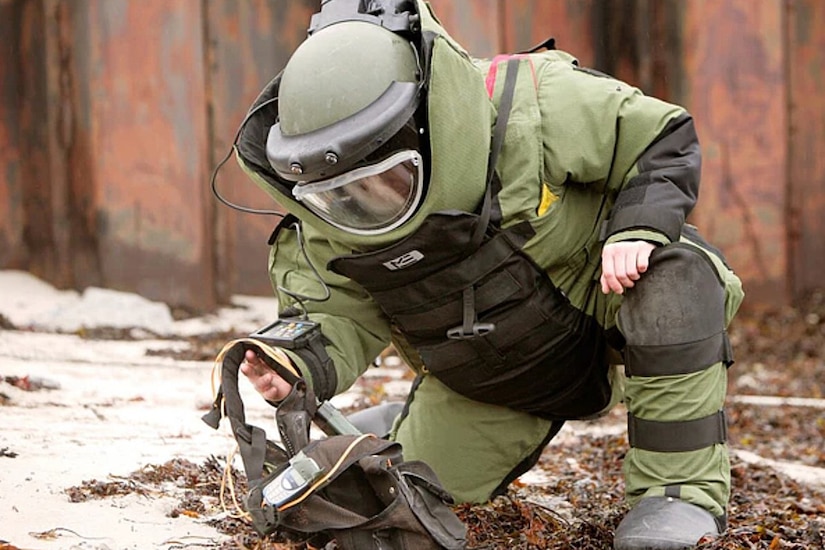
A person in a bomb suit kneels down to pick up a bag lying on the ground.

 
Working directly with students at the Naval School Explosive Ordnance Disposal at Eglin Air Force Base, Florida, the study has enrolled 1,908 participants since October 2022 — 95% of its target goal of 2,000. 
 
The school, which trains approximately 1,350 students annually from all branches of the military, runs a rigorous eight-month training pipeline. The course is divided into eight technical divisions, with an additional underwater component for Navy students. The demanding physical and intellectual challenges of the program mirror the intensity of the EOD career field itself. 
 
The enrollment strategy is tailored to this unique environment. The study team conducts recruitment briefings at multiple places, including Army, Marine, and Air Force indoctrinations, range indoctrination, and the Advanced Improvised Explosive Devices Division course for operational EOD technicians. They also partner annually with the local base EOD shop to engage service members after permanent change of station. 

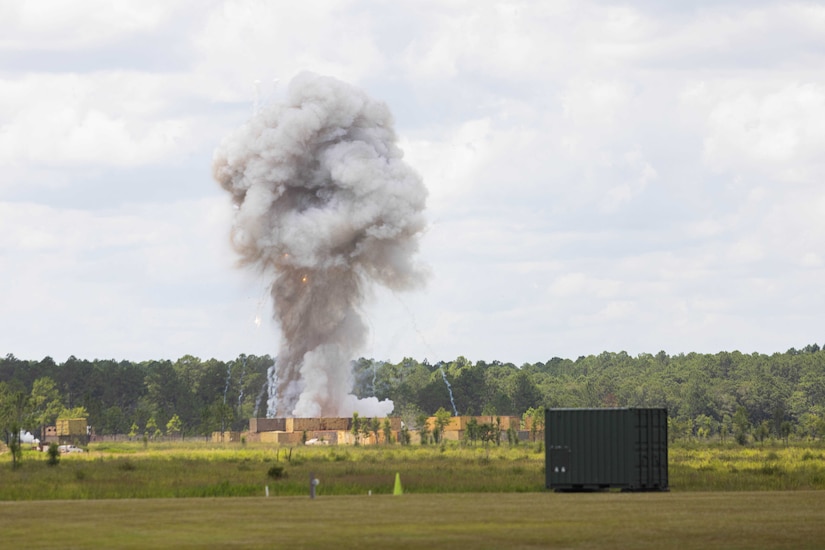
A plume of gray smoke rises from an explosion in the distance. There are trees in the background and shipping containers surrounding the area where the explosion occurred.

 
"Meeting students where they are — literally and figuratively — has been critical," said Sarah Delgado, one of the researchers supporting the study. "The training schedule is relentless, and even small barriers, like running across campus to our office, can make follow-up participation difficult." 
 
Currently, the study maintains a 36% follow-up rate. While distance and the high demands of the curriculum pose challenges, the team is countering them through consistent community engagement. Staff members volunteer at major schoolhouse functions and teach classes tied directly to their research expertise, building credibility and trust within the EOD community. 
 
This study group is the newest addition to the Concussion, Assessment, Research and Education Consortium's service member initiative, otherwise known as the CARE Consortium. Unlike previous groups, the EOD cohort represents enlisted service members with high cumulative exposure to blast and explosions over the course of their careers — making them a particularly important population for understanding brain health risks. 

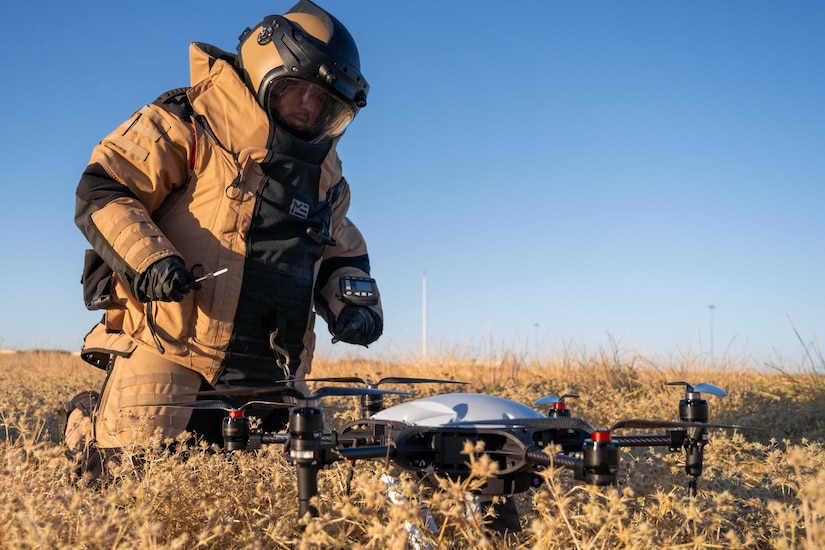
In a field, a person in a bomb suit kneels in front of a drone. The person is holding a tool in their right hand.

 
Leaders and instructors at the school are key partners in reinforcing the importance of the study. 
 
"EOD technicians are expected to perform at the highest levels in some of the most dangerous environments imaginable," said Navy Lt. Colin McNamara, senior medical officer at the school. "Supporting this research is about more than collecting data — it's about protecting the long-term health and readiness of our force." 
 
With recruitment nearing completion, these efforts mark a significant step forward in addressing one of the most pressing health concerns for today's warfighters: the long-term effects of concussions and blast exposure. 

Friday, September 12, 2025

Simulated Chemical Attack Puts Cavalry Regiment to the Test

Sept. 12, 2025 | By Army Maj. Brian Sutherland, 7th Mobile Public Affairs Detachment

As the morning fog lifted during the early hours of Exercise Saber Junction 25, Sept. 8, yellow and white smoke fell on top of the headquarters element of the Army's 1st Cavalry Squadron, 2nd Cavalry Regiment, at the Hohenfels Training Area in Germany.  

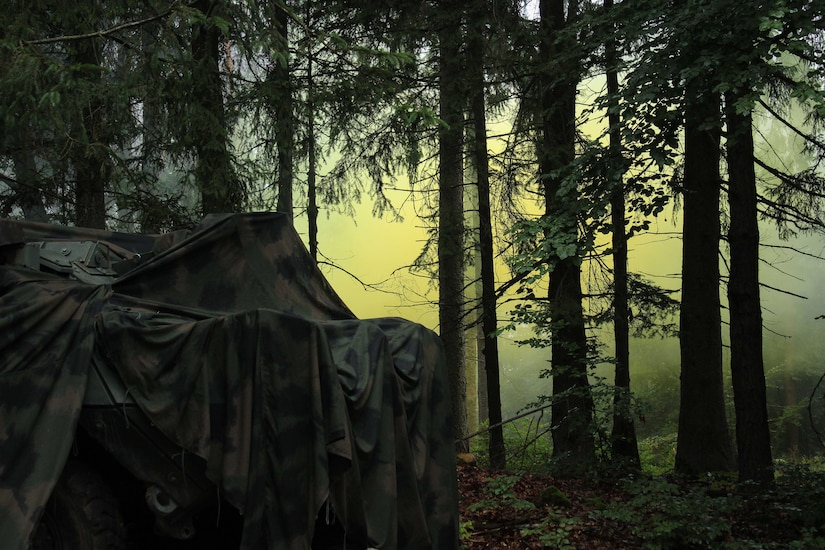
A military tent in a dark wooded area with yellow smoke in the background is shown.

The soldiers were about to experience a simulated chemical attack, which would test the unit's ability to operate in a chemical, biological, radiological, and nuclear environment. 
 
 "Gas! Gas! Gas!" yelled Army Command Sgt. Maj. Paul Hamako, as the simulated artillery rounds impacted around the squadron command post. "Grab your masks and get accountability!" 

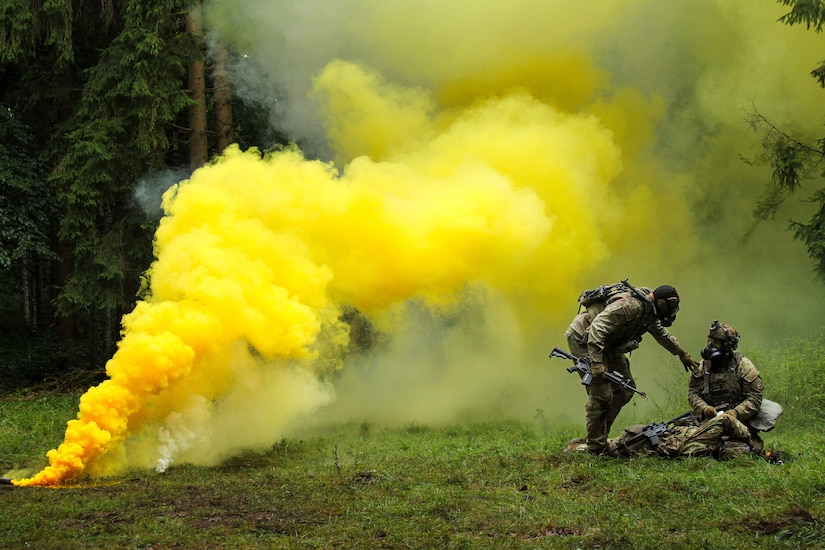
Two soldiers wearing camouflage military uniforms and gas masks provide medical assistance to another soldier in similar attire lying on the ground during an exercise. Yellow smoke billows in the background to simulate a chemical attack.

 
Soldiers ran frantically through the wood line to grab their gas masks while also treating simulated casualties who were injured from the attack. The unit was being targeted by indirect fire and chemical rounds to simulate a coordinated enemy attack on a headquarters position. 
 
Yellow smoke represented chemical rounds, while the white smoke was generated by tear gas grenades, forcing soldiers from the 2nd Cavalry Regiment to don their gas masks. If they failed to get their masks on in time, the soldiers would experience an intense and very uncomfortable burning sensation to their eyes, skin and lungs. 

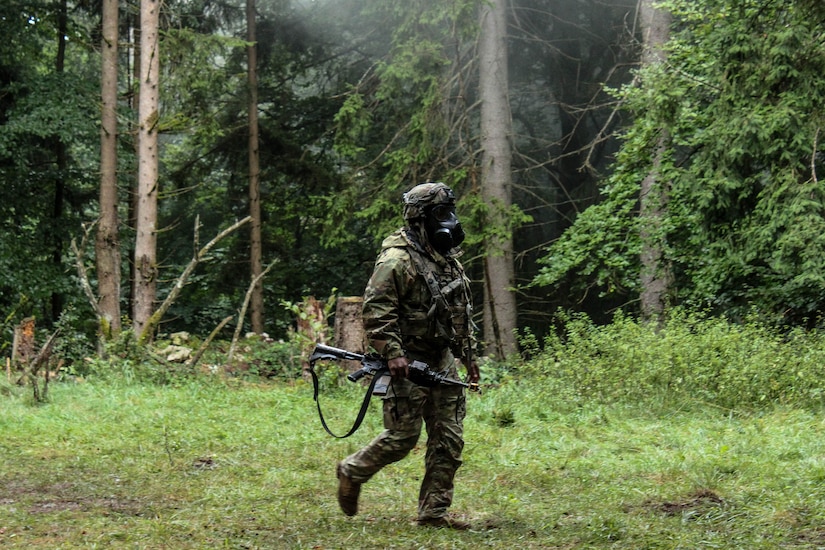
A soldier wearing a camouflage military uniform and gas mask walks in a wooded area. The soldier is carrying a rifle in their right hand.

 
The chemical attack threat in a combat environment can include both military-grade chemical weapons and toxic industrial chemicals, posing risks from nerve agents, blistering agents and choking agents.  

To ensure protection from these types of threats, it requires individuals to use protective masks and clothing as well as to seek protection in vehicles and conduct training to ensure soldiers can operate in a CBRN environment. That is what soldiers from the regiment were tested on during the exercise as they prepare for future fights. 

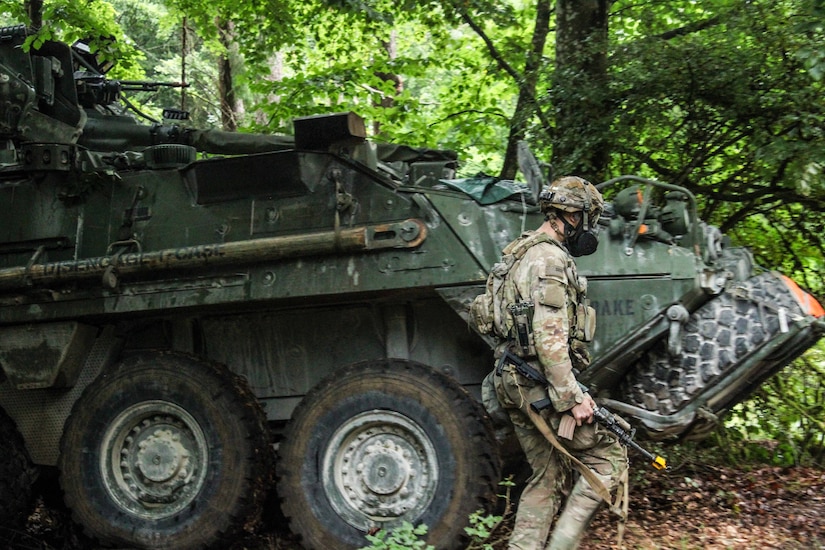
A soldier wearing a camouflage military uniform and gas mask walks in front of a military tank.

At the Joint Multinational Readiness Center in Germany, the 2nd Cavalry Regiment is training to face a chemical threat at the Army's only forward-deployed combat training center. The training provides realistic scenarios for units on large-scale combat operations. 
 
The regiment is at the JMRC from Aug. 14 to Sept. 21, conducting Saber Junction 25, where they are focusing on developing individual and leader skills at the tactical level and building their unit's combat readiness during force-on-force scenarios.

Thursday, September 04, 2025

Army Corps Contractor Receives Defense of Freedom Medal for Actions in Iraq

For two decades, Iraqi-born Mohannad Ali stood shoulder to shoulder with U.S. military forces in Iraq, Syria, Qatar and Saudi Arabia as a contractor linguist, security specialist and, at times, the last line of defense. 

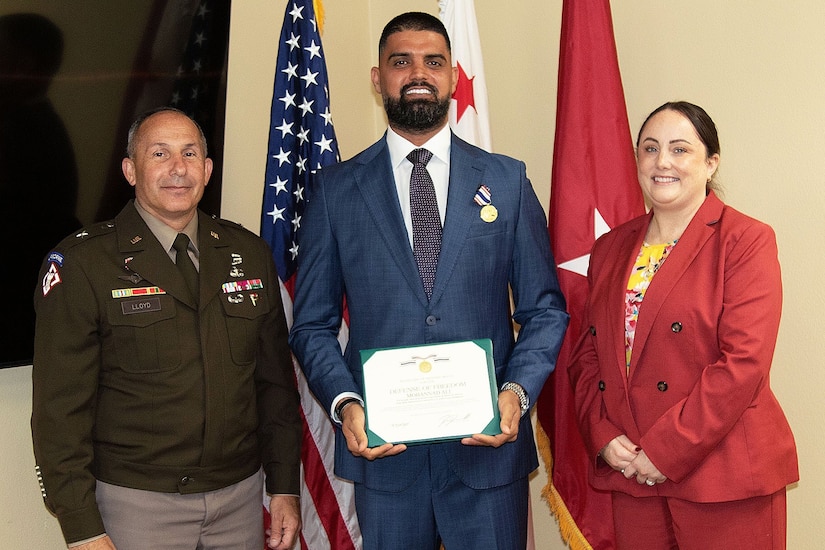
A man, center, wearing civilian attire holds a certificate and smiles. There is a man in a military dress unform standing to the left and a woman in civilian attire standing to the right. There are three flags in the background, the flag to the left us the American flag.

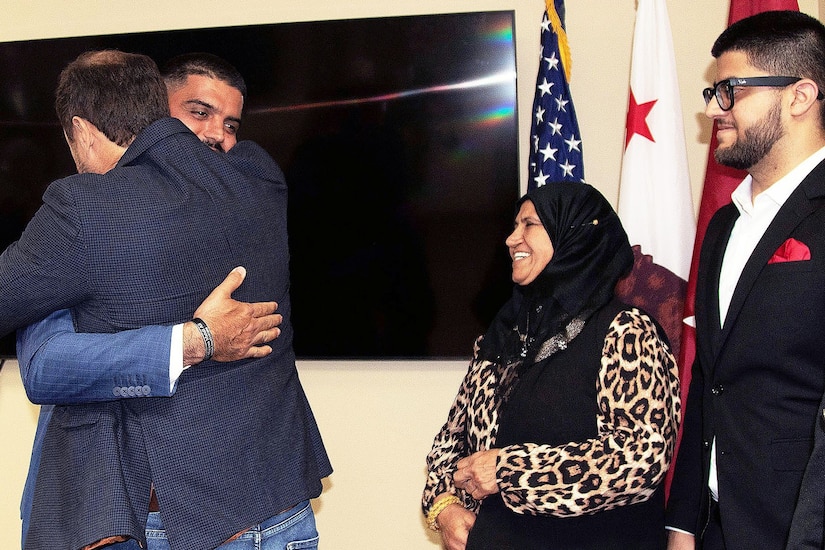
On Aug. 26, he was awarded the Secretary of Defense Medal for the Defense of Freedom during a ceremony in San Diego for injuries sustained in 2010 assignment as a contractor in Iraq for the U.S. Army Corps of Engineers' Gulf Region District.

The medal, the civilian equivalent of the Purple Heart, honors Defense Department civilian employees who are killed or wounded by hostile action while serving in support of DOD. It serves as a reminder of the contributions made by civilians who risked their lives in support of these efforts. 

Two men dressed in civilian attire are hugging while a woman dressed in hijab and a man wearing civilian attire watch. In the background there are flags, including the American flag.

Ali's story began in Baghdad, where he recalled the kindness and professionalism of the U.S. military during the 2003 Iraq invasion, known as Operation Iraqi Freedom, leaving a lasting impression on him. 

"The treatment we received from the U.S. military was phenomenal," Ali said. "I remember meeting a linguist at the time whose job was to assist, and he was so good at it. I remember thinking, I want to be just like him. I want to help people." 

Inspired by this encounter, Ali set his sights on becoming a linguist, securing his first contracting job with the U.S. military at the age of 18. 

From the start, moments in Ali's career were marked by danger. 

He was in a Chinook helicopter en route to Fallujah, Iraq, on his first assignment with five other linguists when rocket-propelled grenades struck the aircraft. While they safely landed, Ali described it as his "wake-up call." 

"You quickly realize how fragile life is in this line of work," he said. 

Ali demonstrated his dedication to the mission and the U.S. military early in his career. When he suspected a fellow linguist of being an insider threat, he took matters into his own hands, exposing the individual and possibly preventing U.S. casualties. 

Then, in 2010, tragedy struck when an explosively formed penetrator tore through the vehicle he was riding in. 

Ali vividly remembers the attack. 

"It was pitch dark. I couldn't hear anything, and then I heard prayers very loud and clear," he said. "I looked down and saw a hole in our vehicle. I knew that was it, we'd been hit." 

With the vehicle now far from the road, his team leader, Robbie, unconscious, and his driver, Haider, severely wounded with shrapnel in his face, Ali's instincts kicked in. 

"I remembered knowing I needed to pull security like I had been trained, administer medical aid to Robbie and Haider like I was trained, but also thinking this is how I was going to die," he said. 

Ali managed to call for help through the chaos, and a helicopter arrived to extract them. Only after administering care to his team and calling for help did he realize he was bleeding from a severe thigh wound. 

In agony from his own injuries, he listened to flight medics unsuccessfully attempt to revive his team leader in the helicopter on the way to the hospital.  

"I will never forget that ride," Ali said. 

After undergoing multiple surgeries, Ali learned that word of the attack had spread quickly back home, and in the confusion, his family was told he had been killed.  

"I remember begging my dad not to tell my mom and reassuring him I was alive," he said.  

The fear was compounded by painful memories from years earlier when one of Ali's brothers was killed after neighbors discovered Ali was working with the Americans. At the time, Ali was traveling to the "14th of July Bridge" in the Green Zone to help recruit locals to work for U.S. defense contractors when someone in the neighborhood recognized him. 

Ali's younger brother, who later became a linguist himself and served alongside coalition forces and the Air Force in Iraq and Qatar, is still alive. 

Ali and Haider shared a hospital room in recovery for two weeks. On the day Ali was scheduled to return to Baghdad, the team sent to pick him up was attacked, wounding some of the personnel involved. 

Despite the constant danger before, during and after the incident, Ali remained committed to the mission. Just six months later, he rejoined U.S. forces and continued his 20-year career with the same focus and dedication. 

"For 20 years, I dedicated my life to the teams I worked with," Ali said. "I was surrounded by heroes, real heroes, and all I wanted was to make sure they got home safe." He considered his fellow soldiers and contractor families, saying, "I would've taken a bullet for any of them, any day, without thinking twice." 

The Gulf Region District, formed as part of USACE operations during Operation Iraqi Freedom, provided full-spectrum construction management to the United States Forces-Iraq command, the U.S. Embassy-Baghdad Mission, and the Government of Iraq until its inactivation at the end of 2011. 

In the intervening years, the GRD's soldiers and civilians, undaunted by the dangers posed by the insurgency, delivered more than 5,100 projects valued at nearly $9 billion. They helped Iraq add 7,000 megawatts of electricity to its grid, supported and expanded oil production capacity to 3 million barrels per day, and managed 1,200 school projects that served hundreds of thousands of children. Five million people benefited directly from the GRD's water and sewer projects, and millions more received treatment in medical facilities that USACE helped build. The division also oversaw the construction of hundreds of infrastructure projects, including roads, railroads, aviation facilities and ports, and it supervised the building of hundreds of vital national security and community safety structures, such as border posts, entry facilities, courthouses and fire stations. 

Now living in San Diego with his family, Ali works as the director of operations, Middle East, for a national space company, but his bond with those with whom he served remains strong. In 2014, Haider visited Ali in San Diego, bringing his own Defense of Freedom Medal. Ali said ever since seeing Haider's medal, he's thought about what this award truly means and represents, which is the sacrifice and valor in service to the nation. 

For Ali, the Defense of Freedom Medal is deeply personal. It reflects events of that day, but also the mission that guided his life, and the heroes he has worked alongside. 

"Thank you so much for this amazing award, it honestly means a lot to me," Ali said. "To my beautiful family, I want to thank you guys for all the support during the last 20 years." 

Coast Guard Cutter Mohawk Returns Home After 75-Day Maritime Border Security Patrol

The crew of the Coast Guard cutter Mohawk returned to their home port in Key West, Florida, Aug. 29, following a 75-day maritime border security patrol in the Windward Passage, Straits of Florida and Caribbean Sea. 

A Coast Guard helicopter hoovers over the ocean beside a large Coast Guard ship.
 
During the patrol, Mohawk's crew deployed to the Coast Guard Southeast District area of responsibility, where they conducted multi-mission operations with joint service, international and interagency partners to protect America's maritime borders from illegal drug trafficking and prevent unlawful alien migration in the region. 

"[The] Mohawk's recent operations demonstrate our unwavering commitment to safeguarding our nation's maritime approaches," said Coast Guard Cmdr. Taylor Kellogg, Mohawk commander. "Our efforts over the last 75 days have served as a deterrent to criminal organizations seeking to exploit our waterways and reinforce our dedication to a safe and secure maritime environment. I'm proud of our crew for their selfless service, teamwork and devotion to duty." 

A Coast Guard helicopter hoovers over the deck of a large white Coast Guard ship.

The crew initially deployed in support of Operation Vigilant Sentry while on patrol in the Windward Passage to deter illegal alien migration along the coast of Haiti.  
 
On Aug. 16, Mohawk's crew assisted the Jamaica DefenseForce by interdicting and transferring a vessel with five Haitians aboard who were attempting to illegally enter Jamaica. 
 
The crew also patrolled the Caribbean Sea in support of the Joint Interagency Task Force South mission of detecting and monitoring illegal drug shipments in the maritime domain for subsequent interdiction and apprehension.   

A large gray foreign military ship, left, sails in the ocean beside a white Coast Guard ship.

A Navy aircrew identified a suspicious vessel in the Caribbean Sea Aug. 21, and a Coast Guard aircrew assisted in tracking the vessel with three suspected drug smugglers aboard.  

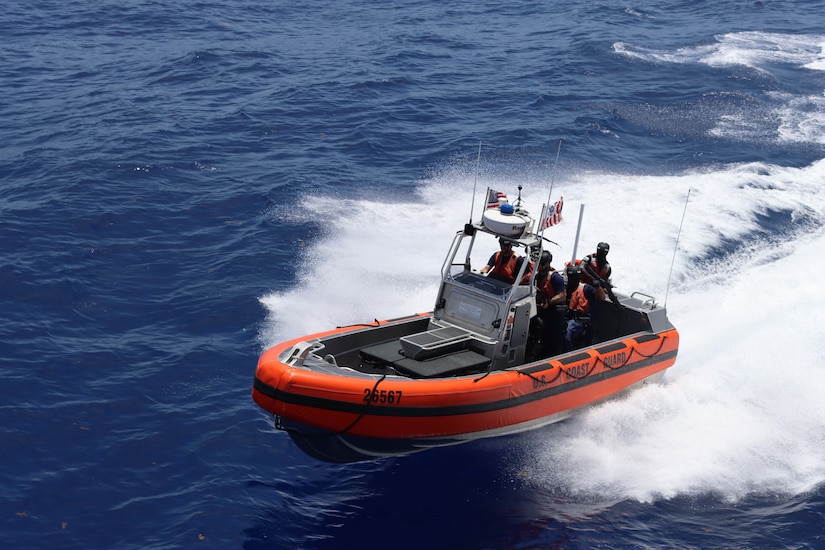
Once the Mohawk was alerted, crew members launched the cutter's primary interceptor boat for a 113-nautical-mile pursuit. The team coordination with Jamaica DefenseForce personnel, who interdicted the vessel in Jamaican waters. 

Three service members wearing blue coveralls and reflect vests ride in an orange boat while another service member in similar attire steers the boat in the ocean.

 
In total, while working with the Jamaica DefenseForce during four maritime law enforcement cases, the Mohawk's crew seized narcotics and interdicted or assisted in the interdiction or transfer of 13 suspected smugglers and two suspect vessels to Jamaican authorities for prosecution. 

In addition, the Mohawk worked alongside Defense Department and Department of Homeland Security partners, contributing to the disposition of 21 drug smugglers, 2,425 pounds of cocaine and 4,300 pounds of marijuana with an estimated street value of nearly $23 million.

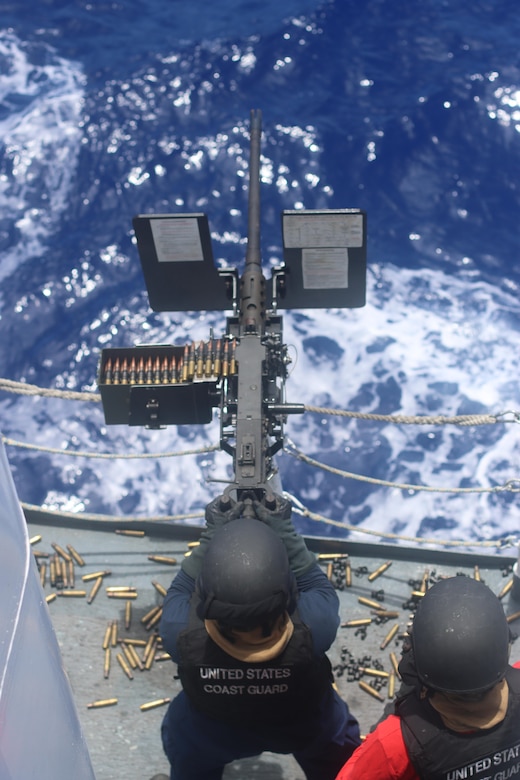
A person wearing blue coveralls, a helmet and gloves fires a machine gun from the deck of a ship. There are shell casings on the deck and another person in similar attire standing behind the person shooting the gun.

Throughout the deployment, the crew engaged in joint patrols and at-sea transfers with a variety of Coast Guard assets, including the Coast Guard cutter Spencer, the Coast Guard cutter Vigorous and the Coast Guard cutter Alert.

Reinforcing interagency cooperation, the Mohawk partnered with the crews of the USS Cole and USS Jason Dunham, who provided maritime patrol aircraft support and facilitated a critical transfer of contraband and detainees. These operations support U.S. national objectives and a commitment to a coordinated, multifaceted approach to deter illicit trafficking and bolster regional security. 
 
Collaborating with U.S. Customs and Border Protection, the Mohawk's crew also provided offshore presence to support Coast Guard Sector Miami alongside additional Coast Guard air and surface assets to help prevent illegal immigration and drug smuggling, while augmenting search and rescue capability off the coast of Florida.