Friday, November 28, 2025

Executive Order 14362 and the Expanding Front of Terrorism Designations

Executive Order 14362, issued on November 24, 2025, represents a significant escalation in the United States’ efforts to counter terrorism networks operating across the Middle East. While the Muslim Brotherhood is not being designated wholesale as a terrorist organization, the order initiates an accelerated process to identify and potentially designate specific chapters in Lebanon, Egypt, and Jordan as Foreign Terrorist Organizations (FTOs) and Specially Designated Global Terrorists (SDGTs). The order cites the involvement of certain Brotherhood-linked groups in violence following the October 7, 2023 attacks on Israel and longstanding ties between Brotherhood leaders and militant wings of Hamas. This shift carries major implications for U.S. counterterrorism strategy, regional diplomacy, immigration enforcement, and transnational financial networks.

The Muslim Brotherhood has functioned for nearly a century as a decentralized movement with both political and militant offshoots. Founded in Egypt in 1928, it inspired chapters across the Middle East, some of which became integral parts of local political systems. Others developed military wings or clandestine operations that have intersected with global jihadist movements. The U.S. government has periodically evaluated the Brotherhood’s activities since the early 2000s, but has historically distinguished between political factions and groups actively engaged in terrorism. Recent intelligence assessments, however, indicate increasing collaboration between certain Brotherhood-linked entities and designated terrorist organizations, especially during periods of regional conflict. Public reporting has documented the participation of Brotherhood-aligned fighters in rocket attacks launched from Lebanon following the October 7 attacks in Israel, as well as leaders in Egypt and Jordan calling for support to Hamas.

Executive Order 14362 sets a strict timeline requiring the Departments of State and Treasury, along with the Attorney General and the Director of National Intelligence, to provide a formal designation report within 30 days. Within 45 days after that report is delivered, the government must take appropriate action consistent with U.S. terrorism laws. This structure signals a near certainty that at least some Brotherhood chapters will be designated. Historically, when similar orders have been issued—such as Executive Order 13224, used after the September 11 attacks—designation processes have moved quickly once interagency reviews conclude.

Designation would have immediate operational consequences. Under 8 U.S.C. 1189 and the International Emergency Economic Powers Act, all assets of designated groups under U.S. jurisdiction would be frozen, and U.S. persons would be prohibited from engaging in financial dealings with them. The material support statute, 18 U.S.C. 2339B, would expose individuals or organizations to criminal liability for providing funds, services, training, or any tangible assistance. Past designations of groups such as Hamas and Hezbollah dramatically constrained their international fundraising and disrupted support networks abroad. A similar effect would be expected here, particularly for Brotherhood chapters accused of facilitating Hamas financing.

Law enforcement and intelligence agencies would also gain expanded tools. An FTO or SDGT designation enables broader surveillance authorities, tighter monitoring of financial institutions, enhanced subpoena powers, and expanded information-sharing with foreign partners. Historically, these tools have allowed the FBI, Treasury Department, and Department of Homeland Security to map transnational networks more effectively, particularly those that operate through charitable fronts or diaspora communities. With many Muslim Brotherhood-affiliated organizations operating across borders, enhanced investigative capacity could reshape counterterrorism enforcement domestically.

The immigration consequences would be equally significant. Members of designated groups would be inadmissible to the United States, and those already residing in the U.S. could face removal proceedings. Prior cases involving Hezbollah, Islamic Jihad, and other designated groups show that DHS frequently reopens immigration files and conducts additional vetting when new designations occur. Asylum claims involving Brotherhood-affiliated applicants would also be reevaluated, and the federal courts have historically upheld the government’s authority to deny immigration benefits on terrorism-related grounds.

Regional implications may be substantial. Egypt has long designated the Muslim Brotherhood as a terrorist organization and is likely to welcome U.S. alignment with its stance. Jordan, however, maintains a sensitive political balance with its Brotherhood-affiliated political party, and U.S. action could complicate domestic dynamics in Amman. Lebanon’s security environment is already volatile, and designating Brotherhood-linked militants there may intersect with broader counter-Hezbollah policy. Additionally, the order reinforces U.S. counterterrorism coordination with Israel, particularly following the heightened security concerns after October 7.

Critics warn that the designations could increase anti-American sentiment, fuel regional instability, or drive Brotherhood factions underground. Academic experts have noted that in some countries, Brotherhood parties function within parliamentary systems, and lumping political activity together with militant activity could complicate diplomatic relationships. Civil liberties organizations in the United States may also raise concerns about overbreadth or potential chilling effects on domestic Muslim communities, although the EO explicitly targets foreign chapters, not U.S.-based organizations.

In a counterterrorism context, however, the order reflects growing bipartisan concern over transnational networks that support Hamas and other militant entities. U.S. strategy in recent years has increasingly emphasized disrupting financial conduits, diaspora-linked networks, and ideological organizations that serve as force multipliers for designated groups. Executive Order 14362 positions the United States to widen the scope of its counterterrorism posture in a region already undergoing dramatic shifts.

Executive Order 14362 marks a decisive moment in U.S. counterterrorism policy. By initiating the designation process for select Muslim Brotherhood chapters, the U.S. is signaling a willingness to expand its terrorism framework to target supporters of Hamas and other militant groups more aggressively. The effects will be far-reaching, touching international finance, domestic law enforcement, regional diplomacy, and immigration. Whether the order will stabilize or further complicate Middle East dynamics remains to be seen, but its impact on U.S. counterterrorism operations will be immediate and significant.


References

Byman, D. (2015). Al Qaeda, the Islamic State, and the global jihadist movement. Oxford University Press.

Gambhir, H. (2014). The Islamic State’s global propaganda strategy. Institute for the Study of War.

International Crisis Group. (2019). How the Muslim Brotherhood operates in the Middle East.

Levitt, M. (2006). Hamas: Politics, charity, and terrorism in the service of jihad. Yale University Press.

U.S. Congress. (1996). Antiterrorism and Effective Death Penalty Act, 18 U.S.C. § 2339B.

U.S. Department of State. (2023). Country Reports on Terrorism.

U.S. Government. (2025). Executive Order 14362, Designation of Certain Muslim Brotherhood Chapters as Foreign Terrorist Organizations and Specially Designated Global Terrorists.

Thursday, November 27, 2025

Dozens of Federal Agencies Initiate Counter-UAS CollaborationDozens of Federal Agencies Initiate Counter-UAS Collaboration

Over 180 experts from the War Department and other agencies in the federal government met yesterday for a summit to begin a planned three-year effort to deliver counter-small unmanned aircraft system capabilities to warfighters and keep the skies over America safe from dangerous drones.

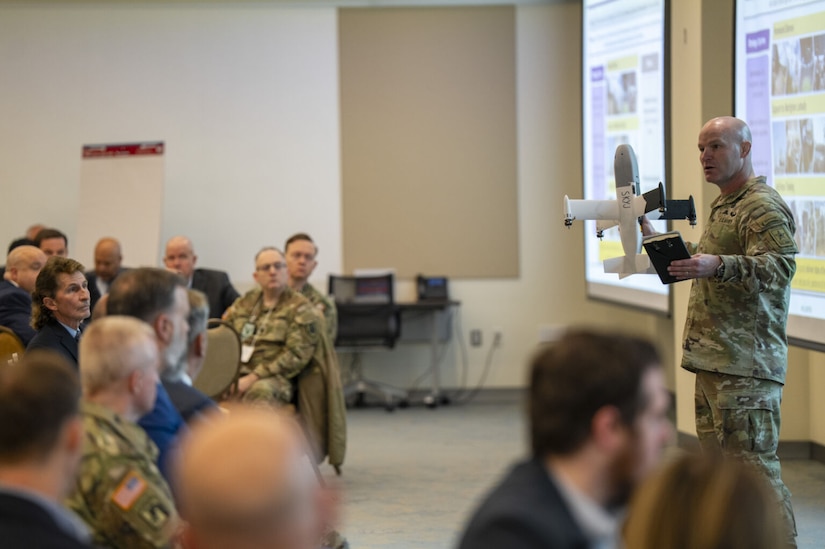
A man in a camouflage military uniform stands in front of a seated audience.

In August, Secretary of War Pete Hegseth launched the Joint Interagency Task Force 401. Just two weeks ago, senior leaders from the department and partner agencies, including Secretary of the Army Dan Driscoll, met at the White House to discuss how to best leverage the new task force and defend the homeland. 

"My priorities for transformation and acquisition reform include improving [counter-small unmanned aircraft systems] mobility and affordability and integrating capabilities into warfighter formations," Hegseth wrote in the August memo, which directed Driscoll to stand up the task force. "[The department] must focus on speed over process by ... establishing JIATF 401 with expanded authorities to execute capability development and delivery timelines that outpace the threat." 

Launching the task force, which Hegseth said will maintain operational capabilities for 36 months, is fully in line with the president's direction to reestablish air sovereignty over the U.S.

"[The department] must enhance its [counter-small UAS] capabilities to protect personnel, equipment and facilities at home and abroad," Hegseth said. 

Representatives from the War Department, Department of Homeland Security, FBI, Transportation Department, Federal Aviation Administration and other agencies — about 50 total — met for the first time at the Mark Center in Alexandria, Virginia, as part of an introductory summit for task force partners.

"This was an opportunity to bring together all of the services, all of our interagency partners that have shared interests and equities with countering small UAS threats, because no one agency can solve this on their own," said Army Brig. Gen. Matt Ross, joint task force commander. "What we're really trying to do is expand the community of interest into a community of action and make sure we're taking tangible steps to defeat the UAS threat we face on a daily basis."

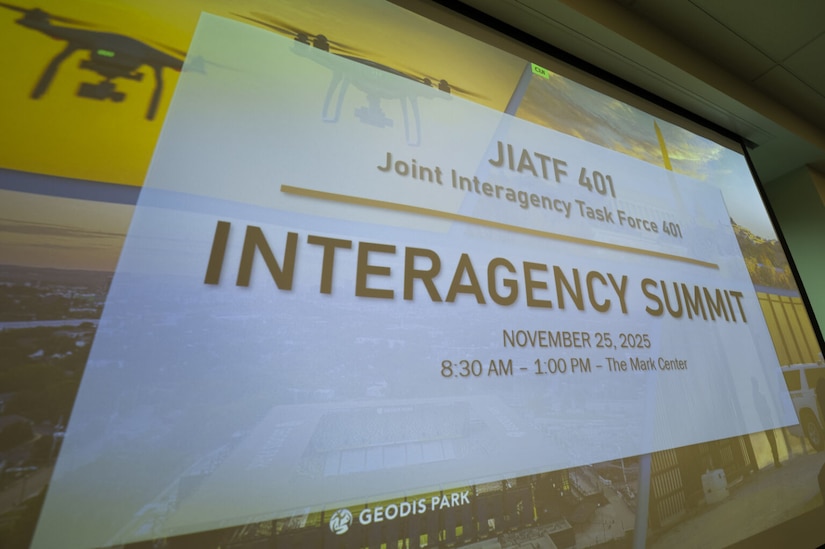
A screen reads JIATF 401 Joint Interagency Task Force 401 Interagency Summit, Nov. 25, 2025.

The threat from small UAS is growing, Ross told task force members. 

"Unmanned systems are a defining threat for our time, and I say that because they're prolific, they're evolving quickly, and they're no longer confined to combat," he said. "The [changing landscape] of drones is putting exquisite surveillance and precision strike capability into the hands of individuals and small groups that used to be reserved for our state adversaries." 

Ross emphasized the task force’s three lines of effort to defeat the counter-small UAS threats: defending the homeland, supporting warfighter lethality and joint force training. 

In the short term, according to Ross, homeland defense will focus on the area around Washington; the southern border; and supporting the FIFA World Cup event in June 2026, which is a national special security event.

U.S. Northern Command and Joint Task Force Southern Border personnel have reported some 3,000 drone incursions over the border in the past year and have seen over 60,000 drones just south of the border looking into the U.S., according to Ross. 

Ross affirmed his belief that addressing threats from drones at the border isn't about a hardware solution; it involves communications and data sharing.

A close-up view of a patch on the arm of a service member reads "U.S. Customs and Border Protection."

"We need a common air picture that includes drones," he said. "In some cases, we need cross-domain solutions that will allow us to see data that's picked up on a secret radar and an unclassed sensor. We need to proliferate active and passive sensors that provide air situational awareness along the southern border." 

That kind of integration is what JIATF 401 is all about, and it's what the task force is expected to bring to bear on the small UAS issue, according to Ross. 

In the National Capital Region, the task force will monitor how sensors from various agencies are able to track threats as they move through the sky, how that information can be passed to decision-makers and how those with the ability to take those threats out of the sky can be given the authority to do so.

"We're not there yet, but we're making progress," Ross said. 

Because the 2026 World Cup is a national special security event, it is a priority. One focus JIATF 401 has during the World Cup is to ensure security personnel have access through the Defense Logistics Agency to purchase counter-UAS capabilities that have been rigorously tested by the War Department. 

Keeping the drone threat at bay and protecting the U.S. homeland — including people and infrastructure — will take a whole-of-government approach, Ross emphasized.

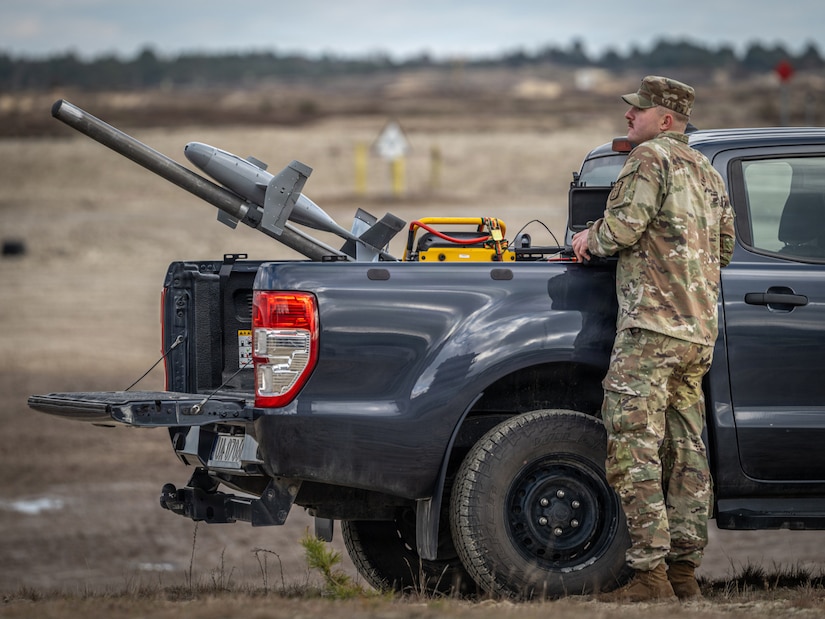
A soldier in a camouflage military uniform stands outdoors near a truck. A device that looks like a missile attached to a pole is mounted in the back of the truck.

"It's important that this is a joint and interagency effort because nobody can solve this problem alone," Ross said. "[JIATF 401] is a whole-of-government effort to be able to protect our critical infrastructure against the threat of unmanned systems. We've got to partner closely with our local law enforcement and other federal, state, local, tribal and territorial law enforcement to be able to counter this threat, see it before it starts to manifest and then to defeat it before an attack is successful." 

Daniel Tamburello, the undersecretary of science and technology for the Department of Homeland Security, acknowledged that working together across the federal government will be crucial to mission success. 

Both Northcom and DHS are responsible for protecting the homeland, including from drones. 

"There's a lot of overlap in those missions," Tamburello said. "Jointness and interagency cooperation is actually extremely essential with this." 

The threat from drones will only continue to grow. 

"The unmanned aerial system threat is one that has become prolific and widespread, and it's only going to get bigger and more complicated as more people adopt these systems and learn how to use them," Tamburello said. "They've become [accessible], they've become crowd sourced, ubiquitous and available pretty much anywhere. Any bad actor who wants to do something has a chance to do it, and we have to stop them." 

The goals for the task force, Tamburello said, include coordinating with every U.S. agency that deals with the threat posed by counter-UAS to enable interoperability and open communication.

"That is really going to be the best value for the taxpayer to make sure that we're acquiring not only the best systems, but we're not wasting money in the process," he said. 

Micheal Torphy, unit chief of the FBI's UAS and counter-UAS programs within their Critical Incident Response Group, attended the summit. He said the task force's interagency focus will empower the FBI.   

"We're exceptionally excited about this initiative, and we do believe it will enhance our ability to work with our partners to disrupt threats," he said. 

One of the things the FBI is bringing to the table is the National Counter-UAS Training Center, which recently opened in Huntsville, Alabama.  

"Its purpose is to train state, local, tribal and territorial law enforcement officers on counter-UAS, getting them ready for the World Cup, America 250 [celebration] and ultimately the Olympics and other events," he said. 

Torphy also said he thinks the interoperability inside the task force is going to make it easier for the FBI to work hand in hand with other partners to contribute to the mission of keeping the skies over America safe.  

"The way this has been rolled out has been extraordinary," he said. "Gen. Ross and his team have been fantastic in getting us involved very, very early. We're really excited about the future."

Tuesday, November 25, 2025

The Lone-Wolf Trap: How Algorithmic Radicalization Is Creating Terrorists in Plain Sight

Terror in the Open

The popular imagination still frames terrorism in images of shadowy training camps, desert compounds, or whispered conspiracies in unmarked safehouses. Yet the most dangerous terrorist of the modern age may never step inside a foreign training camp or commit to a formal extremist group. Increasingly, he—and sometimes she—follows a quieter, more insidious path: a path paved by social media, recommendation algorithms, and the psychological vulnerabilities of an overstressed society.

We used to talk about “lone wolves” as if they emerged spontaneously, fully formed. But nothing about their radicalization is spontaneous. In the age of algorithmic personalization, radicalization is not merely an accident—it can be an outcome. A predictable result of constant exposure to curated outrage, grievance amplification, and extremist validation.

In this sense, terrorism has evolved. It has become friction
less, personalized, and scalable. And it is happening right in front of us—in the search bar, in the next video auto-play, in the chat group that seems “just edgy enough,” and in the infinite scroll of the angry and aggrieved.

This is the lone-wolf trap: a mechanism of radicalization hiding in plain sight, driven not by secret meetings but by an attention economy that thrives on emotional extremity.


The Shift: From Cells to Solitude

Traditional terrorism relied on group structures: hierarchies, recruiters, indoctrination spaces, shared ideology, shared training, and shared risk. That model has not disappeared—foreign terrorist organizations still operate in this manner—but for U.S. homeland security officials, the threat profile has flipped.

According to the FBI’s 2023 Threat Assessment, the greatest danger comes not from organized groups but from domestic violent extremists operating independently, often radicalized entirely online. DHS echoes the same conclusion: individuals inspired by extremist narratives online are now the primary terrorism concern in the United States.

These individuals share patterns:

  • Self-radicalization via online content

  • Fragmented belief systems drawn from multiple extremist sources

  • No direct contact with formal terrorist organizations

  • A desire for notoriety, grievance expression, or catastrophic impact

  • Often no detectable planning chatter for law enforcement to intercept

In short: solitude has become the new training ground.

But solitude alone does not radicalize. Something has to pull the individual deeper. Something has to feed them. Something has to make extremism feel like truth, inevitability, or destiny.

That “something” today is algorithmic amplification.


The Algorithmic Accelerant

Social media platforms are built to maximize engagement, not accuracy, safety, or civic health. The longer a user stays on the platform, the more ads they can be shown. Over the past decade, the platforms discovered something troubling: the content that keeps users hooked is not balanced, rational, or nuanced.

It is content that triggers emotion—especially outrage, fear, and grievance.

A landmark report by the National Counterterrorism Innovation, Technology, and Education Center found that extremist content thrives in algorithmic environments because it sparks high-arousal emotions, making it more likely to be recommended, shared, and reshared.

A vulnerable individual does not stumble into extremism. The platform nudges them step by step:

  1. Anger video → recommended

  2. Conspiracy theory → recommended

  3. Anti-government rhetoric → recommended

  4. Extremist ideology → recommended

  5. Violent extremist justification → recommended

  6. Arms acquisition tutorials → recommended

This pattern is so common it now has a name in national security circles: the Radicalization Pipeline.

And because the individual believes they are in control—that they “found” this information themselves—the radicalization feels authentic, self-realized, even empowering.

This is the lone-wolf trap: an illusion of autonomy hiding a highly structured process.


Psychological Vulnerability: The Open Door

The algorithm may be the accelerant, but every fire needs oxygen. Modern American life provides it in abundance.

According to a meta-analysis by the American Psychological Association, individuals experiencing loneliness, economic instability, or identity disruption are significantly more susceptible to extremist narratives. Extremist content does not recruit by ideology—it recruits by unmet emotional need:

  • The need for significance

  • The need for belonging

  • The need for direction

  • The need to resolve grievances

  • The need to be seen, to matter, to strike back

Terrorism thrives where meaning breaks down.

This is why counterterrorism professionals increasingly view radicalization not as an ideological shift but as a psychological displacement: a retreat into an identity that provides clarity, certainty, and perceived empowerment.

When a person begins searching for meaning amid personal turmoil, the platforms respond—not with healthier content, but with whatever keeps them clicking. For many, that becomes extremism.

It is no coincidence that the rise of algorithmic radicalization parallels rising rates of depression, anxiety, and social isolation.

In a society drifting toward fragmentation, extremist narratives offer counterfeit purpose.


Case Studies: Terror Born in the Feed

Law enforcement investigations reveal a common thread: nearly every major “lone-wolf” terrorist attack in the United States over the past ten years involved online self-radicalization.

  1. The Buffalo Supermarket Shooter (2022)
    The attacker spent hours each day on extremist forums and video platforms, absorbing grievance narratives and white supremacist ideology. His manifesto explicitly referenced the online content that guided his worldview.

  2. The El Paso Walmart Shooter (2019)
    Self-radicalized online through anti-immigrant propaganda, never having formal contact with extremist groups.

  3. The Pittsburgh Synagogue Shooter (2018)
    Used online forums as both ideological source and community.

  4. ISIS-Inspired Lone Actor Attacks
    Several attackers in the U.S. and Europe never interacted with ISIS physically—they were radicalized entirely through online media.

  5. QAnon-Driven Violence
    Cases involving kidnapping plots and murder emerged from online conspiracy radicalization, not organizational recruitment.

Each attacker believed they were acting independently. Yet each followed a nearly identical digital path.

This is not coincidence. It is design.


The Leadership Crisis Behind Radicalization

Radicalization is not simply a security threat—it is a failure of leadership at every level of American civic life.

In The Temple Within, I argued that societies unravel when their internal moral infrastructure collapses. The same applies here. When institutions—political, educational, familial, spiritual—withdraw from the role of meaning-making, the void does not remain empty.

It gets filled.

Algorithms fill it with fury. Extremists fill it with ideology. Grievance merchants fill it with identity. Terrorists fill it with purpose.

Leadership is supposed to provide:

  • Stability

  • Truth

  • Courage

  • Impartiality

  • Guardrails

When these fail, the individual becomes vulnerable to darker narratives.

Radicalization is not born from strength. It is born from weakness—societal, institutional, personal.


Why This Threat Is So Hard to Stop

Three factors make algorithm-driven terrorism uniquely difficult to counter:

  1. No Organizational Footprint
    There is no cell to infiltrate. No hierarchy to map. No phone calls to intercept. The radicalized individual operates alone—but is never truly alone.

  2. Rapid Escalitation
    Traditional radicalization might take months or years. Algorithmic radicalization can accelerate in days.

  3. Fragmented Ideology
    Modern extremists often blend contradictory beliefs. This makes profiling and early detection significantly harder.

In the words of DHS analysts, the attacker may be the only member of his movement.


The Path Forward: Rebuilding the Moral Perimeter

Stopping algorithmic radicalization is not simply a question of platform regulation or algorithm transparency—though both are necessary. It requires something deeper: a cultural restoration of resilience, meaning, and civic responsibility.

  1. Strengthen Digital Literacy
    Teaching people how they are being manipulated is the first defense against manipulation.

  2. Community Intervention Models
    Local law enforcement, mental health professionals, and community leaders must collaborate before downstream threats become violent crises.

  3. Platform Accountability
    Algorithms should reduce exposure to extremist content, not amplify it.

  4. Leadership That Heals, Not Inflames
    Extremism thrives in environments of political spectacle, national division, and intentional outrage. Leaders must choose responsibility over ratings.

  5. Reinforce Meaning and Belonging
    Radicalization often fills a vacuum that families, schools, communities, and institutions failed to fill. Restoring connection is counterterrorism.

  6. Moral Responsibility at Scale
    Every great civilization has maintained some form of interior moral discipline—a shared sense of truth, responsibility, and duty. America needs a renewed commitment to guiding citizens toward ethical strength before they fall into ideological darkness.


Conclusion: The Enemy Within the Feed

The lone-wolf terrorist of the digital age is not a ghost or an enigma. He is a product—shaped by algorithms, fueled by grievance, validated by online communities, and unmoored from traditional structures of meaning.

He is born in plain sight.
He radicalizes in public.
He is encouraged by a system designed for engagement over truth.

If we continue to treat terrorism as a purely external threat, we will remain blind to the mechanisms that are manufacturing violent extremists inside our own society.

The truth is simple and unsettling: We are not dealing with lone wolves. We are dealing with assembly lines.

Counterterrorism in the 21st century is no longer just about stopping attacks. It is about repairing the societal fractures that create attackers.

Leadership, vigilance, and moral clarity are no longer luxuries—they are national security imperatives.

In the end, the terrorists we fail to stop are not hidden in distant deserts. They are scrolling beside us. They are learning in the same feeds we use. They are being shaped by the same digital forces shaping all of us.

And unless we confront that truth with courage, discipline, and a renewed sense of responsibility, the lone-wolf trap will continue to claim more souls—one algorithmic nudge at a time.


References (APA Style)

Borum, R. (2012). Radicalization into violent extremism II: A review of conceptual models and empirical research. Journal of Strategic Security, 4(4), 37–62.

Federal Bureau of Investigation. (2023). Domestic Terrorism Threat Assessment. U.S. Department of Justice.

Mitts, T. (2021). Algorithmic amplification of extremist content. National Counterterrorism Innovation, Technology, and Education Center.

New York State Attorney General’s Office. (2022). Investigation of the Buffalo supermarket attack.

U.S. Department of Homeland Security. (2024). Homeland Threat Assessment.


Saturday, November 22, 2025

Five Months Later: Why the Iran Strikes Still Threaten U.S. Security

The DHS warning was never about the days that followed, but the dangerous months after, when retaliation matures, vigilance fades, and delayed threats take shape.

On June 22, 2025, the U.S. Department of Homeland Security issued a National Terrorism Advisory System bulletin warning that the United States had entered a heightened threat environment following a series of dramatic military events involving Iran. The alert was triggered not by a singular incident, but by a rapid escalation in conflict: Israel’s June 13 air campaign against Iranian military and nuclear targets, followed by the United States conducting its own airstrikes on three Iranian nuclear facilities on the evening of June 21. Although these events now lie five months behind us, the threat landscape that prompted the bulletin has not expired. On the contrary, the long-term nature of retaliatory planning, global radicalization dynamics, and Iran’s established pattern of external operations suggest that the risk today may be more mature, not less.

Israel’s June 13 air operation marked one of the most significant direct attacks on Iranian military and nuclear infrastructure in years. Additional reporting indicates that the strikes killed hundreds of Iranian personnel and severely disrupted key military facilities. Israel has claimed that its campaign severely degraded Iran’s operational capability. Iranian officials called the assault an act of war, and issued multiple vows of retaliation across different fronts. United States forces entered the picture eight days later, when Washington launched an airstrike against three Iranian nuclear sites on June 21. President Trump stated that the strikes were intended to halt Iran’s nuclear escalation and warned Tehran that further retaliation would be met with additional military action.

The following day, DHS issued its nationwide terrorism alert. The bulletin cited the escalating Israel–Iran conflict, Iran’s demonstrated history of conducting external covert operations, and the risk of retaliatory activity targeting the U.S. homeland. DHS emphasized that both foreign terrorist actors and domestically radicalized individuals might be motivated or enabled by the conflict to attempt attacks. The advisory noted that there had been no specific, credible plot identified at that time, but nevertheless warned that the situation required elevated vigilance due to the shifting threat environment.

Critical to understanding the bulletin is recognizing that it was not released as a response to specific intelligence pointing to immediate attacks in late June. Rather, it was issued as a recognition that the conditions were forming for increased risk over an extended period. Terrorism studies consistently show that the most significant threats often emerge months after high-profile geopolitical shocks, especially when state or non-state adversaries seek to retaliate strategically. The bulletin reflected this timeline. DHS warned that Iran and its proxy elements have a history of conducting surveillance, cyber intrusions, assassination attempts, and targeted external operations abroad, and that multiple such plots had been disrupted on U.S. soil since 2020. DHS and intelligence-community reporting further indicated the likelihood of increased cyber activity targeting U.S. infrastructure by actors affiliated with Iran.

Recent academic assessments add important depth to this context. A comprehensive study published by the Combating Terrorism Center at West Point in 2024 documented Iranian-linked external plots in numerous countries, including the United States, over the last decade. Intelligence summaries, as well as previous Department of Homeland Security threat assessments, have similarly identified Iran as a capable external actor when motivated by perceived existential threats or high-profile provocations. Historically, Iran’s retaliatory strategy favors indirect and asymmetric approaches, including cyber operations, targeted attacks against dissidents, proxy-actor involvement, and episodic terrorist plots abroad.

Cybersecurity professionals also warn that the cyber dimension of this threat has expanded significantly in the last two years. High-profile cyber incidents in 2024 and 2025 linked to state-level actors have demonstrated how disruptive cyber retaliation can be. Multiple independent analysts have noted that escalating military conflict in the Middle East has increased the likelihood of cyberattacks targeting U.S. and allied commercial infrastructure. This aligns with DHS’s bulletin guidance directing heightened monitoring by critical-infrastructure operators.

Although the NTAS bulletin issued in June was largely overshadowed by the news cycle at the time, several state emergency management offices republished and amplified the advisory, noting that the heightened threat environment was expected to continue through late September 2025 and could be extended beyond that period based on evolving conditions. It is significant that the bulletin was not rescinded at the conclusion of the initial timeframe. Instead, federal officials signaled that the risk period had not closed.

Because five months have passed since the strikes, many people understandably assume that the danger has diminished. In reality, counterterrorism professionals emphasize that retaliation unfolds slowly. State-linked actors, and networks influenced by state-linked actors, typically operate on months-long planning timelines. Cyber planning, operational reconnaissance, facilitation, financing, logistical preparation, and target identification take time. Physical operational planning is slow, largely compartmentalized, and dependent on opportunity, not immediacy. There is also a relevant psychological factor: public vigilance tends to decrease several months after a major geopolitical event, which paradoxically can increase risk.

In addition, intelligence services historically observe seasonal and symbolic timing patterns. High-profile attacks or attempts are more likely to occur near national holidays, anniversaries, elections, or symbolic dates. For this reason, geopolitical shocks in early summer often produce operational consequences in late fall or early winter. The United States currently sits inside that window.

Second, online radicalization does not unfold instantly. It builds over time. As the conflict has continued, analysts have documented increases in extremist messaging online inspired by regional events. In the past, lone actors motivated by geopolitical grievances have conducted attacks in the United States months after triggering events faded from mainstream public consciousness. DHS noted this danger explicitly in its bulletin.

Third, Iran’s strategic position has not changed. It continues to frame the June strikes as severe aggression. Internal messaging from Iran’s leadership continues to emphasize retaliation as a matter of national honor and religious responsibility. Tehran has historically demonstrated willingness to pursue external action for far less significant provocations than direct strikes on nuclear sites.

Fourth, the cyber threat remains acute. Cyber threat intelligence firms have indicated that probing behavior linked to Iranian-aligned actors has continued in waves since June. Cyber probing campaigns targeting infrastructure and commercial networks do not usually produce immediate visible effect. It is the lateral movement that follows initial reconnaissance that produces material consequences.

Finally, threats remain relevant as long as the underlying geopolitical conflict remains unresolved. Israel’s campaign against Iran has continued episodically. Iran’s regional proxies have fluctuated in activity, but none have disarmed. The conflict remains active, and tensions remain elevated.

The enduring relevance of the June advisory lies not in the events themselves, but in what those events set into motion. Time did not close the window. Time matured it.

Understanding this distinction is crucial for the general public. The National Terrorism Advisory System is not a tool designed to create panic after a single event. It is a system designed to warn about shifts in the long arc of risk. That arc did not end when the headlines faded. It entered a new phase.

While direct action by the general public is limited, there are practical implications. Awareness remains the first line of defense. Individuals should remain attentive to unusual behavior around critical or symbolic locations. Businesses, particularly those with potential vulnerabilities, should ensure cybersecurity protocols remain active and current. Institutions with symbolic or cultural significance should continue to maintain prudent security protocols and coordination with local law enforcement. Federal and state authorities have encouraged the public to report suspicious activity, especially in the context of geopolitical escalation.

Five months on, the threat today is defined not by urgency, but by complexity. The most significant consequences of June’s events may not have manifested yet. Retaliation is most often slow, asymmetric, and opportunistic. The success of the nation’s counterterrorism posture depends as much on long-term vigilance as on immediate reaction. The real measure of public security is not whether instantaneous threats arise, but how resilient society remains while adversaries wait for the opportunity they prefer, not the moment we expect.

The June 2025 DHS bulletin warned Americans about an environment shaped by evolving, not static, danger. That warning remains relevant precisely because time has passed, not in spite of it. As public attention shifts to new stories, the underlying strategic realities remain. It is within this quiet space—between memory and consequence—that vigilance matters most.

========================
REFERENCES

CBS News. (2025, June 23). Homeland Security warns of heightened threat environment after U.S. strikes three Iranian nuclear facilities. CBS News.

Combating Terrorism Center at West Point. (2024). Tehran’s homeland option: External operations and strategic retaliation risk. CTC, U.S. Military Academy.

Department of Homeland Security. (2024). Homeland Threat Assessment 2025. U.S. Department of Homeland Security.

Department of Homeland Security. (2025, June 22). National Terrorism Advisory System Bulletin. U.S. Department of Homeland Security.

Oregon Office of Emergency Management. (2025, June 24). State advisory summary: Heightened threat environment. Oregon OEM.

Trustwave SpiderLabs. (2025, June). Cyber threat trends: Escalation patterns in Middle East conflict. Trustwave Holdings.

United States Cybersecurity and Infrastructure Security Agency. (2025). Cyber activity linked to Iranian-affiliated threat actors: Infrastructure alert summary. CISA.

Washington Post. (2025, June 17). Israel strikes Iran in largest aerial campaign in over a decade, officials say.