Wednesday, October 28, 2015

Inherent Resolve Spokesman Updates Iraq, Syria Operations


By Lisa Ferdinando DoD News, Defense Media Activity

WASHINGTON, October 28, 2015 — The coalition fighting Islamic State of Iraq and the Levant terrorists in Syria and Iraq has conducted 7,712 airstrikes since operations began, the majority in Iraq, an Operation Inherent Resolve spokesman said today.

Army Col. Steve Warren, speaking via teleconference from Baghdad, told reporters at the Pentagon that 5,032 of those airstrikes were in Iraq, while 2,680 were in Syria.

In other developments, Warren recounted how 70 hostages were freed from an ISIL prison in Hawija, Iraq, during an Oct. 22 raid.

Army Master Sgt. Joshua Wheeler was killed by enemy small-arms fire during the operation. "We're all thinking about the family of Master Sgt. Joshua Wheeler. He is a hero," Warren said.

'Tough Fight' in Ramadi

Iraqi security forces are conducting "consolidation and reorganization operations" to retake Ramadi, Warren said. Iraqi forces face improvised explosive device attacks, but have "held the line," he added.

Coalition forces have conducted 26 airstrikes in Ramadi since last week, breaking several enemy counterattacks and providing maneuver space as the Iraqi forces continues to clear obstacles and IED clusters, he said.

Warren described the battle to retake Ramadi as a "tough fight," adding that he is confident Ramadi will be liberated. "But I'm not going to predict a timeline," he said.

Meanwhile, Warren said, in Beiji, the elite Iraqi Counter Terrorism Service, federal police and the Popular Mobilization Forces are working to clear the city and the Beiji oil refinery.

New Counter-IED Tools for Iraqis

The United States has adjusted its training and equipping program, in light of the extensive IED clearance and obstacle reductions the Iraqi forces face, Warren said.

"We're teaching the Iraqis how to get through the types of obstacles that ISIL has emplaced around Ramadi, and we're giving them new tools to help," he said, adding that one example is the Anti-Personnel Obstacle Breaching System.

The APOBS, as it is known, "is kind of an explosive rope attached to a little rocket that can be shot across a minefield and will explode and clear any of the mines or detonate the mines to create a lane that attacking forces can then rush through," he said.

Thirty-five APOBS have been distributed for training and have been issued to the Iraqi security forces, Warren said.

Syria Airstrikes Expected to Increase

Warren said while there has been a drop in airstrikes against ISIL targets in Syria, he expects an increase soon as more sites are identified. The decrease has nothing to do with Russian involvement in air operations in Syria, he explained, but rather is related to the "ebb and flow of battle, the pace of battle and where our priority of efforts are."

As the United States and coalition partners gain intelligence, new targets are acquired, Warren said. "We have a willing, capable and consistent ground partner here in Iraq," he added.

Warren provided a graph showing 369 coalition airstrikes against targets in Syria in July, followed by 212 airstrikes in August and 120 in September.

"The intelligence in Syria continues to pile up, and we continue to sift through it and develop targets and nominate targets," he said. "We are continuing to make ties with forces on the ground in Syria -- that will spur target development as well."

Coalition Airstrikes Hit ISIL Terrorists in Iraq


From a Combined Joint Task Force Operation Inherent Resolve News Release

SOUTHWEST ASIA, October 28, 2015 — U.S. and coalition military forces have continued to attack Islamic State of Iraq and the Levant terrorists in Iraq, Combined Joint Task Force Operation Inherent Resolve officials reported today.

Officials reported details of the latest strikes, noting that assessments of results are based on initial reports.

Airstrikes in Iraq

Attack, bomber and fighter aircraft conducted 14 airstrikes in Iraq, coordinated with and in support of the Iraqi government:

-- Near Mosul, two strikes struck two separate ISIL tactical units and destroyed two ISIL fighting positions and an ISIL heavy machine gun.

-- Near Ramadi, two strikes struck a large ISIL tactical unit and destroyed four ISIL fighting positions and two ISIL light machine guns.

-- Near Samarra, one strike destroyed four ISIL fighting positions.

-- Near Sinjar, four strikes struck two separate ISIL tactical units, destroyed 11 ISIL fighting positions and suppressed an ISIL mortar position.

-- Near Sultan Abdallah, one strike struck an ISIL tactical unit and destroyed an ISIL fighting position.

-- Near Tal Afar, four strikes destroyed eight ISIL fighting positions, an ISIL weapons storage area, an ISIL logistical facility and an ISIL staging area.

Part of Operation Inherent Resolve

The strikes were conducted as part of Operation Inherent Resolve, the operation to eliminate the ISIL terrorist group and the threat they pose to Iraq, Syria, and the wider international community. The destruction of ISIL targets in Syria and Iraq further limits the terrorist group's ability to project terror and conduct operations, officials said.
Coalition nations conducting airstrikes in Iraq include the United States, Australia, Belgium, Canada, Denmark, France, Jordan, the Netherlands and the United Kingdom. Coalition nations conducting airstrikes in Syria include the United States, Australia, Bahrain, Canada, France, Jordan, Saudi Arabia, Turkey and the United Arab Emirates.

Tuesday, October 27, 2015

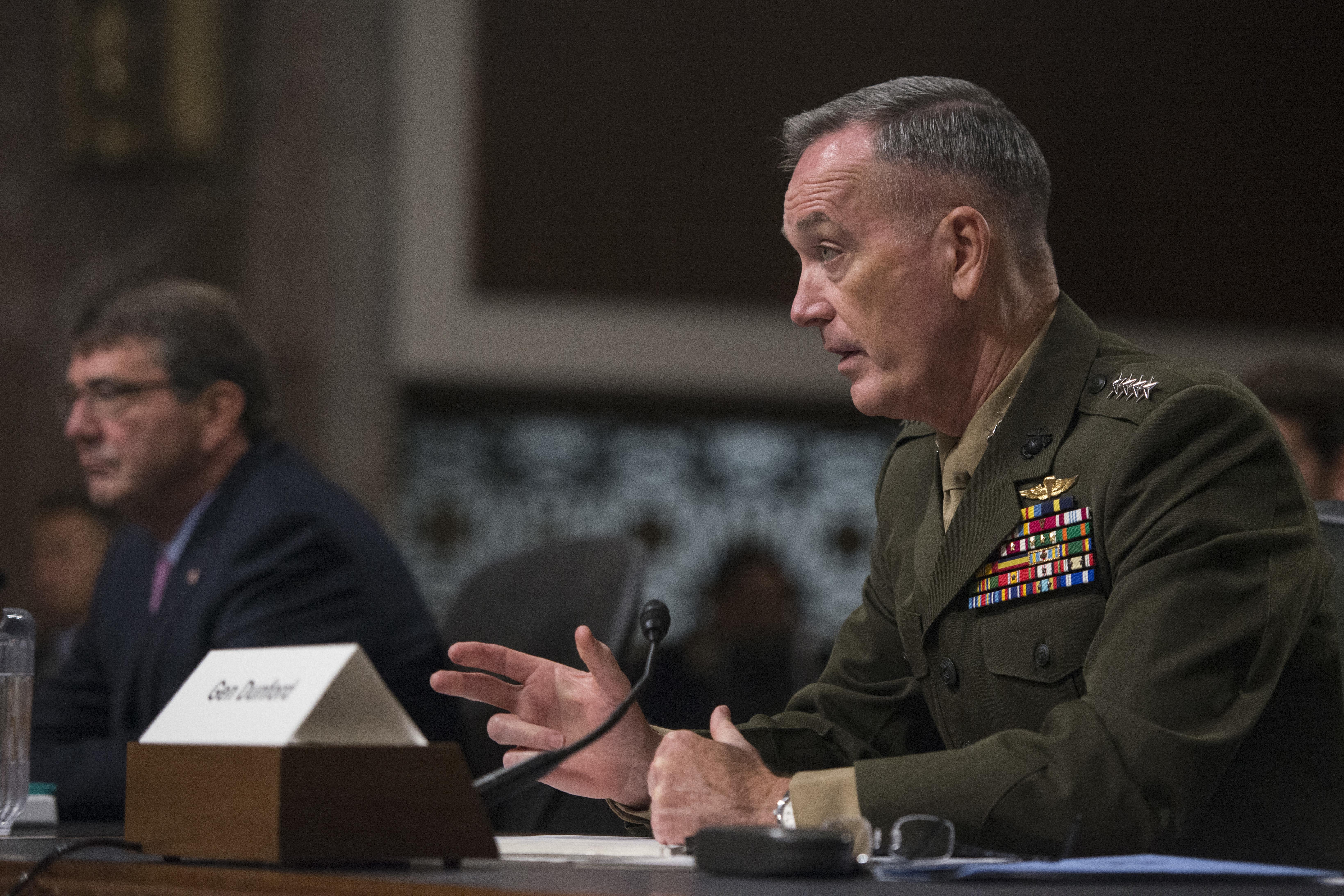
Dunford Tells Senate Now is Time to Reinforce Iraqi Success Against ISIL


By Jim Garamone DoD News, Defense Media Activity

WASHINGTON, October 27, 2015 — Following operations around Beiji and Ramadi, the chairman of the Joint Chiefs of Staff said there is an opportunity to reinforce Iraqi success in the days ahead.

Marine Corps Gen. Joseph F. Dunford Jr. told the Senate Armed Services Committee today that the Defense Department has developed a number of options to capitalize on progress the Iraqis have made.

In Syria, though, the balance of forces favors the regime of President Bashar al-Assad, he said.

The committee hearing focused on the Middle East, and more specifically on operations against the Islamic State of Iraq and the Levant.

Last week, the chairman visited Iraq, Israel and Jordan, where he met with U.S. and local leaders. “I was extremely impressed with the focus and commitment of our sailors, soldiers, airmen and Marines,” he said.

Two Lines of Effort

Dunford told the committee that the coalition must reduce ISIL’s territorial control, destroy its warfighting capability, “and undermine its brand and aura of invincibility.” ISIL’s main attraction is its claim to be the new caliphate.

The two main efforts against the terror group are the air campaign and the train, advise and assist campaign. Airstrikes are intended to kill key leadership and fighters, interdict ISIL’s lines of communication and disrupt their sources of revenue -- primarily oil, the chairman said.

“The second critical element in the military campaign is to develop and support effective partners on the ground, to seize and secure ISIL-held terrain,” he said.

The general called ISIL a trans-regional threat requiring a broader strategy. “The immediate priority is to bear down on core ISIL across Iraq and Syria, simultaneously,” Dunford said. “The framework for the campaign is the same for Iraq and Syria but the conditions on the ground present unique challenges and opportunities.”

Efforts in Syria

Unlike the situation in Iraq, there is no partner on the ground in Syria. “No one is satisfied with our progress to date,” he said. “Moving forward, we must work with Turkish partners to secure the northern border of Syria. We must do all we can to enable vetted Syrian opposition forces willing to fight ISIL, and we must be more aggressive in strikes that will deny ISIL the access they have to oil revenue.”

The general said he supports changes in the train-and-equip effort in Syria. “We will be supporting groups who have already demonstrated the will to fight ISIL, and our support will be contingent upon their attacking objectives and meeting specific standards,” Dunford said. “We will look for opportunities to support vetted opposition groups in both the north and along the border with Jordan.”

The chairman praised the efforts of U.S. forces in the region under Army Maj. Gen. Mike Nagata. “Due to their efforts, we have a much better understanding of the operating environment and the opportunities,” he said. “We’ll be able to leverage their initiatives and lessons learned as we make course and speed corrections.”

Slow Progress in Iraq

“In Iraq, we’ve also been frustrated with the pace of operations,” Dunford said. “That said, there has been recent progress in Beiji, some movement around Ramadi, and the [Kurdish] Peshmerga have made progress in the north.”

Dunford stressed that the coalition must improve “how we leverage our intelligence capabilities and do more to cut the flow of foreign fighters.”

American leaders have expressed concern over Russia’s actions in Syria. Last month, press reports from Iraq seemed to indicate that Iraqi leaders wanted Russian airstrikes in their country. Dunford told the committee that he specifically asked Iraqi Prime Minister Haider Abadi and Defense Minister Khalid Ubaydi about the reports.

“I explained to them how difficult it would be for us to continue to provide support if the Russians were invited in to conduct airstrikes,” he told the senators. “And I was assured at every level that that wouldn’t be the case.”