Friday, November 28, 2025

Executive Order 14362 and the Expanding Front of Terrorism Designations

Executive Order 14362, issued on November 24, 2025, represents a significant escalation in the United States’ efforts to counter terrorism networks operating across the Middle East. While the Muslim Brotherhood is not being designated wholesale as a terrorist organization, the order initiates an accelerated process to identify and potentially designate specific chapters in Lebanon, Egypt, and Jordan as Foreign Terrorist Organizations (FTOs) and Specially Designated Global Terrorists (SDGTs). The order cites the involvement of certain Brotherhood-linked groups in violence following the October 7, 2023 attacks on Israel and longstanding ties between Brotherhood leaders and militant wings of Hamas. This shift carries major implications for U.S. counterterrorism strategy, regional diplomacy, immigration enforcement, and transnational financial networks.

The Muslim Brotherhood has functioned for nearly a century as a decentralized movement with both political and militant offshoots. Founded in Egypt in 1928, it inspired chapters across the Middle East, some of which became integral parts of local political systems. Others developed military wings or clandestine operations that have intersected with global jihadist movements. The U.S. government has periodically evaluated the Brotherhood’s activities since the early 2000s, but has historically distinguished between political factions and groups actively engaged in terrorism. Recent intelligence assessments, however, indicate increasing collaboration between certain Brotherhood-linked entities and designated terrorist organizations, especially during periods of regional conflict. Public reporting has documented the participation of Brotherhood-aligned fighters in rocket attacks launched from Lebanon following the October 7 attacks in Israel, as well as leaders in Egypt and Jordan calling for support to Hamas.

Executive Order 14362 sets a strict timeline requiring the Departments of State and Treasury, along with the Attorney General and the Director of National Intelligence, to provide a formal designation report within 30 days. Within 45 days after that report is delivered, the government must take appropriate action consistent with U.S. terrorism laws. This structure signals a near certainty that at least some Brotherhood chapters will be designated. Historically, when similar orders have been issued—such as Executive Order 13224, used after the September 11 attacks—designation processes have moved quickly once interagency reviews conclude.

Designation would have immediate operational consequences. Under 8 U.S.C. 1189 and the International Emergency Economic Powers Act, all assets of designated groups under U.S. jurisdiction would be frozen, and U.S. persons would be prohibited from engaging in financial dealings with them. The material support statute, 18 U.S.C. 2339B, would expose individuals or organizations to criminal liability for providing funds, services, training, or any tangible assistance. Past designations of groups such as Hamas and Hezbollah dramatically constrained their international fundraising and disrupted support networks abroad. A similar effect would be expected here, particularly for Brotherhood chapters accused of facilitating Hamas financing.

Law enforcement and intelligence agencies would also gain expanded tools. An FTO or SDGT designation enables broader surveillance authorities, tighter monitoring of financial institutions, enhanced subpoena powers, and expanded information-sharing with foreign partners. Historically, these tools have allowed the FBI, Treasury Department, and Department of Homeland Security to map transnational networks more effectively, particularly those that operate through charitable fronts or diaspora communities. With many Muslim Brotherhood-affiliated organizations operating across borders, enhanced investigative capacity could reshape counterterrorism enforcement domestically.

The immigration consequences would be equally significant. Members of designated groups would be inadmissible to the United States, and those already residing in the U.S. could face removal proceedings. Prior cases involving Hezbollah, Islamic Jihad, and other designated groups show that DHS frequently reopens immigration files and conducts additional vetting when new designations occur. Asylum claims involving Brotherhood-affiliated applicants would also be reevaluated, and the federal courts have historically upheld the government’s authority to deny immigration benefits on terrorism-related grounds.

Regional implications may be substantial. Egypt has long designated the Muslim Brotherhood as a terrorist organization and is likely to welcome U.S. alignment with its stance. Jordan, however, maintains a sensitive political balance with its Brotherhood-affiliated political party, and U.S. action could complicate domestic dynamics in Amman. Lebanon’s security environment is already volatile, and designating Brotherhood-linked militants there may intersect with broader counter-Hezbollah policy. Additionally, the order reinforces U.S. counterterrorism coordination with Israel, particularly following the heightened security concerns after October 7.

Critics warn that the designations could increase anti-American sentiment, fuel regional instability, or drive Brotherhood factions underground. Academic experts have noted that in some countries, Brotherhood parties function within parliamentary systems, and lumping political activity together with militant activity could complicate diplomatic relationships. Civil liberties organizations in the United States may also raise concerns about overbreadth or potential chilling effects on domestic Muslim communities, although the EO explicitly targets foreign chapters, not U.S.-based organizations.

In a counterterrorism context, however, the order reflects growing bipartisan concern over transnational networks that support Hamas and other militant entities. U.S. strategy in recent years has increasingly emphasized disrupting financial conduits, diaspora-linked networks, and ideological organizations that serve as force multipliers for designated groups. Executive Order 14362 positions the United States to widen the scope of its counterterrorism posture in a region already undergoing dramatic shifts.

Executive Order 14362 marks a decisive moment in U.S. counterterrorism policy. By initiating the designation process for select Muslim Brotherhood chapters, the U.S. is signaling a willingness to expand its terrorism framework to target supporters of Hamas and other militant groups more aggressively. The effects will be far-reaching, touching international finance, domestic law enforcement, regional diplomacy, and immigration. Whether the order will stabilize or further complicate Middle East dynamics remains to be seen, but its impact on U.S. counterterrorism operations will be immediate and significant.


References

Byman, D. (2015). Al Qaeda, the Islamic State, and the global jihadist movement. Oxford University Press.

Gambhir, H. (2014). The Islamic State’s global propaganda strategy. Institute for the Study of War.

International Crisis Group. (2019). How the Muslim Brotherhood operates in the Middle East.

Levitt, M. (2006). Hamas: Politics, charity, and terrorism in the service of jihad. Yale University Press.

U.S. Congress. (1996). Antiterrorism and Effective Death Penalty Act, 18 U.S.C. § 2339B.

U.S. Department of State. (2023). Country Reports on Terrorism.

U.S. Government. (2025). Executive Order 14362, Designation of Certain Muslim Brotherhood Chapters as Foreign Terrorist Organizations and Specially Designated Global Terrorists.

Thursday, November 27, 2025

Dozens of Federal Agencies Initiate Counter-UAS CollaborationDozens of Federal Agencies Initiate Counter-UAS Collaboration

Over 180 experts from the War Department and other agencies in the federal government met yesterday for a summit to begin a planned three-year effort to deliver counter-small unmanned aircraft system capabilities to warfighters and keep the skies over America safe from dangerous drones.

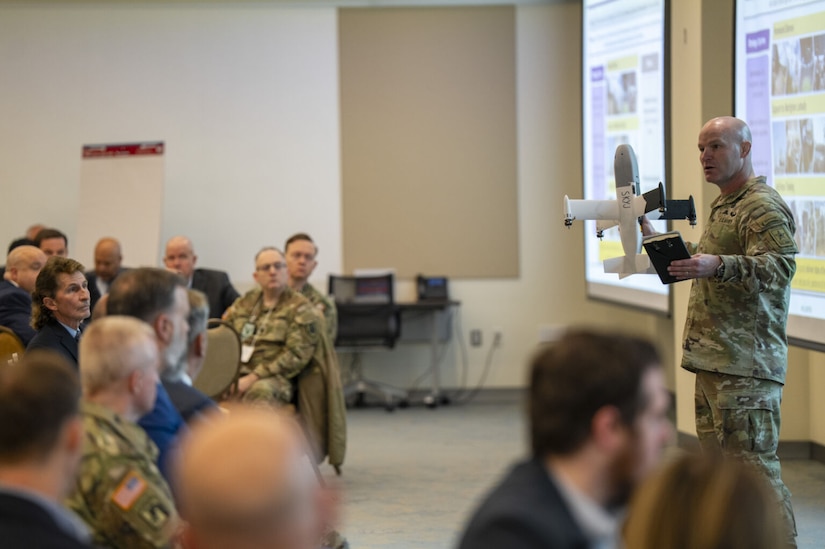
A man in a camouflage military uniform stands in front of a seated audience.

In August, Secretary of War Pete Hegseth launched the Joint Interagency Task Force 401. Just two weeks ago, senior leaders from the department and partner agencies, including Secretary of the Army Dan Driscoll, met at the White House to discuss how to best leverage the new task force and defend the homeland. 

"My priorities for transformation and acquisition reform include improving [counter-small unmanned aircraft systems] mobility and affordability and integrating capabilities into warfighter formations," Hegseth wrote in the August memo, which directed Driscoll to stand up the task force. "[The department] must focus on speed over process by ... establishing JIATF 401 with expanded authorities to execute capability development and delivery timelines that outpace the threat." 

Launching the task force, which Hegseth said will maintain operational capabilities for 36 months, is fully in line with the president's direction to reestablish air sovereignty over the U.S.

"[The department] must enhance its [counter-small UAS] capabilities to protect personnel, equipment and facilities at home and abroad," Hegseth said. 

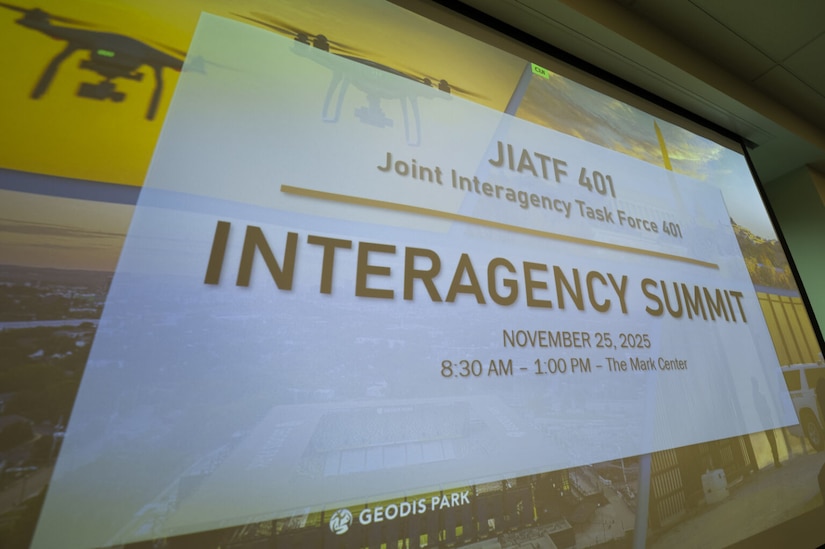
Representatives from the War Department, Department of Homeland Security, FBI, Transportation Department, Federal Aviation Administration and other agencies — about 50 total — met for the first time at the Mark Center in Alexandria, Virginia, as part of an introductory summit for task force partners.

"This was an opportunity to bring together all of the services, all of our interagency partners that have shared interests and equities with countering small UAS threats, because no one agency can solve this on their own," said Army Brig. Gen. Matt Ross, joint task force commander. "What we're really trying to do is expand the community of interest into a community of action and make sure we're taking tangible steps to defeat the UAS threat we face on a daily basis."

A screen reads JIATF 401 Joint Interagency Task Force 401 Interagency Summit, Nov. 25, 2025.

The threat from small UAS is growing, Ross told task force members. 

"Unmanned systems are a defining threat for our time, and I say that because they're prolific, they're evolving quickly, and they're no longer confined to combat," he said. "The [changing landscape] of drones is putting exquisite surveillance and precision strike capability into the hands of individuals and small groups that used to be reserved for our state adversaries." 

Ross emphasized the task force’s three lines of effort to defeat the counter-small UAS threats: defending the homeland, supporting warfighter lethality and joint force training. 

In the short term, according to Ross, homeland defense will focus on the area around Washington; the southern border; and supporting the FIFA World Cup event in June 2026, which is a national special security event.

U.S. Northern Command and Joint Task Force Southern Border personnel have reported some 3,000 drone incursions over the border in the past year and have seen over 60,000 drones just south of the border looking into the U.S., according to Ross. 

Ross affirmed his belief that addressing threats from drones at the border isn't about a hardware solution; it involves communications and data sharing.

A close-up view of a patch on the arm of a service member reads "U.S. Customs and Border Protection."

"We need a common air picture that includes drones," he said. "In some cases, we need cross-domain solutions that will allow us to see data that's picked up on a secret radar and an unclassed sensor. We need to proliferate active and passive sensors that provide air situational awareness along the southern border." 

That kind of integration is what JIATF 401 is all about, and it's what the task force is expected to bring to bear on the small UAS issue, according to Ross. 

In the National Capital Region, the task force will monitor how sensors from various agencies are able to track threats as they move through the sky, how that information can be passed to decision-makers and how those with the ability to take those threats out of the sky can be given the authority to do so.

"We're not there yet, but we're making progress," Ross said. 

Because the 2026 World Cup is a national special security event, it is a priority. One focus JIATF 401 has during the World Cup is to ensure security personnel have access through the Defense Logistics Agency to purchase counter-UAS capabilities that have been rigorously tested by the War Department. 

Keeping the drone threat at bay and protecting the U.S. homeland — including people and infrastructure — will take a whole-of-government approach, Ross emphasized.

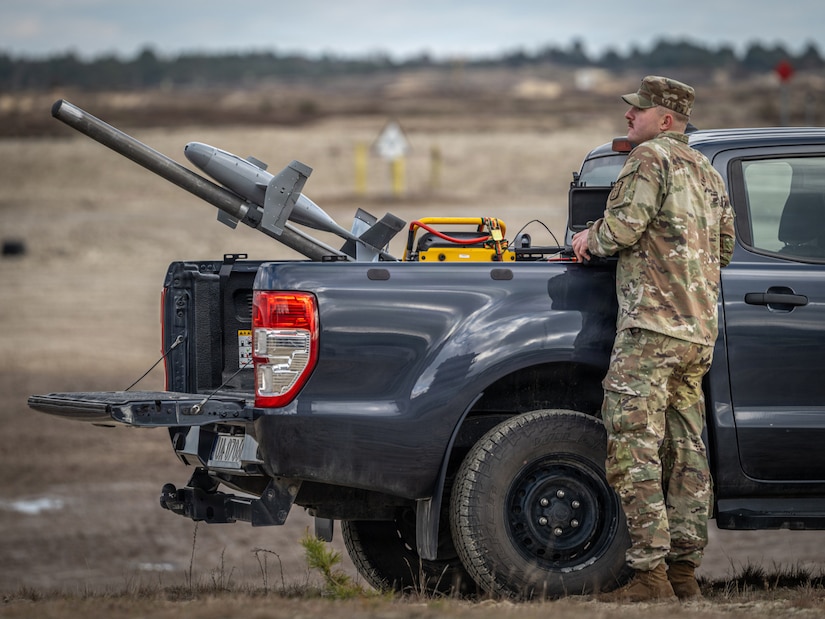
A soldier in a camouflage military uniform stands outdoors near a truck. A device that looks like a missile attached to a pole is mounted in the back of the truck.

"It's important that this is a joint and interagency effort because nobody can solve this problem alone," Ross said. "[JIATF 401] is a whole-of-government effort to be able to protect our critical infrastructure against the threat of unmanned systems. We've got to partner closely with our local law enforcement and other federal, state, local, tribal and territorial law enforcement to be able to counter this threat, see it before it starts to manifest and then to defeat it before an attack is successful." 

Daniel Tamburello, the undersecretary of science and technology for the Department of Homeland Security, acknowledged that working together across the federal government will be crucial to mission success. 

Both Northcom and DHS are responsible for protecting the homeland, including from drones. 

"There's a lot of overlap in those missions," Tamburello said. "Jointness and interagency cooperation is actually extremely essential with this." 

The threat from drones will only continue to grow. 

"The unmanned aerial system threat is one that has become prolific and widespread, and it's only going to get bigger and more complicated as more people adopt these systems and learn how to use them," Tamburello said. "They've become [accessible], they've become crowd sourced, ubiquitous and available pretty much anywhere. Any bad actor who wants to do something has a chance to do it, and we have to stop them." 

The goals for the task force, Tamburello said, include coordinating with every U.S. agency that deals with the threat posed by counter-UAS to enable interoperability and open communication.

"That is really going to be the best value for the taxpayer to make sure that we're acquiring not only the best systems, but we're not wasting money in the process," he said. 

Micheal Torphy, unit chief of the FBI's UAS and counter-UAS programs within their Critical Incident Response Group, attended the summit. He said the task force's interagency focus will empower the FBI.   

"We're exceptionally excited about this initiative, and we do believe it will enhance our ability to work with our partners to disrupt threats," he said. 

One of the things the FBI is bringing to the table is the National Counter-UAS Training Center, which recently opened in Huntsville, Alabama.  

"Its purpose is to train state, local, tribal and territorial law enforcement officers on counter-UAS, getting them ready for the World Cup, America 250 [celebration] and ultimately the Olympics and other events," he said. 

Torphy also said he thinks the interoperability inside the task force is going to make it easier for the FBI to work hand in hand with other partners to contribute to the mission of keeping the skies over America safe.  

"The way this has been rolled out has been extraordinary," he said. "Gen. Ross and his team have been fantastic in getting us involved very, very early. We're really excited about the future."

Tuesday, November 25, 2025

The Lone-Wolf Trap: How Algorithmic Radicalization Is Creating Terrorists in Plain Sight

Terror in the Open

The popular imagination still frames terrorism in images of shadowy training camps, desert compounds, or whispered conspiracies in unmarked safehouses. Yet the most dangerous terrorist of the modern age may never step inside a foreign training camp or commit to a formal extremist group. Increasingly, he—and sometimes she—follows a quieter, more insidious path: a path paved by social media, recommendation algorithms, and the psychological vulnerabilities of an overstressed society.

We used to talk about “lone wolves” as if they emerged spontaneously, fully formed. But nothing about their radicalization is spontaneous. In the age of algorithmic personalization, radicalization is not merely an accident—it can be an outcome. A predictable result of constant exposure to curated outrage, grievance amplification, and extremist validation.

In this sense, terrorism has evolved. It has become friction
less, personalized, and scalable. And it is happening right in front of us—in the search bar, in the next video auto-play, in the chat group that seems “just edgy enough,” and in the infinite scroll of the angry and aggrieved.

This is the lone-wolf trap: a mechanism of radicalization hiding in plain sight, driven not by secret meetings but by an attention economy that thrives on emotional extremity.


The Shift: From Cells to Solitude

Traditional terrorism relied on group structures: hierarchies, recruiters, indoctrination spaces, shared ideology, shared training, and shared risk. That model has not disappeared—foreign terrorist organizations still operate in this manner—but for U.S. homeland security officials, the threat profile has flipped.

According to the FBI’s 2023 Threat Assessment, the greatest danger comes not from organized groups but from domestic violent extremists operating independently, often radicalized entirely online. DHS echoes the same conclusion: individuals inspired by extremist narratives online are now the primary terrorism concern in the United States.

These individuals share patterns:

  • Self-radicalization via online content

  • Fragmented belief systems drawn from multiple extremist sources

  • No direct contact with formal terrorist organizations

  • A desire for notoriety, grievance expression, or catastrophic impact

  • Often no detectable planning chatter for law enforcement to intercept

In short: solitude has become the new training ground.

But solitude alone does not radicalize. Something has to pull the individual deeper. Something has to feed them. Something has to make extremism feel like truth, inevitability, or destiny.

That “something” today is algorithmic amplification.


The Algorithmic Accelerant

Social media platforms are built to maximize engagement, not accuracy, safety, or civic health. The longer a user stays on the platform, the more ads they can be shown. Over the past decade, the platforms discovered something troubling: the content that keeps users hooked is not balanced, rational, or nuanced.

It is content that triggers emotion—especially outrage, fear, and grievance.

A landmark report by the National Counterterrorism Innovation, Technology, and Education Center found that extremist content thrives in algorithmic environments because it sparks high-arousal emotions, making it more likely to be recommended, shared, and reshared.

A vulnerable individual does not stumble into extremism. The platform nudges them step by step:

  1. Anger video → recommended

  2. Conspiracy theory → recommended

  3. Anti-government rhetoric → recommended

  4. Extremist ideology → recommended

  5. Violent extremist justification → recommended

  6. Arms acquisition tutorials → recommended

This pattern is so common it now has a name in national security circles: the Radicalization Pipeline.

And because the individual believes they are in control—that they “found” this information themselves—the radicalization feels authentic, self-realized, even empowering.

This is the lone-wolf trap: an illusion of autonomy hiding a highly structured process.


Psychological Vulnerability: The Open Door

The algorithm may be the accelerant, but every fire needs oxygen. Modern American life provides it in abundance.

According to a meta-analysis by the American Psychological Association, individuals experiencing loneliness, economic instability, or identity disruption are significantly more susceptible to extremist narratives. Extremist content does not recruit by ideology—it recruits by unmet emotional need:

  • The need for significance

  • The need for belonging

  • The need for direction

  • The need to resolve grievances

  • The need to be seen, to matter, to strike back

Terrorism thrives where meaning breaks down.

This is why counterterrorism professionals increasingly view radicalization not as an ideological shift but as a psychological displacement: a retreat into an identity that provides clarity, certainty, and perceived empowerment.

When a person begins searching for meaning amid personal turmoil, the platforms respond—not with healthier content, but with whatever keeps them clicking. For many, that becomes extremism.

It is no coincidence that the rise of algorithmic radicalization parallels rising rates of depression, anxiety, and social isolation.

In a society drifting toward fragmentation, extremist narratives offer counterfeit purpose.


Case Studies: Terror Born in the Feed

Law enforcement investigations reveal a common thread: nearly every major “lone-wolf” terrorist attack in the United States over the past ten years involved online self-radicalization.

  1. The Buffalo Supermarket Shooter (2022)
    The attacker spent hours each day on extremist forums and video platforms, absorbing grievance narratives and white supremacist ideology. His manifesto explicitly referenced the online content that guided his worldview.

  2. The El Paso Walmart Shooter (2019)
    Self-radicalized online through anti-immigrant propaganda, never having formal contact with extremist groups.

  3. The Pittsburgh Synagogue Shooter (2018)
    Used online forums as both ideological source and community.

  4. ISIS-Inspired Lone Actor Attacks
    Several attackers in the U.S. and Europe never interacted with ISIS physically—they were radicalized entirely through online media.

  5. QAnon-Driven Violence
    Cases involving kidnapping plots and murder emerged from online conspiracy radicalization, not organizational recruitment.

Each attacker believed they were acting independently. Yet each followed a nearly identical digital path.

This is not coincidence. It is design.


The Leadership Crisis Behind Radicalization

Radicalization is not simply a security threat—it is a failure of leadership at every level of American civic life.

In The Temple Within, I argued that societies unravel when their internal moral infrastructure collapses. The same applies here. When institutions—political, educational, familial, spiritual—withdraw from the role of meaning-making, the void does not remain empty.

It gets filled.

Algorithms fill it with fury. Extremists fill it with ideology. Grievance merchants fill it with identity. Terrorists fill it with purpose.

Leadership is supposed to provide:

  • Stability

  • Truth

  • Courage

  • Impartiality

  • Guardrails

When these fail, the individual becomes vulnerable to darker narratives.

Radicalization is not born from strength. It is born from weakness—societal, institutional, personal.


Why This Threat Is So Hard to Stop

Three factors make algorithm-driven terrorism uniquely difficult to counter:

  1. No Organizational Footprint
    There is no cell to infiltrate. No hierarchy to map. No phone calls to intercept. The radicalized individual operates alone—but is never truly alone.

  2. Rapid Escalitation
    Traditional radicalization might take months or years. Algorithmic radicalization can accelerate in days.

  3. Fragmented Ideology
    Modern extremists often blend contradictory beliefs. This makes profiling and early detection significantly harder.

In the words of DHS analysts, the attacker may be the only member of his movement.


The Path Forward: Rebuilding the Moral Perimeter

Stopping algorithmic radicalization is not simply a question of platform regulation or algorithm transparency—though both are necessary. It requires something deeper: a cultural restoration of resilience, meaning, and civic responsibility.

  1. Strengthen Digital Literacy
    Teaching people how they are being manipulated is the first defense against manipulation.

  2. Community Intervention Models
    Local law enforcement, mental health professionals, and community leaders must collaborate before downstream threats become violent crises.

  3. Platform Accountability
    Algorithms should reduce exposure to extremist content, not amplify it.

  4. Leadership That Heals, Not Inflames
    Extremism thrives in environments of political spectacle, national division, and intentional outrage. Leaders must choose responsibility over ratings.

  5. Reinforce Meaning and Belonging
    Radicalization often fills a vacuum that families, schools, communities, and institutions failed to fill. Restoring connection is counterterrorism.

  6. Moral Responsibility at Scale
    Every great civilization has maintained some form of interior moral discipline—a shared sense of truth, responsibility, and duty. America needs a renewed commitment to guiding citizens toward ethical strength before they fall into ideological darkness.


Conclusion: The Enemy Within the Feed

The lone-wolf terrorist of the digital age is not a ghost or an enigma. He is a product—shaped by algorithms, fueled by grievance, validated by online communities, and unmoored from traditional structures of meaning.

He is born in plain sight.
He radicalizes in public.
He is encouraged by a system designed for engagement over truth.

If we continue to treat terrorism as a purely external threat, we will remain blind to the mechanisms that are manufacturing violent extremists inside our own society.

The truth is simple and unsettling: We are not dealing with lone wolves. We are dealing with assembly lines.

Counterterrorism in the 21st century is no longer just about stopping attacks. It is about repairing the societal fractures that create attackers.

Leadership, vigilance, and moral clarity are no longer luxuries—they are national security imperatives.

In the end, the terrorists we fail to stop are not hidden in distant deserts. They are scrolling beside us. They are learning in the same feeds we use. They are being shaped by the same digital forces shaping all of us.

And unless we confront that truth with courage, discipline, and a renewed sense of responsibility, the lone-wolf trap will continue to claim more souls—one algorithmic nudge at a time.


References (APA Style)

Borum, R. (2012). Radicalization into violent extremism II: A review of conceptual models and empirical research. Journal of Strategic Security, 4(4), 37–62.

Federal Bureau of Investigation. (2023). Domestic Terrorism Threat Assessment. U.S. Department of Justice.

Mitts, T. (2021). Algorithmic amplification of extremist content. National Counterterrorism Innovation, Technology, and Education Center.

New York State Attorney General’s Office. (2022). Investigation of the Buffalo supermarket attack.

U.S. Department of Homeland Security. (2024). Homeland Threat Assessment.


Saturday, November 22, 2025

Five Months Later: Why the Iran Strikes Still Threaten U.S. Security

The DHS warning was never about the days that followed, but the dangerous months after, when retaliation matures, vigilance fades, and delayed threats take shape.

On June 22, 2025, the U.S. Department of Homeland Security issued a National Terrorism Advisory System bulletin warning that the United States had entered a heightened threat environment following a series of dramatic military events involving Iran. The alert was triggered not by a singular incident, but by a rapid escalation in conflict: Israel’s June 13 air campaign against Iranian military and nuclear targets, followed by the United States conducting its own airstrikes on three Iranian nuclear facilities on the evening of June 21. Although these events now lie five months behind us, the threat landscape that prompted the bulletin has not expired. On the contrary, the long-term nature of retaliatory planning, global radicalization dynamics, and Iran’s established pattern of external operations suggest that the risk today may be more mature, not less.

Israel’s June 13 air operation marked one of the most significant direct attacks on Iranian military and nuclear infrastructure in years. Additional reporting indicates that the strikes killed hundreds of Iranian personnel and severely disrupted key military facilities. Israel has claimed that its campaign severely degraded Iran’s operational capability. Iranian officials called the assault an act of war, and issued multiple vows of retaliation across different fronts. United States forces entered the picture eight days later, when Washington launched an airstrike against three Iranian nuclear sites on June 21. President Trump stated that the strikes were intended to halt Iran’s nuclear escalation and warned Tehran that further retaliation would be met with additional military action.

The following day, DHS issued its nationwide terrorism alert. The bulletin cited the escalating Israel–Iran conflict, Iran’s demonstrated history of conducting external covert operations, and the risk of retaliatory activity targeting the U.S. homeland. DHS emphasized that both foreign terrorist actors and domestically radicalized individuals might be motivated or enabled by the conflict to attempt attacks. The advisory noted that there had been no specific, credible plot identified at that time, but nevertheless warned that the situation required elevated vigilance due to the shifting threat environment.

Critical to understanding the bulletin is recognizing that it was not released as a response to specific intelligence pointing to immediate attacks in late June. Rather, it was issued as a recognition that the conditions were forming for increased risk over an extended period. Terrorism studies consistently show that the most significant threats often emerge months after high-profile geopolitical shocks, especially when state or non-state adversaries seek to retaliate strategically. The bulletin reflected this timeline. DHS warned that Iran and its proxy elements have a history of conducting surveillance, cyber intrusions, assassination attempts, and targeted external operations abroad, and that multiple such plots had been disrupted on U.S. soil since 2020. DHS and intelligence-community reporting further indicated the likelihood of increased cyber activity targeting U.S. infrastructure by actors affiliated with Iran.

Recent academic assessments add important depth to this context. A comprehensive study published by the Combating Terrorism Center at West Point in 2024 documented Iranian-linked external plots in numerous countries, including the United States, over the last decade. Intelligence summaries, as well as previous Department of Homeland Security threat assessments, have similarly identified Iran as a capable external actor when motivated by perceived existential threats or high-profile provocations. Historically, Iran’s retaliatory strategy favors indirect and asymmetric approaches, including cyber operations, targeted attacks against dissidents, proxy-actor involvement, and episodic terrorist plots abroad.

Cybersecurity professionals also warn that the cyber dimension of this threat has expanded significantly in the last two years. High-profile cyber incidents in 2024 and 2025 linked to state-level actors have demonstrated how disruptive cyber retaliation can be. Multiple independent analysts have noted that escalating military conflict in the Middle East has increased the likelihood of cyberattacks targeting U.S. and allied commercial infrastructure. This aligns with DHS’s bulletin guidance directing heightened monitoring by critical-infrastructure operators.

Although the NTAS bulletin issued in June was largely overshadowed by the news cycle at the time, several state emergency management offices republished and amplified the advisory, noting that the heightened threat environment was expected to continue through late September 2025 and could be extended beyond that period based on evolving conditions. It is significant that the bulletin was not rescinded at the conclusion of the initial timeframe. Instead, federal officials signaled that the risk period had not closed.

Because five months have passed since the strikes, many people understandably assume that the danger has diminished. In reality, counterterrorism professionals emphasize that retaliation unfolds slowly. State-linked actors, and networks influenced by state-linked actors, typically operate on months-long planning timelines. Cyber planning, operational reconnaissance, facilitation, financing, logistical preparation, and target identification take time. Physical operational planning is slow, largely compartmentalized, and dependent on opportunity, not immediacy. There is also a relevant psychological factor: public vigilance tends to decrease several months after a major geopolitical event, which paradoxically can increase risk.

In addition, intelligence services historically observe seasonal and symbolic timing patterns. High-profile attacks or attempts are more likely to occur near national holidays, anniversaries, elections, or symbolic dates. For this reason, geopolitical shocks in early summer often produce operational consequences in late fall or early winter. The United States currently sits inside that window.

Second, online radicalization does not unfold instantly. It builds over time. As the conflict has continued, analysts have documented increases in extremist messaging online inspired by regional events. In the past, lone actors motivated by geopolitical grievances have conducted attacks in the United States months after triggering events faded from mainstream public consciousness. DHS noted this danger explicitly in its bulletin.

Third, Iran’s strategic position has not changed. It continues to frame the June strikes as severe aggression. Internal messaging from Iran’s leadership continues to emphasize retaliation as a matter of national honor and religious responsibility. Tehran has historically demonstrated willingness to pursue external action for far less significant provocations than direct strikes on nuclear sites.

Fourth, the cyber threat remains acute. Cyber threat intelligence firms have indicated that probing behavior linked to Iranian-aligned actors has continued in waves since June. Cyber probing campaigns targeting infrastructure and commercial networks do not usually produce immediate visible effect. It is the lateral movement that follows initial reconnaissance that produces material consequences.

Finally, threats remain relevant as long as the underlying geopolitical conflict remains unresolved. Israel’s campaign against Iran has continued episodically. Iran’s regional proxies have fluctuated in activity, but none have disarmed. The conflict remains active, and tensions remain elevated.

The enduring relevance of the June advisory lies not in the events themselves, but in what those events set into motion. Time did not close the window. Time matured it.

Understanding this distinction is crucial for the general public. The National Terrorism Advisory System is not a tool designed to create panic after a single event. It is a system designed to warn about shifts in the long arc of risk. That arc did not end when the headlines faded. It entered a new phase.

While direct action by the general public is limited, there are practical implications. Awareness remains the first line of defense. Individuals should remain attentive to unusual behavior around critical or symbolic locations. Businesses, particularly those with potential vulnerabilities, should ensure cybersecurity protocols remain active and current. Institutions with symbolic or cultural significance should continue to maintain prudent security protocols and coordination with local law enforcement. Federal and state authorities have encouraged the public to report suspicious activity, especially in the context of geopolitical escalation.

Five months on, the threat today is defined not by urgency, but by complexity. The most significant consequences of June’s events may not have manifested yet. Retaliation is most often slow, asymmetric, and opportunistic. The success of the nation’s counterterrorism posture depends as much on long-term vigilance as on immediate reaction. The real measure of public security is not whether instantaneous threats arise, but how resilient society remains while adversaries wait for the opportunity they prefer, not the moment we expect.

The June 2025 DHS bulletin warned Americans about an environment shaped by evolving, not static, danger. That warning remains relevant precisely because time has passed, not in spite of it. As public attention shifts to new stories, the underlying strategic realities remain. It is within this quiet space—between memory and consequence—that vigilance matters most.

========================
REFERENCES

CBS News. (2025, June 23). Homeland Security warns of heightened threat environment after U.S. strikes three Iranian nuclear facilities. CBS News.

Combating Terrorism Center at West Point. (2024). Tehran’s homeland option: External operations and strategic retaliation risk. CTC, U.S. Military Academy.

Department of Homeland Security. (2024). Homeland Threat Assessment 2025. U.S. Department of Homeland Security.

Department of Homeland Security. (2025, June 22). National Terrorism Advisory System Bulletin. U.S. Department of Homeland Security.

Oregon Office of Emergency Management. (2025, June 24). State advisory summary: Heightened threat environment. Oregon OEM.

Trustwave SpiderLabs. (2025, June). Cyber threat trends: Escalation patterns in Middle East conflict. Trustwave Holdings.

United States Cybersecurity and Infrastructure Security Agency. (2025). Cyber activity linked to Iranian-affiliated threat actors: Infrastructure alert summary. CISA.

Washington Post. (2025, June 17). Israel strikes Iran in largest aerial campaign in over a decade, officials say.

Sunday, October 26, 2025

From Suspicious Activity to Scene Response: Empowering CERT Volunteers in Terror-Threat Environments


When the Unthinkable Happens Nearby

When the unthinkable happens—a backpack left behind at a street fair, a car parked too long near a parade route—the space between awareness and official response can define the outcome. In that gap, calm, trained Community Emergency Response Team (CERT) volunteers become the bridge between fear and coordination. Their vigilance and composure can mean the difference between chaos and control.

The Federal Emergency Management Agency (FEMA) developed CERT to educate and organize citizens before disasters strike. But in an age of “soft-target” terrorism—public venues and everyday spaces vulnerable to low-tech, high-impact attacks—the CERT mission extends beyond earthquakes and floods. It now includes the prevention, recognition, and initial stabilization of human-caused threats (FEMA, n.d.-a).


The New Front Line: Suspicious Activity in the Era of Soft Targets

Terrorism today increasingly exploits community openness. A 2023 United Nations Counter-Terrorism Committee report identified “everyday venues” as the preferred settings for attackers seeking maximum fear with minimal planning. Such events often begin not with explosions or gunfire, but with indicators—unattended bags, unauthorized filming of access points, or someone testing barriers (United Nations, 2023).

The Department of Homeland Security’s If You See Something, Say Something® campaign reminds citizens that vigilance is a civic responsibility (DHS, n.d.-a). Yet for CERT members, vigilance is professionalized. They are trained to distinguish between credible observation and paranoia. CERT Unit 8, Terrorism and CERT, teaches volunteers how to identify precursor behaviors, collect descriptive details, and report accurately without escalating public panic (FEMA, n.d.-b).

This awareness transforms fear into readiness. By learning to see instead of merely look, CERT members extend national security’s reach into the spaces where Americans live, shop, and celebrate.


Empowerment Through Training: Turning Fear into Readiness

Preparedness transforms anxiety into agency. CERT volunteers train to observe calmly, communicate clearly, and act confidently. The FEMA course Introduction to Community Emergency Response Teams (IS-317) outlines the core mission: protect life, prevent additional harm, and support professional responders (FEMA, n.d.-c).

Training focuses on practical empowerment:

  • Observation and Reporting: noting who, what, when, where, and why before contacting authorities (DHS, n.d.-b).

  • Scene Safety: keeping distance from suspicious objects or areas while maintaining situational awareness.

  • Psychological First Aid: stabilizing frightened bystanders, easing fear through presence and direction.

The Texas A&M Engineering Extension Service (TEEX) complements CERT education with WMD/Terrorism Awareness for Emergency Responders (AWR160)—a course that teaches volunteers to recognize chemical, biological, radiological, nuclear, and explosive indicators (TEEX, n.d.). The objective is not heroism but discipline: the courage to stay calm and the knowledge to act correctly.


Between Chaos and Control: The CERT Role at the Scene

When an incident occurs, the first few minutes define everything. FEMA’s Target Capabilities List (2007) emphasizes the intelligence and investigations function—collecting, verifying, and sharing information between the public and response agencies. CERTs play a unique role here: they are the trained eyes on the ground.

They do not confront suspects or defuse devices. Instead, they gather data, manage crowds, and maintain order until command arrives. They speak the same language as first responders because CERT training integrates the Incident Command System (ICS), ensuring consistent communication and chain-of-command discipline.

In practice, this means that when communication lines falter, CERT volunteers become the human relay—a stabilizing link that keeps local officials informed and communities safe.


Building a Culture of Vigilance and Trust

Effective counterterrorism begins with community trust. CERT volunteers embody that trust. Through neighborhood drills, faith-based workshops, and civic outreach, they normalize preparedness and replace fear with familiarity.

FEMA’s CERT guidance stresses that community education is prevention. Awareness sessions help residents recognize that suspicious activity is defined by behavior, not appearance—a distinction essential to maintaining both security and civil liberties (FEMA, n.d.-a).

The Department of Homeland Security’s Community Awareness Briefing similarly warns that bias-driven suspicion undermines the credibility of vigilance programs (DHS, n.d.-c). By training citizens to focus on actions—such as surveillance, testing of security, or unauthorized access—CERTs help ensure that vigilance strengthens unity rather than division.

Through this outreach, CERTs become more than responders. They are the local ambassadors of resilience—neighbors who remind others that preparedness is a shared duty, not a specialist’s privilege.


Prepared, Not Paranoid

Preparedness is not about predicting the next attack—it is about participation. The CERT volunteer embodies that principle: watchful but not fearful, proactive but not reckless.

When the next moment of uncertainty comes—a strange noise at a fairground, a suspicious package at a transit hub—the community’s first safeguard may not wear a uniform. It may be a trained volunteer who remembers the mission: see clearly, stay calm, and serve with courage.

Because the difference between chaos and coordination is often one steady voice—ready before the sirens ever sound.


References

Department of Homeland Security. (n.d.-a). If You See Something, Say Something® campaign. U.S. Department of Homeland Security. https://www.dhs.gov/see-something-say-something

Department of Homeland Security. (n.d.-b). How to report suspicious activity. U.S. Department of Homeland Security. https://www.dhs.gov/see-something-say-something/how-to-report-suspicious-activity

Department of Homeland Security. (n.d.-c). Community Awareness Briefing (CAB). U.S. Department of Homeland Security. https://www.dhs.gov/prevention/clearinghouse-category/training-opportunities

Federal Emergency Management Agency. (2007). Target Capabilities List: A companion to the National Preparedness Guidelines. U.S. Department of Homeland Security. https://www.fema.gov/pdf/government/training/tcl.pdf

Federal Emergency Management Agency. (n.d.-a). Community Emergency Response Team (CERT) Program. U.S. Department of Homeland Security. https://www.fema.gov/emergency-managers/individuals-communities/preparedness-activities-webinars/community-emergency-response-team

Federal Emergency Management Agency. (n.d.-b). CERT Basic Training: Participant Manual, Unit 8 – Terrorism and CERT. U.S. Department of Homeland Security. https://www.ready.gov/sites/default/files/2019.CERT_.Basic_.IG_.FINAL_.508c.pdf

Federal Emergency Management Agency. (n.d.-c). IS-317: Introduction to Community Emergency Response Teams. U.S. Department of Homeland Security. https://training.fema.gov/is/courseoverview.aspx?code=IS-317

Texas A&M Engineering Extension Service. (n.d.). AWR160 – WMD/Terrorism Awareness for Emergency Responders. https://teex.org/class/awr160/

United Nations Counter-Terrorism Committee Executive Directorate. (2023). Protecting vulnerable targets from terrorism. United Nations. https://www.un.org/counterterrorism


Wednesday, October 22, 2025

Youth Radicalization and the 488% Jump in Terrorism Charges in Canada

Between April 2023 and March 2024, the Royal Canadian Mounted Police (RCMP) reported a staggering 488 percent increase in terrorism-related charges across the nation. Twenty-five suspects were accused of 83 terrorism offences—an extraordinary rise from the previous year. Among those charged were several minors and young adults, a revelation that underscores a growing concern within Canada’s national security community: the rapid radicalization of youth. The surge is not merely a statistical anomaly; it represents a deepening social and psychological crisis emerging from digital spaces, ideological fragmentation, and an under-resourced prevention infrastructure.


The Data: Understanding the Spike

The RCMP’s internal briefing to Public Safety Canada in early 2024 revealed that terrorism-related charges had increased by nearly fivefold within one year. Three minors and six young adults were among those charged, while eight additional youths were placed under terrorism peace bonds. Law-enforcement agencies also reported six foiled terrorist plots between 2023 and 2024, spanning cities such as Edmonton, Ottawa, and Toronto. These figures reflect both improved investigative capacity and a real escalation in extremist activity among young Canadians.

This sharp rise is particularly concerning given that terrorism prosecutions in Canada have historically been rare. The Criminal Code’s terrorism provisions were first enacted in 2001 under the Anti-Terrorism Act (Bill C-36), yet charges have typically numbered only in the single digits each year. The 2023–2024 increase therefore signals a fundamental shift in the threat landscape rather than a routine fluctuation.


Youth Radicalization in the Digital Era

Radicalization among Canadian youth differs from traditional extremist recruitment models. According to RCMP intelligence assessments, online ecosystems have become the primary incubators for extremist belief systems. Young individuals increasingly encounter violent ideologies through algorithm-driven content feeds, encrypted messaging apps, and online gaming communities. Unlike earlier generations, these recruits often have minimal physical contact with organized terror networks.

Social isolation, identity struggles, and mental-health vulnerabilities have compounded this digital exposure. The COVID-19 pandemic intensified many of these factors, creating conditions in which adolescents sought meaning and belonging through online movements. Ideologically Motivated Violent Extremism (IMVE)—including far-right, conspiracy-based, and religiously motivated movements—has drawn youth through narratives of empowerment and grievance. In many cases, radicalization occurs within echo chambers that reinforce hostility toward perceived enemies, whether political, ethnic, or religious.


The Canadian Context: Why Now?

Several converging factors have accelerated youth radicalization in Canada. First, the global information environment is increasingly polarized, with geopolitical conflicts—such as the 2023 Israel-Hamas war—spilling into domestic discourse. The RCMP and the Canadian Security Intelligence Service (CSIS) have both warned that such international events fuel online hate speech and ideological mobilization among young Canadians.

Second, resource limitations have hindered effective prevention. The RCMP briefing noted that the increase in violent extremism has “not seen a parallel increase in resourcing.” Counter-radicalization programs such as the Canada Centre for Community Engagement and Prevention of Violence operate on modest budgets, often without the capacity to reach at-risk youth before extremist networks do.

Third, evolving domestic legislation—ranging from Bill C-51 (2015) to Bill C-59 (2019)—has expanded authorities’ ability to investigate and prosecute terrorism cases. While these tools improve accountability, they also highlight the reactive nature of Canada’s approach: arrests often follow rather than prevent radicalization.


Case Studies: Youth Involvement in Terror-Related Activity

Several high-profile cases illustrate the human dimension behind the statistics. In 2024, a teenager in Ottawa was charged with plotting violence against Jewish individuals—a case that shocked both the Jewish community and counter-terrorism officials. The accused, influenced by online extremist narratives, allegedly viewed violence as a form of social validation. Similar arrests in Calgary and Toronto involved youth drawn into ideological movements ranging from jihadist extremism to violent incel culture.

While these examples differ in ideology, they share key traits: social isolation, digital radicalization, and a lack of early intervention. Law enforcement has increasingly used terrorism peace bonds in such cases—civil orders restricting individuals believed likely to commit terrorism offences when evidence falls short of criminal thresholds. These measures, though preventive, reveal the difficulty of addressing the issue before it escalates.


Drivers and Mechanisms of Radicalization

Several drivers have emerged as central to the 2023–2024 wave of youth radicalization:

  1. Online Exposure: Extremist content proliferates through platforms such as Telegram, Discord, and niche forums, often disguised as memes or self-help material.

  2. Identity and Alienation: Youth struggling with belonging find purpose within ideological narratives that promise empowerment through destruction or defiance.

  3. Ideological Fluidity: Many young radicals blend ideologies—combining, for instance, misogyny, conspiracy theories, and pseudo-religious justifications—making classification difficult.

  4. Lack of Institutional Capacity: Canadian counter-radicalization programs remain fragmented across federal and provincial levels, with few sustained partnerships between law enforcement, educators, and mental-health providers.

  5. Global Resonance: International extremist groups exploit Western youth through encrypted communications and propaganda videos, customizing narratives to local grievances.

The convergence of these elements forms what analysts describe as “networked radicalization,” where peer groups, influencers, and algorithms jointly reinforce extremist worldviews.


Policy and Law-Enforcement Responses

Canada’s counter-terrorism architecture combines enforcement and prevention. The RCMP leads national investigations through its Federal Policing branch, while CSIS handles intelligence collection. The Canada Centre for Community Engagement and Prevention of Violence funds initiatives through the Community Resilience Fund, supporting local programs aimed at early intervention. However, these efforts often lag behind the pace of online radicalization.

Recent RCMP statements emphasize youth-focused interventions, particularly partnerships with schools and parents to identify behavioral changes. Yet significant obstacles remain: overextended investigators, jurisdictional overlap, and legal constraints surrounding surveillance of minors. Moreover, public discourse around civil liberties complicates the introduction of stronger monitoring mechanisms, even when directed at extremist propaganda.

The legal system has also adapted. The increase in peace bonds—essentially pre-charge supervision agreements—illustrates a preventive but imperfect tool. They provide temporary containment but seldom address underlying psychological or ideological causes. Long-term de-radicalization requires multi-disciplinary engagement, including education, counseling, and digital-literacy programs.


Broader Implications

The rise in youth-linked terrorism charges carries profound implications for Canada’s national identity and public safety. Beyond law enforcement, it raises moral and developmental questions: why are young people, often from stable communities, attracted to violent extremism? The answer appears tied to a loss of social cohesion and the unchecked spread of digital misinformation. If Canada fails to address these root causes, the nation risks normalizing extremist behavior among its youngest citizens.

Globally, the trend aligns with findings from Europol and the United Nations Office on Drugs and Crime, which note increasing youth engagement in online radicalization networks across Western democracies. Canada’s experience thus mirrors a broader transformation in how terrorism incubates—less in physical training camps and more in digital subcultures.


Recommendations

Addressing youth radicalization demands a layered approach. First, education systems must incorporate digital-literacy curricula that help students identify manipulative content and misinformation. Second, community-based mental-health resources should be strengthened to detect and support vulnerable youth before extremist recruiters reach them. Third, technology companies must assume greater responsibility for moderating extremist content, collaborating with law enforcement while maintaining privacy safeguards. Fourth, policy reforms should ensure sustainable funding for prevention programs, matching the scope of the threat. Finally, research institutions must continue studying the evolving typologies of youth extremism to inform data-driven responses.

Each of these measures reflects a recognition that radicalization is not simply a law-enforcement issue—it is a social one rooted in identity, alienation, and the search for belonging.


Conclusion

The 488 percent surge in terrorism-related charges in Canada is a warning sign, not a statistical curiosity. It reveals an emerging generational crisis where ideology, technology, and psychology converge to draw young people toward violence. While the RCMP’s response has demonstrated vigilance, sustainable prevention requires far more than arrests and peace bonds. Canada must invest in its youth—educationally, socially, and emotionally—to prevent the next generation from finding purpose in destruction. Only through comprehensive, community-based engagement can the nation hope to reverse the trajectory of youth radicalization and ensure that future headlines tell a different story.


References

Associated Press. (2024, May 10). Canadian youth facing terrorism charges for alleged plot against Jewish people. AP News.

Government of Canada. (2019). National Strategy on Countering Radicalization to Violence. Public Safety Canada.

Hoffman, B. (2024). Inside terrorism (4th ed.). Columbia University Press.

Llewellyn, C. (2023). The evolution of Canada’s domestic counter-terrorism strategy. Canadian Forces College.

Royal Canadian Mounted Police. (2024). Federal Policing Annual Report 2023–2024. RCMP Communications.

Times of India. (2024, May 11). RCMP claims 488 % spike in Canada’s terrorism charges.

United Nations Office on Drugs and Crime. (2023). Preventing youth involvement in violent extremism and terrorism.

Vision of Humanity. (2024). Global terrorism index 2024. Institute for Economics and Peace.


Saturday, October 18, 2025

Inside the Next Wave: What 2026 Holds for America’s Fight Against Terrorism


“The next wave of terrorism won’t come from the desert—it will come from data.”


The Silence Before the Storm

The jetliner roar and collapsing towers that defined a generation’s idea of terrorism are two decades behind us. Yet in 2026, the danger feels both quieter and closer. The new threat hums in the background of our ordinary lives—inside the algorithms that shape opinion, the coins that move unseen across digital ledgers, and the invisible networks that link extremists a continent apart.

This next wave is not a return to 9/11-style spectacle but a mutation: smaller, faster, more adaptive, and more personal. Homeland Security analysts call it “the hybrid era”—where crime, ideology, and technology converge so completely that separating them is like untangling light from heat.

Terrorism is no longer a headline—it’s an atmosphere.


The Shape-Shifting Enemy

America’s counterterrorism machine was built to chase hierarchies: training camps, emirs, and command chains. What confronts us now is an ecosystem.

According to the Homeland Threat Assessment 2025 (Department of Homeland Security [DHS], 2024), domestic violent extremism remains the most persistent and lethal danger inside U.S. borders. Meanwhile, the Annual Threat Assessment (Office of the Director of National Intelligence [ODNI], 2025) warns that global jihadist networks have become franchised micro-movements—from ISIS-K in Central Asia to al-Qaida affiliates spreading across the Sahel. Each is self-financing, self-radicalizing, and digitally fluent.

The distinction between foreign and domestic has eroded. The same encrypted chat app used by an Afghan recruiter is used by an American conspiracy theorist. The same meme that spreads in Nigeria finds a new caption in Nebraska.

Yesterday’s terrorist carried a passport. Tomorrow’s carries a profile.


Cyber: The First Front

The world’s power grids, hospitals, and supply chains now double as potential war zones. In 2026, cyberterrorism has matured from nuisance to strategic weapon.

The Defense Intelligence Agency’s Worldwide Threat Assessment 2025 notes that state-backed hackers from Russia, China, Iran, and North Korea are blurring lines between espionage, crime, and terror support. They rent infrastructure to ideological allies and conceal operations beneath criminal ransomware noise.

AI-driven intrusion software can now map a target’s digital ecosystem, craft personalized spear-phishing lures, and deploy within minutes. The next blackout might not signal an act of war but a profit-sharing venture between criminals and extremists.

Municipal systems and hospitals remain especially vulnerable. In the past year alone, ransomware attacks disrupted emergency services in five states. Analysts warn that the terroristic potential of chaos itself—not just profit—has become a motivating factor. The attackers do not always need to win; they only need to remind us how easily the lights go out.

In the Quiet War, every router is a trench and every password a perimeter.


The Currency of Conflict

If cyber is the bloodstream of modern terrorism, money is still its heart. Yet the heart now beats invisibly.

The Financial Action Task Force (FATF) Comprehensive Update on Terrorist Financing Risks (2025) found that virtual assets have “lowered barriers to entry” for extremists. The same blockchain that democratizes investment also democratizes illicit finance.

North Korean operatives reportedly stole more than $600 million in cryptocurrency during 2024; a portion of those funds likely supported weapons programs and proxy networks (Reuters, 2025). FATF warns of AI-managed laundering—algorithms that shift funds between coins and mixers before investigators can trace them.

Meanwhile, micro-financing—thousands of small donations beneath reporting thresholds—allows sympathizers to funnel capital through charity fronts or crowd-funding platforms. The result is a “trickle-to-torrent” effect that sustains insurgencies without a single blockbuster transfer.

The new terrorist banker isn’t a man in a suit—it’s a line of code.


The Cognitive Battlefield

The third front is inside our heads.

Disinformation, deepfakes, and algorithmic manipulation are no longer side-shows; they are the main theater of psychological warfare. A RAND Corporation study (2025) found that AI-generated propaganda now achieves engagement rates up to 40 percent higher than human-written posts.

Foreign intelligence services exploit domestic divisions, while domestic extremists borrow foreign disinformation techniques. Social media has become both recruitment ground and reality distortion field. The old “propaganda of the deed” has evolved into the “propaganda of the meme.”

During 2025, analysts tracked deepfake videos depicting fabricated police shootings that sparked real-world protests before verification caught up. The goal was not persuasion but polarization—to replace truth with tribal reflex.

The meme is the new missile, and outrage is the fuel.


The Global Hot Zones

The Sahel

Once a cartographic afterthought, West Africa’s Sahel is now the world’s fastest-growing terror front (United Nations Security Council Counter-Terrorism Committee [CTED], 2025). Islamic State in the Greater Sahara and al-Qaida-aligned JNIM exploit collapsing governance, climate stress, and displacement. Their expansion toward coastal states threatens ports, shipping lanes, and Western interests.

Afghanistan – Pakistan Border

ISIS-K remains the most globally ambitious jihadist group. The UN Secretary-General’s Report on ISIL/Da’esh (2025) describes its “sophisticated propaganda and external operations intent.” Expect continued attempts to inspire or enable lone-actor plots abroad.

Latin America

Criminal-terror hybrids, such as Ecuador’s Los Lobos gang, adopt bombings and assassinations once associated with insurgencies (Associated Press, 2025). When cartels weaponize terror tactics, geography stops being comfort.

The Homeland

Domestically, ideologically fluid extremism is the signature threat. According to DHS (2024), racially motivated and anti-government extremists remain the top killers, but new clusters—eco-radicals, anti-tech saboteurs, and gender-based militants—are emerging. Their unifying feature is self-radicalization through digital echo chambers.

The new map of terrorism isn’t drawn in sand—it’s drawn in bandwidth.


America’s Blind Spots

Despite two decades of counterterror investment, America’s security architecture still carries the DNA of 2001.

Legal frameworks lag behind hybrid realities: the Patriot Act never envisioned cryptocurrencies or AI-generated propaganda. Jurisdictional walls between domestic and foreign intelligence slow information fusion. And the public—exhausted by crises—tunes out warnings until an attack trends.

The Europol TE-SAT 2024 report noted that Europe thwarted 58 terrorist attacks across 14 member states; the United States, by contrast, measures success largely in absence—what didn’t happen. That absence can breed complacency.

Information fatigue is the enemy’s ally. As one counterterror official put it, “We built an army to fight an enemy that now travels at the speed of rumor.”

The danger isn’t surprise—it’s distraction.


Adapting the Arsenal

The next wave demands tools as flexible as the threat.

  1. Data Fusion, Not Hoarding. Intelligence value decays by the hour; cross-agency latency kills context. Real-time fusion between federal, state, and private partners is essential.

  2. Financial Transparency. FinCEN’s Advisory FIN-2025-A001 urges stricter oversight of virtual-asset service providers and shell companies. Implementing beneficial-ownership registries is dull policy—but lethal to terrorists.

  3. Cyber Hygiene at the Bottom of the Market. Most ransomware chaos begins in underfunded local systems. Subsidizing security for hospitals and utilities may prevent the next national emergency.

  4. Counter-Narrative Literacy. Media-literacy curricula and civic education inoculate citizens against manipulation. When people recognize emotional bait, the algorithm loses its teeth.

  5. Community-Level Prevention. Programs modeled on public-health outreach—identifying early behavioral indicators without stigmatization—show promise in reducing domestic radicalization (DHS, 2024).

The strongest firewall is public trust.


What 2026 Could Look Like

Analysts outline several plausible near-term scenarios:

  • Synchronized lone-actor violence—small attacks amplified through live-streaming to create nationwide panic.

  • Ransomware blackouts targeting emergency services during an election cycle.

  • AI-generated “false flag” incidents—fabricated atrocities prompting real-world retaliation.

  • Terrorist use of decentralized autonomous organizations (DAOs) to crowd-fund operations under philanthropic disguise.

  • Regional collapse in the Sahel or Horn of Africa exporting fighters and ideology via migration routes.

Each shares the same DNA: digital agility, psychological shock, and strategic deniability.


The Human Factor

Technology changes the medium; people decide the meaning. Leadership that communicates calmly, transparently, and compassionately after an incident denies terrorists their ultimate goal—fear amplification.

Veterans of counter-insurgency remind us that empathy is a security asset. When citizens feel heard, they are harder to recruit or divide. The ultimate counterterror skill is not codebreaking but community-building.

America’s greatest defense has never been surveillance—it’s solidarity.


The Road Ahead

Terrorism in 2026 will not vanish; it will metastasize. But adaptation is possible. The U.S. has the analytical talent, financial leverage, and technological depth to blunt this next wave—if it recognizes that terrorism is now a systemic, not episodic threat.

That recognition begins with language. Words like “war,” “enemy,” and “battlefield” still frame our imagination, but the real fight is for stability in the everyday. The goal is not perpetual mobilization—it is persistent resilience.

Victory in the next wave won’t be declared from a podium. It will be lived quietly in a society that refuses to fracture.


References

Associated Press. (2025, August 22). Islamic State and al-Qaida threat is intense in Africa, with growing risks in Syria, UN experts say. AP News.

Defense Intelligence Agency. (2025). Worldwide Threat Assessment: Statement for the Record to the House Armed Services Committee. Washington, DC: U.S. Department of Defense.

Department of Homeland Security. (2024). Homeland Threat Assessment 2025. Washington, DC: DHS.

Financial Action Task Force. (2025). Comprehensive Update on Terrorist Financing Risks. Paris: FATF.

Financial Crimes Enforcement Network. (2025). Advisory FIN-2025-A001: ISIS-Related Illicit Financial Activity. Washington, DC: U.S. Department of the Treasury.

Office of the Director of National Intelligence. (2025). Annual Threat Assessment of the U.S. Intelligence Community. Washington, DC: ODNI.

RAND Corporation. (2025). Artificial Intelligence and the Future of Online Propaganda. Santa Monica, CA: RAND Research Report.

Reuters. (2025, September 3). Financial crime watchdog calls for countries to come clean on shell companies. Reuters Business.

United Nations Security Council, Counter-Terrorism Committee Executive Directorate (CTED). (2025). Briefing on the Secretary-General’s Strategic-Level Report on ISIL/Da’esh. New York, NY: United Nations.

Europol. (2024). European Union Terrorism Situation and Trend Report (TE-SAT 2024). The Hague: Europol.

Saturday, October 11, 2025

Lone-Wolf Attacks, Online Radicalization, and the Future of Homegrown Terrorism

The Invisible War Next Door

On October 9, 2025, a man armed with a pistol entered a Manchester synagogue during Yom Kippur services, proclaiming allegiance to the Islamic State before being subdued by worshippers. Authorities later revealed he had never traveled abroad or met with terrorist operatives—his radicalization occurred entirely online. Such incidents highlight the rise of the “lone-wolf” terrorist: an individual who acts independently of formal networks yet carries global ideological echoes. In the digital age, terrorism no longer requires a chain of command or physical training camps. Instead, radicalization spreads through social media, encrypted apps, and algorithmic echo chambers that can turn alienation into extremism. This essay examines the evolution of terrorism into decentralized, homegrown forms; the mechanisms of online radicalization; the challenges of prevention; and what the future may hold for counterterrorism in a hyperconnected world.


The Evolution of Terrorism: From Networks to Nodes

Terrorism has evolved from coordinated, hierarchical networks to decentralized individual actions. In the early 2000s, groups such as al-Qaeda operated as global franchises with structured leadership and training facilities. Their model emphasized spectacular, large-scale operations that demanded coordination, secrecy, and physical presence (Hoffman, 2017). The emergence of the Islamic State (ISIS) introduced a hybrid model—territorial control in Iraq and Syria combined with a sophisticated online propaganda campaign that reached disaffected individuals worldwide (Byman, 2016). When ISIS lost its territorial caliphate, it pivoted toward what analysts describe as “virtual jihad,” encouraging sympathizers to wage war wherever they lived.

This strategic decentralization turned ideology into a digital virus. The global defeat of centralized terror groups did not extinguish their influence; instead, it fragmented it into thousands of digital “nodes.” Each node—a chatroom, Telegram group, or encrypted server—serves as both a recruiting center and echo chamber. Through these virtual communities, extremist groups continue to spread propaganda, coordinate micro-attacks, and maintain psychological presence despite losing physical ground (Clarke & Pantucci, 2020). The battlefield, once territorial, has become cognitive.


The Digital Radicalization Pipeline

Radicalization in the twenty-first century increasingly occurs through online interactions. The internet’s democratization of information allows extremist ideologies to flourish under the guise of free expression. Algorithms that reward engagement—regardless of moral content—amplify divisive material and guide users toward progressively extremist content (Conway, 2017). The result is a feedback loop: emotional outrage drives clicks, clicks drive exposure, and exposure normalizes extremism.

Modern extremist propaganda is not limited to lengthy manifestos or sermons. It includes memes, gaming aesthetics, and short-form videos that blend humor with hate. These digital artifacts recruit through familiarity, particularly among young, alienated men seeking identity and belonging. Studies show that online radicalization often progresses through stages: exposure to grievances, participation in ideological forums, adoption of extremist narratives, and eventual operational intent (Gill et al., 2017).

Recent examples reinforce this pattern. In 2025, the Manchester synagogue attacker had consumed months of ISIS content and communicated through encrypted apps. Similar cases across Europe and North America show individuals self-initiating plots without external direction, motivated by online propaganda and perceived global injustice (Europol, 2024). The psychological dimension is crucial: loneliness, resentment, and a search for purpose provide fertile ground for extremist recruitment. The internet supplies both validation and instruction.


The Challenge of Prevention

Preventing lone-wolf terrorism presents unique legal, ethical, and technological dilemmas. Law enforcement agencies face the paradox of identifying threats that manifest primarily as private digital behavior. Most lone-wolf attackers display subtle warning signs—isolated comments, symbolic posts, or private manifestos—detected only after violence occurs (Hamm & Spaaij, 2017). Predicting such acts with precision remains nearly impossible without encroaching on civil liberties.

Efforts to enhance digital surveillance raise contentious debates about privacy and state overreach. While some advocate monitoring encrypted channels, others warn that excessive surveillance erodes trust and may inadvertently validate extremist narratives about government oppression. Meanwhile, technology companies are under increasing pressure to regulate extremist content, yet they struggle with the scale and complexity of identifying intent without stifling legitimate expression (Weimann, 2021).

Community-based approaches offer a complementary path. Programs in Germany, the United Kingdom, and Australia focus on early intervention—training educators, parents, and peers to recognize behavioral shifts associated with radicalization. Such initiatives emphasize empathy, mental health, and inclusion rather than punishment. When implemented well, they demonstrate that counterterrorism can occur through social resilience rather than perpetual surveillance.


The Future of Homegrown Terrorism

Looking forward, homegrown terrorism is likely to become more sophisticated, individualized, and technologically adaptive. Artificial intelligence and deepfake technology are already being exploited to generate personalized propaganda and fake leadership messages, blurring the line between authenticity and fabrication (Berger, 2022). Extremist groups increasingly use cryptocurrencies to finance operations and maintain anonymity, while decentralized online platforms make content moderation nearly impossible.

Moreover, ideological boundaries are eroding. Scholars observe “ideological cross-pollination,” where far-right groups adopt jihadist propaganda tactics and vice versa (Clarke & Pantucci, 2020). The result is a hybrid threat landscape defined less by ideology and more by shared grievance, nihilism, and performative violence. The modern terrorist is less a soldier of a cause than a seeker of notoriety—amplified by social media’s promise of instant visibility.

The next generation of counterterrorism must therefore adapt to psychological and digital realities. Traditional methods—border control, military strikes, and surveillance—are ill-suited to combating ideologies that exist in cloud storage and human emotion. Prevention will depend on digital literacy, mental health outreach, and cross-platform cooperation among governments, educators, and technology firms.


Conclusion — Winning the Invisible Battle

The war on terror has migrated from deserts and mountains to browsers and bedrooms. Today’s terrorist needs no passport, no orders, and no accomplices—only a Wi-Fi signal and a grievance amplified by algorithms. Lone-wolf terrorism represents the most unpredictable and personal form of modern violence, one that challenges the foundations of both security and democracy. To win this invisible battle, societies must think beyond policing and embrace prevention rooted in empathy, education, and early intervention. Technology created the terrain of modern radicalization; human connection must reclaim it. As one analyst observed, “the modern terrorist doesn’t need to cross a border—only a broadband threshold” (Hoffman, 2017, p. 94).


References

Berger, J. M. (2022). Extremist propaganda in the age of artificial intelligence. Brookings Institution Press.

Byman, D. (2016). Al Qaeda, the Islamic State, and the global jihadist movement. Oxford University Press.

Clarke, C. P., & Pantucci, R. (2020). After the caliphate: The Islamic State and the future terrorist diaspora. Polity Press.

Conway, M. (2017). Determining the role of the internet in violent extremism and terrorism: Six suggestions for progressing research. Studies in Conflict & Terrorism, 40(1), 77–98.

Europol. (2024). European Union terrorism situation and trend report (TE-SAT 2024). European Union Agency for Law Enforcement Cooperation.

Gill, P., Corner, E., Thornton, A., & Conway, M. (2017). What are the roles of the internet in terrorism? Measuring online behaviors of convicted UK terrorists. VOX-Pol Network of Excellence Working Paper Series, 2(1), 1–26.

Hamm, M. S., & Spaaij, R. (2017). The age of lone wolf terrorism. Columbia University Press.

Hoffman, B. (2017). Inside terrorism (3rd ed.). Columbia University Press.

Weimann, G. (2021). Terrorism in cyberspace: The next generation. Columbia University Press.


Tuesday, October 07, 2025

Predicting the Descent into Extremism and Terrorism: Promise, Peril, and Policy

Radicalization used to be slow—letters, meetings, sermons, pamphlets. Today, it can accelerate in hours. Platforms amplify grievance, connect would-be adherents, and wrap ideology in meme-speed narratives. Intelligence and law-enforcement agencies face a basic asymmetry: the volume of online speech is effectively infinite; human analysts are not. This gap has given rise to predictive extremism detection—a family of methods that use natural-language processing (NLP) and statistical tracking to infer whether a person’s public speech is drifting toward violent extremism.

A recent research contribution by Lane, Holmes, Taylor, State-Davey, and Wragge (2025) shows how this can work in practice. Their approach encodes written statements as vectors, classifies them (e.g., “centrist,” “extremist,” or “terrorist”), and tracks each speaker’s trajectory over time—flagging gradual drifts or sharp jumps that may presage violence. While early, the results suggest real potential for early warning. They also spotlight a minefield of risks: false positives, speech chilling, overbroad government use, and algorithmic bias.

This essay explains, in public-facing terms, what these systems do, where they help, where they can harm, and how policymakers can harness benefits without undermining civil liberties. It offers a lightly technical tour for non-technical leaders, grounded in current research and threat reporting. 


What the technology does—in plain English

1) Turning words into “coordinates”

Modern NLP models convert sentences into embeddings—numerical vectors that capture semantic meaning. Think of each sentence as a dot in a high-dimensional map where nearby dots mean similar ideas or tones. One widely used approach is the Universal Sentence Encoder (USE), introduced in 2018, which outputs a 512-number vector per sentence and transfers well to many classification tasks. Anthology)

2) Classifying rhetoric

Once you can place statements on that semantic map, you can train a classifier to distinguish categories. Lane et al. use support-vector machines (SVMs)—a standard technique—to separate regions associated with ordinary political discourse, extremist endorsement, and explicit terrorist advocacy or justification. Trained on labeled examples, such models can identify patterns that are statistically associated with each category. In their experiments, detecting explicitly terrorist rhetoric was highly accurate; detecting early extremism—a subtler signal—was harder but still promising.

3) Tracking trajectories over time

A single statement can be an outlier; what matters is movement. The research uses a tracker (conceptually similar to a Kalman filter) to smooth noisy observations and estimate a person’s latent “state of mind” as it evolves. That moving estimate lets analysts see whether a speaker is inching toward, or bouncing into, more dangerous rhetorical regions, and whether the trend is accelerating. 

4) Visualizing change for humans

The final ingredient is visual analytics. By projecting the high-dimensional map into two dimensions, analysts can view a person’s path over days or months, and compare it to group averages, leaders, or events. The display itself is not the intelligence; the trend—especially a sustained drift toward justification of violence—is.


Why this matters now

Threat reporting on both sides of the Atlantic underscores an evolving landscape. In Europe, Europol’s most recent EU Terrorism Situation and Trend Report (TE-SAT 2025) documents dozens of completed, foiled, or failed terrorist attacks across member states in 2024, alongside persistent online propaganda ecosystems. In the United States, the Homeland Threat Assessment 2025 emphasizes that domestic violent extremists and foreign terrorist organizations continue to exploit social platforms to recruit, radicalize, and call for violence. These reports do not endorse any particular predictive system, but they frame the scale and velocity of the problem such systems attempt to address. 


Where predictive tools can help

  1. Early, non-coercive intervention
    If a credible trajectory is detected early—before criminal conduct—schools, community organizations, or public-health-style programs can attempt soft interventions (counseling, exit ramps, counter-narratives). That is both ethically preferable and practically cheaper than post-attack responses.

  2. Analyst triage at scale
    No agency can read everything. A reliable model can prioritize review of accounts showing concerning trends while allowing most speech to pass untouched. The tool does not “decide” anything; it queues human review.

  3. Group-level insight
    Radicalization is social. Tracking vectors over time can reveal influence patterns—for example, when followers’ rhetoric predictably drifts after a propagandist releases new content. That enables targeted counter-messaging and community engagement rather than mass surveillance.

  4. Program evaluation
    When governments fund prevention initiatives, they need metrics beyond raw arrest counts. Aggregate trajectory measures can help evaluate whether a program correlates with de-escalation in community rhetoric.

  5. Academic clarity
    Scholars have long debated the internet’s causal role in radicalization. Reviews and meta-analyses show mixed but significant links between online ecosystems and extremist offending. Better measurement—trajectory-based rather than snapshot-based—can sharpen that literature. 


Technical realities (and limits) policymakers should understand

  1. Good at the obvious; less certain at the subtle
    Lane et al. report very strong performance when detecting overtly terrorist rhetoric in their dataset, but early extremism is fuzzier. That is intuitive: explicit praise of terrorist acts has clear linguistic markers; nascent radicalization often mimics heated but lawful political speech. Expect false positives near the boundary and false negatives where coded language or irony is used.

  2. Models inherit bias from their inputs
    Embeddings trained on large corpora can encode the biases present in those corpora. Even when technical teams test for bias, deployment to new communities, languages, or dialects can surface unexpected disparities in error rates and flagging patterns. The USE paper itself examined bias metrics; those assessments must be continuous, not one-off.

  3. Domain shift is the norm
    Extremist rhetoric evolves. Slogans mutate; euphemisms replace banned words; community norms shift. Models degrade unless they are retrained or adapted with fresh, representative data—ideally with diverse annotators and public documentation of changes.

  4. Labels are political
    Who decides what counts as “extremism” or “terrorism”? Legal definitions vary by jurisdiction and can shift with administrations. Systems that bake those labels into training data risk hard-coding political choices into code. This is not a reason to avoid modeling; it is a reason to separate technical work from policy authority and to publish the mapping between legal definitions and model classes.

  5. Ground truth is hard
    Most research, including Lane et al., relies on open-source text (e.g., speeches, posts, quotes) and expert labeling. But radicalization is a process, not a single post. To evaluate whether a system truly predicts behavior, researchers need carefully governed access to longitudinal data (with strong privacy controls) and agreed proxy endpoints (e.g., platform bans, arrests, or verified participation in violent groups). 


The civil-liberties red lines

Civil-society groups have warned for years that predictive technologies can amplify injustice and chill lawful speech. In policing, the ACLU and others have documented how prediction built on biased data reproduces bias; similar logics apply to speech-based systems. International media-freedom bodies have likewise issued guidance: if states use AI to moderate or surface content, they must protect freedom of expression, ensure transparency, and provide avenues for redress. For predictive extremism detection to be legitimate in a democracy, these critiques are not adversarial “gotchas”—they are design requirements


Guardrails that make the difference

1) Keep humans in the loop—by statute, not just policy.
Algorithms should flag, never decide. Any action that affects a person’s rights (from investigative targeting to social-service outreach) should require a documented human review with accountability.

2) Narrow purpose and separation of powers.
Specify in law what the models can be used for (e.g., triage for analyst review; not for automated detention or immigration decisions), which agencies may use them, and how judiciary or independent bodies can check misuse. Purpose limitation curbs function creep.

3) Transparency and independent audits.
Require public model cards (what data, with what bias tests, for what use), an annual public report on performance and complaints, and third-party audits with access to de-identified production data. If the law already provides oversight channels (e.g., specialized courts or inspectors general), extend their remit to algorithmic systems.

4) Due process and redress.
If a model contributes to a decision that burdens someone, that person must have an explainable basis to contest it. Even when operational security limits disclosure, policymakers can mandate structured summaries of the reasons behind flags.

5) Data hygiene and minimization.
Do not build massive shadow dossiers. Collect the minimum public data necessary; avoid scraping private data without warrants; delete data when no longer needed; and encrypt everything. Clear deletion schedules should be auditable.

6) Bias testing and community impact assessments.
Before deployment—and regularly thereafter—test for differential error rates across protected classes, dialects, and political viewpoints. Conduct community impact assessments (analogous to environmental impact statements), especially where systems may expose marginalized groups to disproportionate scrutiny.

7) Clear thresholds and calibration for action.
A model’s raw score is not a decision. Calibrate thresholds with policymakers and community partners: a low-score drift might trigger soft outreach; a sustained, high-confidence move into explicit violent advocacy might warrant analyst escalation. Put those thresholds in a public policy; do not leave them to vendor defaults.


How this fits with current threat reporting

Public threat assessments increasingly emphasize online ecosystems as accelerants. TE-SAT 2025 catalogs persistent propaganda channels associated with jihadist, right-wing, and other ideologies; DHS’s Homeland Threat Assessment details how domestic and foreign actors exploit open platforms and fringe boards alike. Predictive extremism systems are not panaceas, but they address a specific problem implied in these reports: signal extraction from torrents of content. Good governance lets agencies sift without surveilling everyone; bad governance invites overreach and backlash that ultimately reduces cooperation and safety. 


A short technical appendix (for non-technical leaders)

  • Embeddings: Models like USE translate each sentence into a vector of numbers. Similar sentences have similar vectors. The math (cosine similarity, margins) lets algorithms tell “how close” two statements are in meaning. 

  • Classifiers: An SVM draws boundaries in that vector space. Training gives it examples of each class; the model learns a surface that best separates those examples.

  • Tracking: A tracker treats each new sentence as a noisy measurement of an underlying state (the person’s current rhetorical posture). It updates the state over time, dampening overreactions to one-off outbursts and highlighting sustained drifts.

  • Evaluation: For tasks with clear language (e.g., praising terrorist attacks), models often achieve high accuracy on test sets. For subtle boundary cases—sarcasm, dog-whistles—the uncertainty is greater. Proper deployment requires confidence scores and calibration to avoid over-triggering. 


Responsible public-sector uses (and non-uses)

Appropriate uses

  • Content triage for human review in open-source intelligence units.

  • Program evaluation to see whether prevention efforts correlate with de-escalation in aggregate rhetoric.

  • Public-health style referral to community resources where lawful and transparent.

Out-of-bounds uses

  • Automated punitive actions (e.g., arrests, detention, immigration status changes) triggered by a score.

  • Secret blacklists without notice, appeal, or periodic review.

  • Generalized mass surveillance—indiscriminate scraping of private communications or bulk collection without statutory authorization and court oversight.

These lines are not abstract. Human-rights guidance stresses that any AI system touching speech must be coupled with freedom-of-expression safeguards and narrow proportionality tests. (OSCE)


Research and policy to invest in now

  1. Bilingual and dialect-fair models.
    Radicalization is multilingual. Fund research on embeddings and classifiers that perform evenly across languages and dialects—and mandate bias testing accordingly.

  2. Open datasets with ethical governance.
    Create de-identified, governed corpora for research with transparent labeling guidelines, community oversight, and strict privacy rules. This avoids dependence on opaque, vendor-owned datasets.

  3. Independent testbeds and red-team exercises.
    Standing testbeds—jointly run by civil society, academia, and government—can evaluate claims before public money is spent. Fund red-teams to probe for failure modes and disparate impact.

  4. Outcome-based metrics.
    Shift from “did the model flag something?” to “did flagged trajectories correlate with measurable prevention (e.g., engagement that reduces risk) without chilling lawful speech?” That requires closer collaboration between security agencies, social-science researchers, and communities.

  5. Clearer legal definitions and sunset clauses.
    Because labels like “extremism” are politically volatile, tie deployments to codified definitions, require sunset clauses, and force periodic legislative reconsideration informed by independent audits.


Conclusion: Prevention with restraint

Predictive extremism detection speaks to a real need: to surface faint signals of danger amid overwhelming noise. The core technical ideas—embedding language, classifying rhetoric, tracking trajectories—are not science fiction; they are here, and the basic evidence shows promise. At the same time, history warns that predictive tools can drift from prevention toward unaccountable surveillance, especially when definitions blur and oversight lags.

For policymakers, the mandate is not to choose between safety and liberty; it is to engineer both. That means guarding purpose, keeping humans in the loop, publishing what the models do and don’t do, auditing impacts, and measuring success by de-escalation, not merely by flags. Done right, these systems become modest, transparent instruments that help communities intervene earlier and more humanely. Done wrong, they become blunt tools that erode trust and, paradoxically, make prevention harder.

Safety is not a switch; it’s a system. If we’re going to predict, we must also protect—the public, the targets of algorithmic error, and the hard-won freedoms that define the societies we aim to keep safe.


References

Binder, J. F. (2022). Terrorism and the Internet: How dangerous is online radicalization? Frontiers in Psychology, 13, 997390.

Cer, D., Yang, Y., Kong, S., Hua, N., Limtiaco, N., St. John, R., Constant, N., Guajardo-Céspedes, M., Yuan, S., Tar, C., Sung, Y.-H., Strope, B., & Kurzweil, R. (2018). Universal Sentence Encoder. In Proceedings of the 2018 Conference on Empirical Methods in Natural Language Processing: System Demonstrations (pp. 169–174). Association for Computational Linguistics.

Department of Homeland Security. (2024). Homeland Threat Assessment 2025. Office of Intelligence and Analysis.

Europol. (2025). European Union Terrorism Situation and Trend Report 2025 (EU TE-SAT 2025). Europol Public Information.

Federal Bureau of Investigation & Department of Homeland Security. (2021). Strategic Intelligence Assessment and Data on Domestic Terrorism. U.S. Government.

Lane, R. O., Holmes, W. J., Taylor, C. J., State-Davey, H. M., & Wragge, A. J. (2025). Predicting the descent into extremism and terrorism. arXiv preprint.

OSCE Representative on Freedom of the Media. (2022). Spotlight on Artificial Intelligence and Freedom of Expression. Organization for Security and Co-operation in Europe.