Showing posts with label special operations modernization. Show all posts

Thursday, May 21, 2026

Top Special Ops Civilian Recounts Successes, Lays Out Vision for Future

Derrick Anderson, assistant secretary of war for special operations and low-intensity conflict, closed out the Special Operations Forces Week 2026 convention in Tampa, Florida, today with a keynote speech that focused on underscoring the SOF community's recent successes, as well as articulating his vision for its future. 
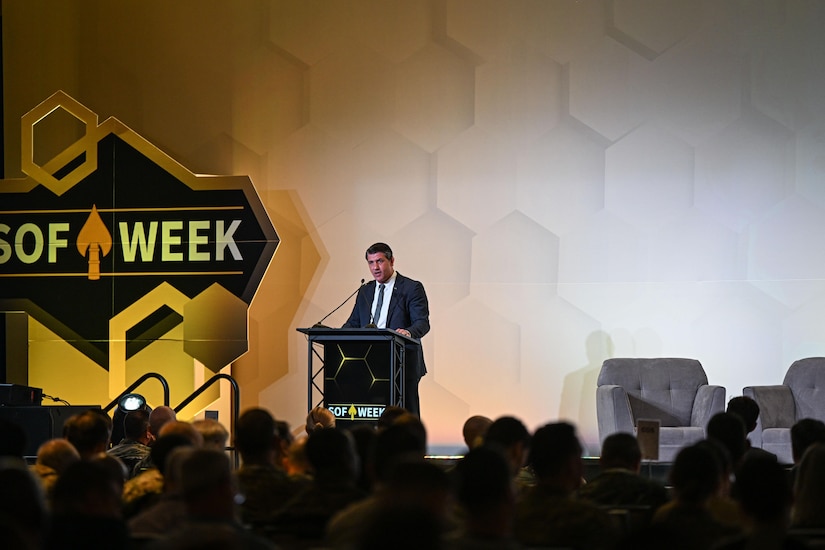
A man in business attire stands behind a lectern and speaks into a microphone. In front of him is a seated audience with their backs to the camera.

Anderson began his remarks by highlighting the sheer numbers of the event. With roughly 700 vendors, representatives from more than 70 countries and approximately 30,000 attendees, the four-day event was the largest to date. 

"This event is our community's biggest event of the year, but it's more than just a gathering. It provides a rare opportunity for the entire SOF community to come together in one place to share insights, evaluate technologies, align around emerging challenges, shape programs and connect special operators with solutions," he said. 

Noting that the U.S. military's SOF component comprises just 3% of the joint force and a single-digit percentage of the War Department's budget, Anderson highlighted the SOF community's recent successes in real-world, tactical engagements over the past few months. 

He noted that Operation Absolute Resolve, the successful Jan. 3 joint force mission to capture Venezuelan leader Nicolás Maduro, took place during Anderson's first week on the job. 

"Our operators executed one of — if not the — most complex jointly-integrated operations in U.S. history. Watching the coordination of the special operations forces and the triad of SOF, cyber and space in action should make us all very proud," he said. 

He next mentioned Operation Southern Spear, the ongoing U.S. military campaign launched in the Western Hemisphere that uses a heavy deployment of naval warships and autonomous robotic systems to combat drug cartels, disrupt illicit maritime trafficking and target designated narco-terrorist organizations. 

"Our country has demonstrated American strength in our hemisphere in line with the national defense strategy. These SOF-supported maritime interdiction operations have taken the fight to the narco-terrorists [by] deterring these malign actors and their illicit activities, and sending a clear, unambiguous message that America will do what's necessary to protect our citizens," Anderson told the audience. 

He also mentioned SOF's involvement in Operation Epic Fury, the ongoing military campaign against Iran. Specifically, Anderson referenced SOF's successful Easter weekend recovery of two downed airmen. 

"I got to witness the heroic rescue of the downed pilots in April. Faced with the no-fail mission deep within enemy territory, our people showed their greatness, executing with breathtaking skill, courage and precision and recovering the aircrew in just under 48 hours from when the mission began," Anderson said. 

Following his recap of recent SOF missions and some remarks about changes in the structure of the SOF enterprise, he then pivoted toward SOF's future. 
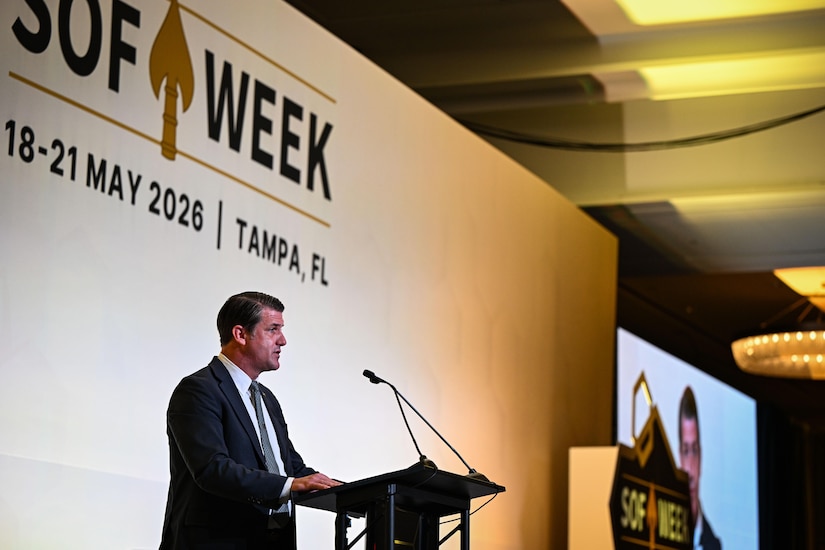
A man in business attire stands behind a lectern and speaks into a microphone. Behind him, a sign on the wall reads, "SOF Week, 18-21 May 2026, Tampa, FL."

"My vision for the SOF enterprise is simple: to create asymmetric advantages and multidomain effects to ensure the joint force wins decisively across the spectrum of conflict. These efforts are undertaken on behalf of the nation, support the priorities laid out in the National Defense Strategy and align with the president's vision of advancing peace through strength," Anderson said.  

To achieve that, he said his department will prioritize five areas, partnership: people, policies, pioneerings and prudence. 

Speaking about people, Anderson said that everything SOF does is built on a foundation of exceptional individuals selected for their merit, judgment, adaptability, resilience, and ability to solve complex problems.  

"The success of any mission hinges on the quality, training and the well-being of the people who make up our force. That means we must be committed to recruiting, training and retaining a total force of soft talent, and to match this with our actions," he said. 

Regarding policies, Anderson said the SOF enterprise needs to have the right policies in place to unleash the full potential of its people and their pioneering capabilities. At the same time, he wants to establish or strengthen policies that increase speed and lethality, and revise or remove policies that act as obstacles. 

"In a rapidly changing world, bureaucracy can be as much of a threat as our adversaries, and it's not always the big things that can impact our operators, enablers and their families the most — it's the small impediments and frustrations that add up," Anderson said. 

In terms of pioneering, he said that SOF has a reputation for capability development and innovation, and that operators need the right tools for the job, scalable at speed. 

"We can serve as the departmentwide leader in developing and validating the required advanced capabilities. In doing so more rapidly, we can demonstrate synchronization across the stove-piped bureaucratic functions that contribute to the traditional pitfalls associated with technology transformation," Anderson said. 

"If we do that, SOF will innovate at the speed of relevance and continue to pioneer the joint force," he added. 

As for partnerships, Anderson said that the SOF enterprise must continue strengthening relationships with international partners, as well as with joint interagency, intergovernmental, multinational and commercial partners. 

"By strengthening these partnerships, we amplify our effectiveness and create a unified front to address shared threats," he said. 

Anderson described the final of the five priorities, prudence, as the need for SOF to be wise stewards of its allocated resources. 

"One thing we cannot forget is that we are entrusted with the nation's resources and with that comes a profound responsibility," he said.   

Anderson wrapped up his remarks by thanking those who enable SOF to sustain its mission. 

"Thank you for the work that you do and the commitment to ensuring SOF remains resourced and ready ... to meet today's mission while transforming for tomorrow's challenges," he said.

Tuesday, May 19, 2026

Special Ops Convention Convenes Under 'Peace Through Strength' Strategy

 May 19, 2026 | By Matthew Olay, Pentagon News

More than 29,000 members of the military's special operations forces community and the public converged both in person and virtually on downtown Tampa, Florida, today for the official kickoff of Special Operations Forces Week 2026.  

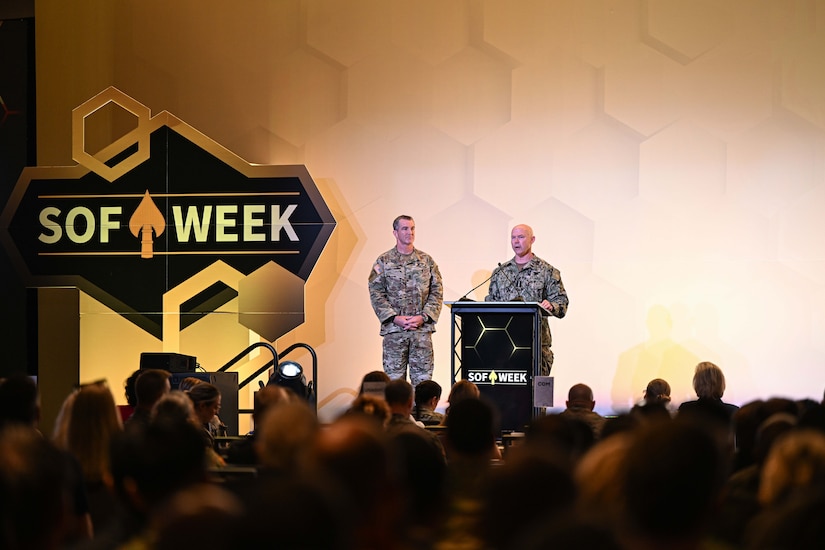
Two men wearing camouflage military uniforms stand indoors on a stage behind a lectern looking out at a large crowd. To the left of the men is a large sign that reads, "SOF Week."

Cohosted by U.S. Special Operations Command and the Global SOF Foundation, this year's convention is hosting representatives from more than 70 allied nations, a majority of whom gathered together for a morning opening address by senior Socom leadership who underscored the importance of maintaining peace through strength across a volatile geopolitical landscape.   

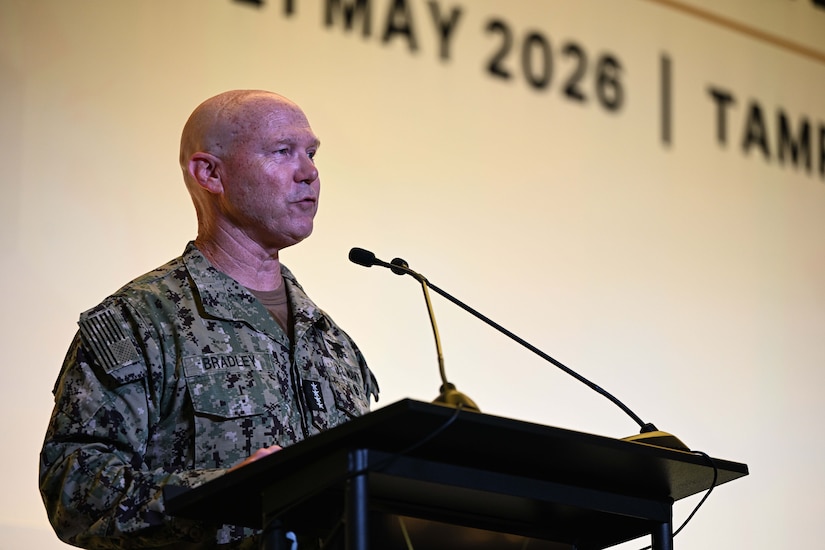
"Peace through strength is the way the United States thinks about deterrence. The strategy of deterrence that has guided us for generations remains ever true today," said Navy Adm. Frank M. Bradley, Socom commander, at the outset of the morning's address. 

"We must deter adversaries not simply by threatening punishment but, frankly, by making it obvious that their aggression will fail if they attempt to launch a war. By building partners' capabilities and integrated force structures that are so formidable and so resilient that no adversary can calculate a path to victory," Bradley explained. 

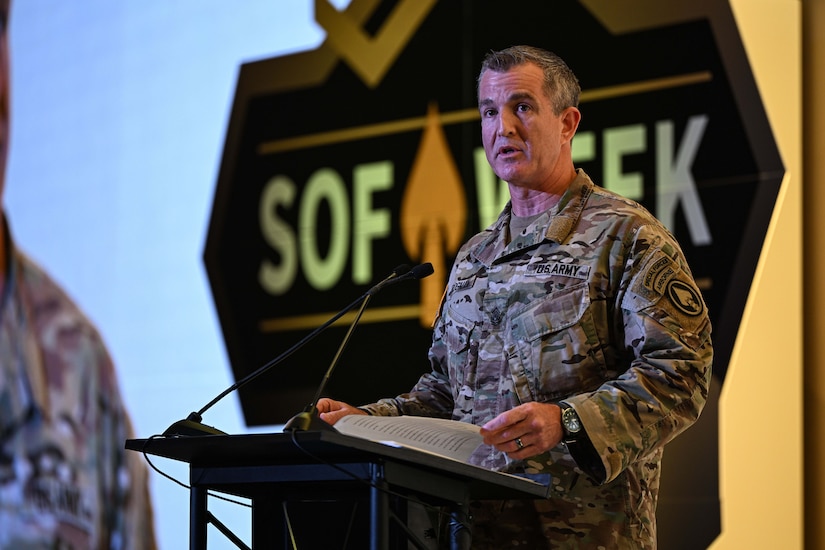
A man wearing a military camouflage uniform stands indoors behind a lectern speaking into a microphone.

Joined on stage by Army Command Sgt. Maj. Andrew J. Krogman, Socom senior enlisted leader, the two men framed the path to peace through strength via multiple priorities including multiplying capabilities through strong partnerships, scaling SOF across the joint force to achieve deep integration, remembering that people — and not materiel — are the "irreplaceable advantage" that fuels success within the community, maintaining a technological edge on the battlefield, and getting industry to continue developing and innovating at a rapid pace.  

Regarding partnerships, Bradley made clear that while the U.S. SOF community's alliances are strong — perhaps the strongest in the world — they are always in need of strengthening.  

As an example of successful partnerships, Bradley referenced the more than 90 nations that came together over the last decade to combat and defeat ISIS.  

"Those 90 sovereign governments, each with their own politics, their own histories, and their own equities, united around that single objective: the enduring defeat of [ISIS]. We didn't simply coordinate airstrikes and share intelligence, we built something durable, something that exists still today," Bradley said, adding that the power of partnerships and coalition are what the U.S. needs to leverage for the future. 

On the topic of scaling SOF across the joint force, Bradley said the crises and challenges the community faces today are different from those faced over the past 25 years since 9/11, and that the counterterrorism conflicts of today and tomorrow require more significant joint force synchronization.  

"SOF is not just on the periphery or leading its own operations separate from the joint force, but [it] is a core element of the main effort — a main effort that will be borne out by our joint force colleagues in the Army, the Navy, the Air Force, the Marine Corps, our cyber and our space forces," Bradley explained. 

He then gave the floor to Krogman, who spoke about the SOF community's most valuable asset: its people. 

A man wearing a military camouflage uniform stands indoors behind a lectern speaking into a microphone.

"What we have observed across the force is that our people are dedicated to being humble, credible and always striving to improve. They have been doing the work — the quiet, relentless, unglamorous … work — and they train not until they get the mission correct, but they train until they cannot get it wrong," Krogman said of the SOF operators he and other Socom senior leaders have interacted with since joining the command, while adding it's those operators and their families who are the most important weapon system.  

Along the lines of rapid technological advancements on the battlefield, Bradley explained that the operator of today needs to not only be a physically superior warrior but also an intellectually superior one.  

"This environment demands exactly what [American soldier and diplomat William J.] 'Wild Bill' Donovan said 80 years ago: 'We need Ph.D.s who can win a bar fight,'" Bradley told the audience, adding that he believes many of today's operators fit that bill. 

"Plenty of you out there [are] operators who are both lethal but are also technically fluent, who can employ cutting-edge tools and the software running [them] and understand how they interweave," Bradley said, adding that it is important to remain humble in such a rapidly evolving technological battlespace. 

The Socom commander then addressed members of industry, explaining that interoperability between SOF capabilities is essential. 

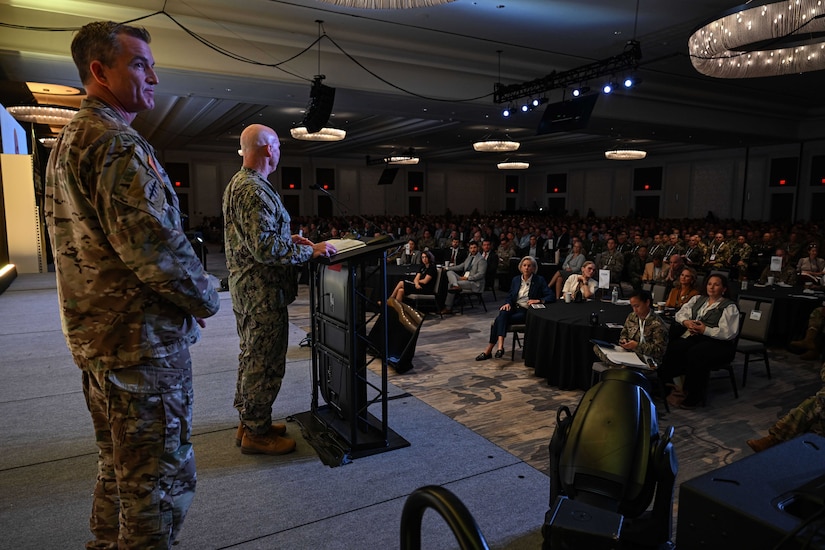
Two men in camouflage military uniforms stand indoors on a stage behind a lectern looking out at a large crowd.

"I want to be absolutely clear about the standard that we have to attend to going forward; every censor must be able to talk to every effector on every battlefield, and every effector must be able to draw from every censor, because capability that can't be shared is not capability at all," Bradley said.  

"We're not asking you to take a leap of faith; we're asking you to look at what you're already doing and find ways to amplify it and make it better, because the industry challenge is ultimately a deterrence challenge," he added. 

Bradley concluded by circling back to the theme of peace through strength. 

"Peace through strength is deterrence. That is the work that we do every day in partnerships that we build, the capabilities we field and standards that we refuse to compromise," he said. "As I reflect on the power of all of you in this in this room, in this network — here together this week — I am incredibly optimistic about our nation's future, about our alliances' future [and] the strength of what that can bring."