Showing posts with label u.s. marines. Show all posts

Wednesday, August 26, 2026

A Gate Between Hope and Hell: A Marine's Story

 Aug. 26, 2026 | By Marine Corps Cpl. Brynn Bouchard, Marine Barracks Washington

Before a blast of shrapnel to his leg and arm changed his life forever, Marine Corps Lance Cpl. Noah Smith spent more than 100 grueling hours holding the line against a desperate sea of humanity.
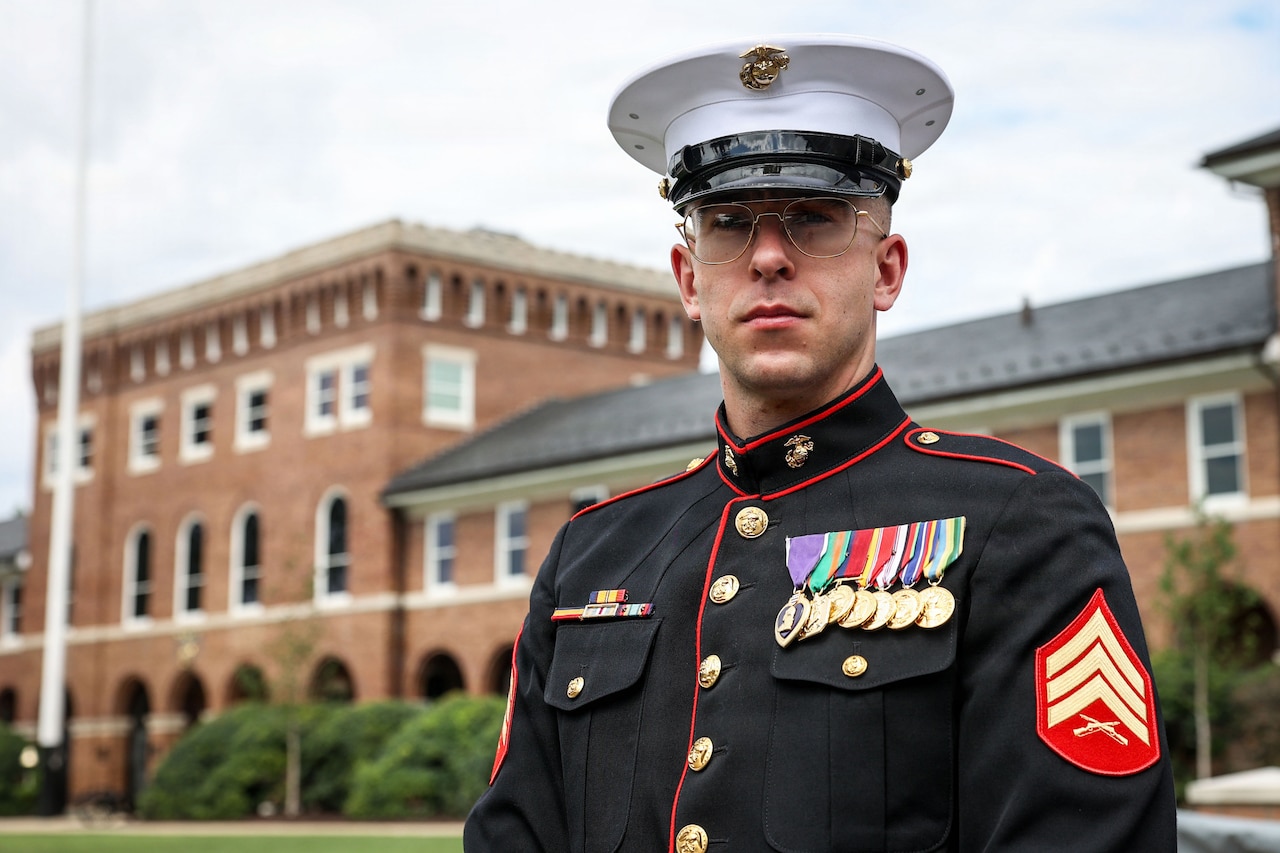
A portrait of a man in a formal military uniform outside in front of a large brick building.

His journey to the gates of Kabul, Afghanistan, began in August 2021, when he was deployed to Jordan with Golf Company, 2nd Battalion, 1st Marine Regiment. Their mission to guard a communications hub was quiet, isolated and normal; then, the world changed overnight. Word trickled down from their company commander, Marine Corps Capt. Geoff Ball, that the unit was moving to Kabul.  
 
Early the next morning, Smith was pulled for guard duty in the intelligence room. On the screens, he watched drone footage of Kabul's airport. Desperate Afghan civilians had massed by the thousands on the airfield. They were holding onto the landing gear of departing planes, desperate to escape the advancing Taliban. 
 
"It was the first tipoff," Smith recalled. "Like, OK, wow ... this is a really real thing that's happening."  
 
When the call came to leave, the massive C-17 Globemaster III aircraft was packed to its limits. Smith stood 6 feet, 5 inches tall and weighed nearly 270 pounds in full combat gear, which included heavy armor plates and loaded magazines. 
 
"My buddy right behind me was carrying the M240 machine gun; he was exhausted. I probably stood for four out of the six hours of that flight just to give the boys a little more space."  
 
When his legs finally gave out, it took five minutes shifting bodies just to sit down.  
 
"My buddy's 240 was between his legs, muzzled up past his shoulder and that weapon basically became my backrest," Smith said. 
 
The aircraft made a steep, fast landing to avoid antiaircraft threats, touching down in Kabul at roughly 1 a.m. Stepping off the ramp into total darkness, squad leaders gave the order to get weapons ready. They loaded their weapons and pulled back the bolts. 
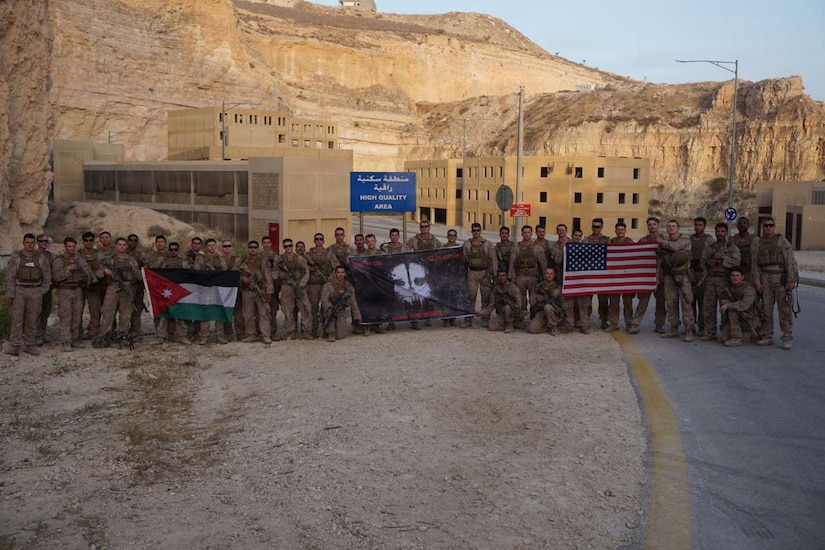
Nearly 50 people wearing camouflage military uniforms stand in a group outside in front of buildings, with mountains in the distance. They are holding an American flag, a Jordanian flag and a black flag with a skull.

 
As the ramp dropped, the squad leaders gave the order: condition one. Smith said an administrative or supply Marine was walking down the ramp alongside them, looking on with wide eyes. 
 
"He looked over and asked, 'Did you just go condition one?'" Smith looked back at him and said, "Dude, we're in Afghanistan, and based on what I watched on the drone footage 36 hours ago? Yeah, that's exactly what I did. As you just heard, the echoes around the ramp as everyone else ran their bolts." 
 
By sunrise, the Marines stripped their gear down to small backpacks for what they were told would be a 48-hour mission outside the airport's Abbey Gate — that time estimate turned out to be completely wrong. Outside the massive steel door, a crowd of desperate people waited. Smith said they threw the doors open into what felt like 50,000 to 100,000 people. When the Marines held the line, people were literally being crushed and suffocated to death by the sheer force of the crowd. 
 
Because of his size, Smith was pushed to the front of pure chaos. During a surge, a British soldier struggling with an Afghan man yelled for Smith to fire warning shots. Relying on his strict training, Smith refused. He told the soldier his orders were to shoot only to kill, and that Marines do not fire warning shots. Moments later, Marines threw tear gas. Canisters filled the concrete hallway with choking smoke, creating a needed gap between the troops and the civilians. 
 
"By Day 4 of wearing that flak with CS crystals digging into your shoulder ... it just starts to feel like your flak is growing into your traps," Smith said. "You're just one with it. Day 1, you're sore. Day 2, it hurts. Day 3, it doesn't really hurt anymore; it's just mush. Everything starts to blend. Your Kevlar helmet is your pillow at that point." 
 
That afternoon, Golf Company pushed forward into the outside road. They fought inch by inch for hours to claim about 500 meters of ground to set up a checkpoint. They held that line for 104 hours without relief. Smith remembers this period as "100 hours of hell," as their heavy helmets and body armor never came off.
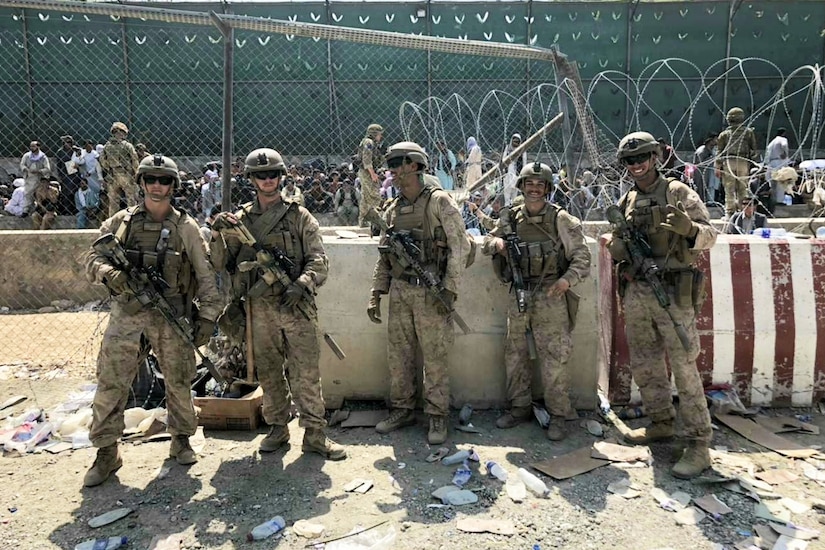
Five men wearing camouflage military uniforms and tactical gear stand outside in front of a concrete vehicle barrier posing for a photo. People in civilian attire are sitting in the background.

On Aug. 26, 2021, the crowd grew increasingly tense. Marine Corps Lance Cpl. Kareem Nikoui, one of Smith's close friends, likely weighing about 145 pounds, was stationed near the sniper tower. He was struggling against the heavy push of the crowd, so Smith offered to trade places with him. 
 
"F--- you, I got this," Nikoui said with a grin. 
 
Smith later said he believes that his friend is one of the few reasons he is alive today, noting that Nikoui likely caught a lot of the shrapnel that would have otherwise hit him. 
 
At roughly 5:38 p.m., Smith had stepped 8 feet away from the wall to help another Marine. Suddenly, his hearing dropped out entirely. It was replaced by total silence and a wall of thick, black smoke. Thinking a stun grenade had gone off, Smith's infantry training took over. He did a quick check for blood. His right side was clean, but when he grabbed his left pant leg, the desert fabric turned bright red. 
 
"I went, 'Ah. So that wasn't a flashbang. That was a bomb,'" Smith said. 
 
He dropped into a clear patch of dirt and ripped an emergency tourniquet from his ankle pocket. Through the clearing smoke, Marine Corps Lance Cpl. Brock Bemis sprinted over carrying a medical kit. Bemis began standard combat medical care, frantically trying to keep his patient awake. Smith replied flatly, "I know. We trained for this." They found a second wound on Smith's left arm, which required another tourniquet. As Bemis knelt over him to finish the treatment, a sharp crack pierced through the air. Dirt exploded exactly where Bemis' head had just been. Official military records would later claim no enemy rounds were fired right after the blast, but Bemis did not hesitate. He yanked the 270-pound Smith to his feet, and the two began a messy hobble toward the gate's interior. 
 
Just as they cleared the fence line, disaster struck again. The emergency tourniquet Smith had carried in his trousers, and practiced using for three months, gave way. Tourniquets are strictly single-use items; the fine desert silt of Kabul had entirely fouled the Velcro, causing the strap to snap loose. Smith felt the sudden rush of heat and fluid down his thigh.  
 
"Hey, Bemis, the tourniquet came off! I need another!" he yelled. 
 
They kept hobbling frantically, shouting for help. Just inside the threshold of Abbey Gate stood Smith's first sergeant, flanked by a shell-shocked support Marine who looked entirely out of his depth.  
 
"Hey, you, dude! Tourniquet right now!" Smith roared. 
 
The Marine blinked, dazed. "Yeah, yeah ..." 
 
"No, like, I need it right now!" Smith bellowed, his patience entirely evaporated. "My tourniquet fell off. Give me yours!" 
 
The realization finally broke through the Marine's shock. He dropped to one knee, fumbling with his gear to apply a fresh strap while Bemis held Smith upright against his shoulder. The Marine's hands were shaking violently. 
 
"The guy just couldn't do a tourniquet to save his life," Smith recalled. Eventually, with the help of a passerby, the second leg strap was secured. 
 
Smith was dragged to a medical point, stripped of his armor and injected with pain medicine. A hospital corpsman leaned over him and asked, "Hey buddy, how you doing?" 
 
"I've been better," Smith grunted. 
 
"You want a little painkiller?" 
 
Smith looked at the chaos around them. "You got something to spare? If you don't, you don't." 
 
"Oh no, we're good," the corpsman replied, promptly administering a heavy dose of what was likely ketamine.
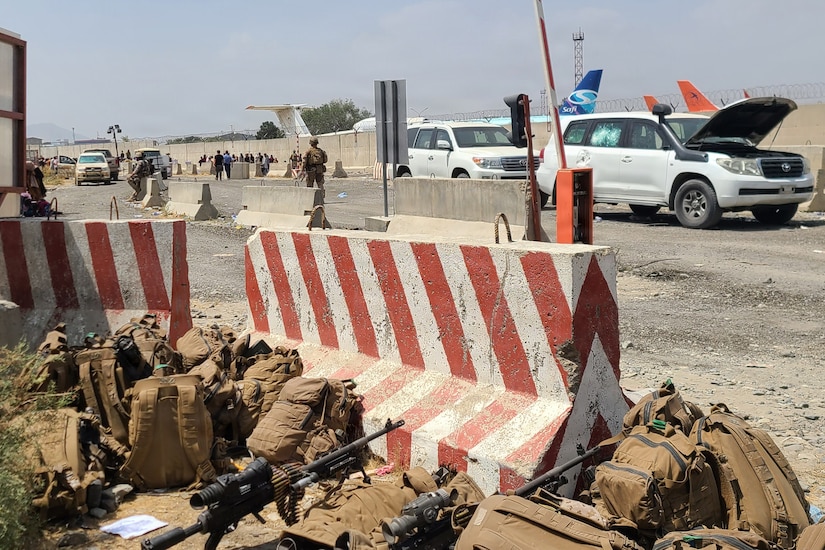
Backpacks and weapons sit on the ground near a vehicle barrier on the side of a street. Cars and people are in the background.

For what felt like an eternity, Smith lay on the gravel as the medication took effect, watching the sky turn into a slow blur. At the same time, commanders coordinated transportation to get vehicles through the debris fields of the gate. Eventually, a female officer began aggressively directing traffic through the checkpoint. A white utility truck decorated with orange stripes backed up to the casualty collection point, its tailgate dropping 5 feet from where Smith lay. 
 
Lifting a 270-pound Marine in full combat gear is a monumental task. Three Marines grabbed him — one under each arm and one gripping the drag handle on the back of his gear — and hauled him upright. They forced him into a half-squat, attempting to bend his left leg, which was severely damaged by shrapnel and locked rigid by a tourniquet. 
 
From the periphery of the gate, Marine Corps Lance Cpl. Eric Pearce, who hadn't been on the wall during the blast, spotted the commotion. Through the dust, he heard Smith's booming voice cut through the air, screaming defiantly: "Let's f------ go!" 
 
During the frantic drive to the field hospital, a Marine by the name of Nick Grey kept Smith from passing out by talking about hunting in Wisconsin. 
 
Smith fought off a blinding feeling that his body was shutting down. He stayed awake until the truck screeched to a halt outside the building. 
 
Inside the hospital, Smith's barefoot lieutenant and sergeant snuck out to the company staging area 400 meters away. They went to get the wounded Marines' personal cellphones. Using an international data plan, Smith called his mother back in the U.S. 
 
"Hey, Mom. It's Noah," Smith said, trying to keep his voice steady. "I just want to let you know that, um, there was an explosion here at the airport. I got hit with some shrapnel. I'm relatively fine. They're going to be medevacing us to Germany ... and um, I am being charged every minute that I'm on the phone with you, so I don't want to just sit here."
A tiny piece of exploded metal shrapnel sits on a military notebook.
The call lasted exactly eight minutes. In retrospect, it was an incredibly short window to talk to a mother who thought her son was dead, and Smith's practical, financial worry about international cell rates would become a point of family ribbing later. After he finally made it home, his mother would lightheartedly scold him: "I was very upset that you said that last line about being charged by the minute! I'll pay your damn phone bill, just talk to me!" 
 
Back in the hospital room, Smith repeatedly asked the medical staff about his fire team. Finally, his team leader, a wounded Marine Corps Cpl. Christian Sanchez, delivered the fatal news that Nikoui did not make it out of the gate.  
 
By 1:45 a.m. on Aug. 27, 2021, injured troops were loaded into a medical C-17 aircraft bound for Ramstein Air Base in Germany. Midflight, Smith needed to use the latrine. The medical staff moved to prepare a standard hospital collection tube, but Smith's stubborn, belligerent infantry pride flared up, and he said, "If I can walk, I'm walking to the bathroom." 
 
The aircraft latrine was located at the extreme forward bulkhead of the C-17, roughly 50 feet through the crowded rows of litters. Smith dragged himself out of his rack. 
 
Physically, he could bear weight on the left leg. He could stand straight up without the bone collapsing, and he could step forward with his right leg perfectly. The conundrum came when he tried to swing his left leg forward to take a stride. The shrapnel damage to the anterior muscles meant he lacked the basic neurological functionality to pull the limb forward. 
 
To adapt, Smith had to reach down with his left hand, shove his palm firmly behind his knee, and physically hoist and curl his leg forward with his arm; every single pace was a detailed, mechanical "curly step." By the time he covered 50 feet to the front of the cabin and dragged himself back to his litter, he was completely exhausted, his chest heaving as if he had just completed a full 26-mile marathon. It was, without question, the longest 50 feet of his life. 
 
After three days of care, the wounded Marines were flown across the Atlantic to Walter Reed National Military Medical Center in Maryland. During his two weeks there, the 38th Commandant of the Marine Corps, Gen. David H. Berger, and the 19th Sergeant Major of the Marine Corps, Sgt. Maj. Troy E. Black, visited the hospital to present Smith with the Purple Heart. Even with his severe injuries and no ability to move his left leg, Smith dragged himself out of bed. He stood at strict attention for the ceremony. 
 
Shortly after his older brother spent a four-day weekend hanging out by his bedside, Smith's mother, stepfather and middle brother arrived at Walter Reed. By the second week, Smith began regaining a crude command over his lower limbs, managing to hobble around the ward with a severe, heavy limp. 
 
It was during this window that hospital staff entered the ward with a sudden announcement: "Hey, POTUS is coming through in like five minutes. Stand by." 
 
President Joe Biden visited the wounded. Smith recorded a brief, polite conversation with the president on his cellphone before receiving a presidential challenge coin.


Today, Smith remains a living example of a timeline that shattered in the dust of Kabul. He is a Marine who stared down death, refused to give up and lived to tell the story. Smith is just one of the many Marines' stories from that day. However, his survival is forever tied to the ultimate sacrifice made by 13 U.S. service members who did not come home.  
 
The nation remembers the 11 Marines lost that day: Staff Sgt. Darin T. Hoover, Sgt. Johanny Rosario Pichardo, Sgt. Nicole L. Gee, Cpl. Hunter Lopez, Cpl. Daegan W. Page, Cpl. Humberto A. Sanchez, Lance Cpl. David L. Espinoza, Lance Cpl. Jared M. Schmitz, Lance Cpl. Rylee J. McCollum, Lance Cpl. Dylan R. Merola and Lance Cpl. Kareem M. Nikoui, alongside Navy Corpsman Maxton W. Soviak and Army Staff Sgt. Ryan C. Knauss. They held the line so others could live and their names will never be forgotten.

Thursday, September 09, 2010

Maritime Raid Force Recaptures Ship From Pirates

From U.S. Naval Forces Central Command Public Affairs

MANAMA, Bahrain (NNS) -- At approximately 5 a.m. local time, Sept. 9, 24 U.S. Marines from the 15th Marine Expeditionary Unit's Maritime Raid Force (MRF) aboard USS Dubuque (LPD 8) operating under Combined Task Force 151 (CTF-151), boarded and seized control of Antigua-Barbuda-flagged, German–owned vessel M/V Magellan Star from pirates who attacked and boarded the vessel early Sept 8.

This successful mission by Combined Maritime Forces (CMF) secured the safety of the ship's crew and returned control of the ship to the civilian mariners. Nine pirates are currently under control of CTF 151, pending further disposition. This ship's crew has not reported any injuries or casualties. There were no reported injuries from the U.S. Maritime Raid Force.

The CTF-151 flagship, TCG Gökçeada, a Turkish frigate, was the first ship on scene, responding to a distress call received from Magellan Star, Sept. 8. Two additional warships assigned to CTF-151, USS Dubuque (LPD 8) and USS Princeton (CG 59) arrived in the vicinity of the attack to provide support to Gökçeada.

Turkish Navy Rear Adm. Sinan Ertugrul, commander, CTF-151 said, "units from the multi-national maritime force, under Combined Task Force 151, are actively engaged in anti-piracy operations. This regional problem, truly, has global impact and we are completely committed to bringing the disruptive acts of piracy to an end. We have full support of the international community and will continue to do everything possible to bring security to the Gulf of Aden and Somali Basin."

CTF-151 is one of three task forces operated by the 25 nation Combined Maritime Forces (CMF). CTF-151 was established in January 2009 in order to deter, disrupt, and suppress piracy, protecting maritime vessels of all nationalities and securing international freedom of navigation.

Additional information will be provided as it becomes available.

Tuesday, January 08, 2008

Police Assume Security Mission in Anbar Province City

By Cpl. Adam Johnston, USMC
Special to American Forces Press Service

Jan. 7, 2008 - How many
Marines does it take to secure Baghdadi? Last year, it took an entire company. Then, as the situation improved, that number dropped to a platoon. And now, with the onset of 2008, the grand total is zero. The Marines of 2nd Platoon, Company A, 1st Battalion, 7th Marine Regiment, Regimental Combat Team 2, have completely pulled out of Command Outpost Baghdadi. Fortunately for local citizens, their replacements already are hard at work.

In a monumental step toward Iraqi sovereignty, the Baghdadi
police force has taken sole responsibility of security within the city limits -- the first to do so in all of Anbar Province.

"In the past, battalions were measured on how many battle positions they established during a deployment," said
Marine Lt. Col. J.J. Dill, commanding officer of 1st Battalion, 7th Marines. "It showed they were moving out into the community, partnering with (Iraqi security forces) to make things happen. But in this stage of the counterinsurgency battle, it's not how many we put up, it's how many we take down."

The transfer of authority comes as a direct result of the Baghdadi
police force's validation, which is determined by U.S. and coalition forces.

"It's a checklist of where they're at," explained
Marine Capt. Craig T. Douglas, commander of Company A, 1st Battalion, 7th Marines. "Can they run their own investigations, conduct security patrols? Are they self-sufficient?"

With their own battle space, the Baghdadi
police face their toughest challenge yet. Douglas said they're ready for the mission. "They want the bad guys out of here just as much as we do," he said. "With logistical support from the government of Iraq, they should be OK."

If the Baghdadi
police officers need emergency assistance, the Marines won't be far behind.

"We'll still be in an overwatch capacity," Douglas said. "But they know that, one day, we'll be gone. They'll need to be able to do things for themselves."

When the new
police station is complete, it also will host city council meetings and other government functions.

"Many people back home think the 'Anbar Awakening' happened overnight," Dill said. "But where we're at today is the culmination of four years' worth of hard work and dedication by Marines and Iraqis, alike. I want this city to stop looking like it's under siege. This is a huge step toward the return to normalcy."

(
U.S. Marine Cpl. Adam Johnston is a combat correspondent serving with Regimental Combat Team 2.)

Iraqi Soldiers Train With U.S. Marines

By Cpl. Billy Hall, USMC
Special to American Forces Press Service

Jan. 7, 2008 - Iraqi soldiers are learning to fight and win on the battlefield thanks to the efforts of
U.S. Marines here. Soldiers from 1st Battalion, 3rd Brigade, 7th Iraqi Army Division, not only are engaged in a constant training cycle with Marines at Combat Outpost North here, but also are excelling at it.

In the brisk winter breeze,
Military Transition Team members partnered with Marines from Weapons Company, Task Force 3rd Battalion, 2nd Marine Regiment, Regimental Combat Team 2, integrated key Iraqi soldiers into their execution of several reactionary drills.

The Iraqi soldiers observed and then participated in immediate-action and break-contact drills with the Marines so they could, in turn, teach their junior soldiers the same
tactics and procedures.

"It's very important to integrate our training," said
Marine Staff Sgt. Charles D. Cox, a section leader for Weapons Company. "If we don't integrate, and it comes time for us to do a joint operation, not everyone will be on the same sheet of music. Should something happen, everyone needs to know how to react."

Training side by side while stationed together at Combat Outpost North, the Marines and Iraqi soldiers interact daily.

"The closer we live, the faster they learn and the better they pick up on our techniques," said
Marine Cpl. Aaron Missey, a squad leader with Weapons Company. "It's only a matter of time until we can all go home, and they can be secure in the fact that they have enough knowledge to stand on their own against oppressive forces."

The Iraqi soldiers at Combat Outpost North have gained the respect and admiration of their Marine comrades and continue to excel at their training.

"These guys we had out here did exceptionally well," Cox said. "They were hand-picked by their company as some of their best shooters and top (noncommissioned officers). Now it's on them to go back to show the rest of their men and teach them how to use these procedures."

The Marines consistently observe the progress and proficiency of the Iraqi soldiers, confirming the effectiveness of the training they undergo.

"The following days after an (enhanced marksmanship program), we could tell that they continued to practice while we were away," Missey noted. "We're not just firing off blank rounds. The things that we're teaching them in training, they're actually incorporating into their
military tactics."

After a hard day's training, the Iraqi soldiers were pleased with the new techniques and tactics they learned from the MTT.

"The training was very good, very useful," one of the soldiers said. "We're 100 percent happy."

(
Marine Cpl. Billy Hall is a combat correspondent serving with 1st Battalion, 7th Marine Regiment, Regimental Combat Team 2.)

Wednesday, September 05, 2007

Meetings in Iraq Give Gates Cause for Optimism

By Jim Garamone
American Forces Press Service

Sept. 5, 2007 - After attending meetings Sept. 3 in Iraq, Defense Secretary Robert M. Gates is more optimistic about the situation in the country, a Pentagon spokesman said today. Geoff Morrell said Gates left meetings with
U.S. military and civilian leaders and Iraqi leaders convinced progress is being made. President Bush and Secretary of State Condoleezza Rice also attended the meetings at Al Asad Air Base in Iraq's Anbar province.

The meetings gave the president a chance to consult with Army Gen. David H. Petraeus, Multinational Force Iraq commander, and U.S. Ambassador to Iraq Ryan C. Crocker. Gates "believes it is essential for the president to speak directly to his senior military
leaders before making a decision on the way forward in Iraq," Morrell said.

Morrell said one highlight of the trip was a meeting with local tribal
leaders and sheikhs who have been instrumental in turning the tables on al Qaeda in Anbar. "Less than a year ago, al Qaeda was touting Anbar as the capital of its future caliphate," Morrell said. "However, a few courageous tribal leaders stood up, rejected al Qaeda's dark and medieval vision for their future and joined with U.S. Marines to defeat the terrorists in Anbar. Anbaris were the first in the Middle East to live under al Qaeda rule, and if our progress in Iraq continues, they will hopefully be the last."

The progress in Anbar is being driven from the bottom up, Morrell said, and it needs to be joined by progress from the top down. "Monday's meeting of leaders from the central government and the tribes is another step in the right direction," he said.

Morrell said there has been a clear reduction in sectarian violence in Iraq. "Sectarian killings have dropped to about half the level they were in December of 2006, when, as you remember, tensions between Sunni and Shiia groups was particularly high," he said.

This does not mean that sectarianism is not a problem. Iraqi police units are rife with sectarian blocs. "The Iraqi government has acknowledged, and our commanders in Iraq have also, that clearly there are problems that persist within the police force when it comes to sectarianism," Morell said. "We have been working very hard to try to rid the national police force and the local police force ... of sectarianism."

Defense
leaders understand that building an Iraqi police force and an army are long-term projects, the spokesman said. The Iraqi police are a work in progress, he said. "Has this happened at the pace we would like? Ideally, this would all happen much faster, whether it be standing up the Iraqi army or ridding the national police of sectarianism," Morrell said.

"Obviously we would like this stuff to happen sooner than it has, but we do not believe either project or process should be abandoned because it hasn't happened at the pace which we would like," he continued. "We believe there is enough progress taking place on both fronts that this is an endeavor worth pursuing, and we believe we will get to the point we need to get so that the Iraqis rely far less on us for their protection and more on their own people."

Monday, September 03, 2007

Bush: With Continued Success, Fewer Troops Will Be Needed

By Fred W. Baker III
American Forces Press Service

Sept. 3, 2007 - President Bush said here today that if reported successes continue in Iraq it will eventually be possible to maintain the same level of security with fewer troops. Flanked by Defense Secretary Robert M. Gates and Secretary of State Condoleezza Rice, the president spoke to reporters for a few minutes following meetings with top
military and political leaders in the country. He stopped short of stating when troop sizes could be drawn down in the region.

"General (David H.) Petraeus and Ambassador (Ryan C.) Crocker tell me if the kind of success we are now seeing continues, it will be possible to maintain the same level of security with fewer Americans," the president said.

In a surprise visit here, President Bush assembled his "war council" at this remote air base in what was most likely the group's last meeting before the president makes his decision on next steps for U.S. involvement in the war.

Gates,
Marine Gen. Peter Pace, chairman of the Joint Chiefs of Staff, Navy Adm. William Fallon, commander of U.S. Central Command, Petraeus, commander of Multinational Force Iraq, Rice, and Crocker all met with top Iraqi political leaders as well as Anbar provincial tribal leaders.

Bush said he was encouraged by the update he received today from Petraeus and Crocker and touted recent progress especially in the Anbar province.

"I was pleased with what I heard," the president said. "The strategy we put in place earlier this year was designed to help the Iraqis improve their security so that political and economic progress could follow. And that is exactly the effect it is having in places like Anbar.

Bush said continuing this progress is vital to meeting the strategic interests of our nation.

"We can't take this progress for granted. Here in Anbar and across Iraq, al Qaeda and other enemies of freedom will continue to try to kill the innocent in order to impose their dark ideology," Bush said.

Bush later met with tribal leaders from Anbar province, sending a message of support for the successes in the region that have brought heralded by top
leaders as key to a secure, stable Iraq.

"I am going to reassure them that America does not abandon our friends. And America will not abandon the Iraqi people. That's the message all three of us bring," Bush said.

Bush said he was told last summer that the region was lost and could be recovered. But that the locals rejected the ideals of the al Qaeda extremists and eventually sided with coalition forces to drive out the insurgents.

"They rejected the dark vision of al Qaeda. They didn't like the idea of murderers deciding their fate," the president said. "They organized themselves. They took on the terrorists and they asked for our help."

In response to what officials are calling a tribal "awakening,"
military officials sent 4,000 more U.S. Marines to help reinforce the areas cleared of al Qaeda and secure the gains the tribes were worried about holding.

"Together with the brave Iraqis we have gone into al Qaeda strongholds and have driven them out," Bush said.

As a result, the level of violence is down,
police are more in control and normal life is returning, Bush said.

"The people of this province are seeing that standing up to the extremists is the path to a better life. That success is possible," Bush said.

Bush said that the Anbar province represents the future of Iraq.

Tuesday, August 28, 2007

Iraq Operations Net 36 Terrorists, Kill Nine

American Forces Press Service

Aug. 27, 2007 - Coalition troops detained 36 terrorists and killed nine others today during a series of raids in Baghdad and other areas in central and northern Iraq, officials reported. Individuals detained in the Baghdad raid are believed to be involved in the transport of weapons and explosively formed penetrators from Iran to Iraq, as well as bringing militants from Iraq into Iran for terrorist training. Coalition forces also confiscated a number of documents, photographs and possible improvised explosive device components. Intelligence reports indicate one of the detainees is a "special groups" senior-level terrorist facilitator with possible Iranian connections.

"The special groups network constitutes a significant threat to security and stability in Sadr City and other areas around Baghdad," said
Army Lt. Col. Christopher Garver, a Multinational Force Iraq spokesman. "We will continue to dismantle and degrade the special groups terrorist network, eliminating their ability to attack innocent Iraqis as well as Iraqi security forces and coalition forces."

Coalition forces killed eight
terrorists and detained 16 others during additional raids in and around Baghdad aimed at key leaders in the al Qaeda in Iraq network operating in central and northern Iraq.

In other Iraq operations today:

-- Coalition troops killed a leader of an al Qaeda in Iraq cell in the Arab Jabour area and one of his associates during an operation north of Salman Pak.

-- Coalition troops captured an alleged
terrorist senior leader today during a raid south of Kirkuk. The suspect is believed to have close ties al Qaeda in Iraq and is believed to facilitate the movement of foreign terrorists into the country. Six additional suspected terrorists were detained during the raid.

-- Coalition units operating near Baajah and Muqdadiyah detained five suspected terrorists for alleged involvement with senior leaders of al Qaeda in Iraq. Coalition troops also found munitions and machine guns, which were destroyed.

In yesterday's operations:

-- U.S. soldiers with Task Force Marne raided an enemy safe house in Suwayrah and captured two suspected insurgents. The raid, dubbed Falcon Fury II, is a component of Operation Marne Husky. Suwayrah is a known enemy safe haven about 25 miles southeast of Baghdad. The troopers' main goal was to disrupt enemy activity in Suwayrah and prevent assaults on civilians and coalition forces in the area, U.S. officials said.

-- Coalition forces killed 11 terrorists and detained six others during a series of operations targeting al Qaeda in Iraq leaders and their networks in central and northern Iraq.

-- Iraqi troops and U.S. Special Forces soldiers detained a terror cell-network leader linked to the former regime of Saddam Hussein during an operation in Tikrit.

-- Iraqi commandos detained a suspected al Qaeda administrative leader and planner for attacks using car bombs in Baghdad.

-- In southern Baghdad yesterday, coalition helicopter crews killed four insurgents who were placing a roadside bomb. At least one other insurgent was wounded.

Earlier in the weekend, Iraqi forces,
U.S. Marines and U.S. Special Forces soldiers detained eight suspected terrorists and killed three during a series of raids Aug. 25. Iraqi and coalition troops also destroyed an al Qaeda-manned fighting position and a safe house near Jurf as Sakhr on Aug. 25 as part of Operation Gecko. OH-58D Kiowa Warrior helicopters engaged the location with one missile, rendering the position useless to the enemy, officials said. Five terrorists found hiding in a nearby building were killed by a 1,000-pound bomb.

(Compiled from Multinational Force Iraq and Multinational Corps Iraq news releases.)

Sunday, April 29, 2007

Forces Capture 21 Suspected Al Qaeda in Iraq Members

American Forces Press Service

April 29, 2007 – U.S. troops captured 21 suspected
terrorists April 28 in Iraq during a series of raids across the country that targeted al Qaeda in Iraq, military officials said. "We're achieving a deliberate, systematic disruption in the al Qaeda in Iraq network," said Lt. Col. Christopher Garver, Multinational Force Iraq spokesman, said.

The captures "will slow al Qaeda's ability to target and harm the people of Iraq," Garver said.

Coalition forces netted six suspects during an operation conducted northwest of Karmah, Iraq. The detainees reportedly are linked to murders, kidnappings, attacks on coalition forces and the manufacture of improvised explosive devices, officials said.

Another two suspects were nabbed southeast of al Asad, including one person suspected of being an intelligence officer for al Qaeda in Iraq, officials said.

Two more captured suspected terrorists have alleged al Qaeda ties, officials noted, and are linked to the recent bombing of the Sarafiyah Bridge in Baghdad.

Another four suspected
terrorists were detained in Mosul by coalition troops. Those detainees are accused of distributing weapons to al Qaeda in Iraq agents and of operating terror network that employed vehicle-borne IEDs, officials said.

Three other suspected
terrorists were captured during a raid east of Balad, Iraq, and coalition forces captured four more suspected terrorists during a raid in Baghdad's Sadr-City section April 28, officials said.

The recent captures illustrate the coalition's determination to put added pressure on al Qaeda operatives in Iraq and elsewhere, officials said.

Pentagon officials announced April 27 that senior al Qaeda leader Abdul Hadi al-Iraqi had been captured last fall and is now being held at the detention facility at Guantanamo Bay, Cuba.

In other Iraq news, coalition aircraft destroyed a truck laden with explosives April 27 during nighttime strike just east of Karmah, Iraq, officials said.

The truck had been stopped and searched by
U.S. Marines at a checkpoint, who'd discovered the vehicle was loaded with explosives. Marine fighter jets used precision-guided munitions to destroy the truck.

Also, U.S. and Iraqi soldiers found a weapons cache during a patrol west of al Iskandariyah, Iraq, on April 27. The cache contained mortar equipment, a machine gun, a rifle, 75 hand grenades and other items.

In a separate operation, Iraqi and U.S. soldiers found a large weapons cache in Baghdad's Ghazaliya district April 26.

The cache yielded 127 mortar tubes, 15 hand grenades, 13 rifles, three anti-tank mines, more than 200 pounds of dynamite, small-arms ammunition, 150 fuses, and other items, officials said.

The Iraqi soldiers also detained seven suspected
terrorists during the raid.

(Information compiled from Multinational Force Iraq and Multinational Corps Iraq news releases.)

Article sponsored by
Criminal Justice online leadership as well as police and military personnel who have authored books.

Saturday, January 27, 2007

Nine Insurgents Killed in Iraq, 21 Detained; Weapons Caches Discovered

American Forces Press Service

, Jan. 26, 2007 – Coalition forces killed nine insurgents and detained 21 more this week in operations across Iraq.
U.S Army soldiers observed six insurgents unloading AK 47 assault rifles into a building Jan. 23 near a gas station in central Ramadi. Soldiers attacked the insurgents with grenades and gunfire, killing three and wounding the three others. Later that morning, soldiers from an adjacent coalition post in Ramadi observed insurgents distributing hand grenades at the same building. Coalition forces killed six more insurgents who attacked the coalition outpost.

Elsewhere that day, Iraqi
police, with U.S. Marines and soldiers from Regimental Combat Team 6 and 1st Marine Expeditionary Force, completed Operation Three Swords in Fallujah. During the operation, combined forces detained 21 suspects responsible for coordinating attacks against Iraqi security forces and coalition forces, military officials said.

In addition, combined forces rescued and treated three hostages inside a "torture house" and found a weapons caches containing two 14.5 mm anti-aircraft guns, high explosive mortar sights, rocket-propelled-grenade materials, a sniper rifle with a scope, and four assault rifles.

"This operation was successful in the fact that coalition forces were able to free three hostages and seize weapons used for murder and intimidation away from insurgents,"
Army Capt. Chip R. Rankin, commander of Company B, 2nd Battalion, 136th Infantry Regiment, said. "The Iraqi police led this mission with confidence, and it demonstrated their desire to provide a more secure mindset for the civilians within these areas."

Nearby, in Fuhaylat, Iraqi
police and coalition advisors detained six suspected insurgent cell members. The insurgent cell is responsible for carrying out improvised-explosive-device attacks against Iraqi and coalition forces, and it is linked to al Qaeda in Iraq, military officials said.

In Baghdad this week:

U.S. Army soldiers from 1st Battalion, 18th Infantry Regiment, 2nd Brigade Combat Team, 1st Infantry Division discovered three large caches Jan. 24 in the Jihad neighborhood. The caches contained seven rocket-propelled-grenade launchers, two mortar tubes, more than 80 mortar rounds, two 30 mm rockets, two heavy machine guns, two roadside bombs, one block of plastic explosive, and nearly 2000 rounds of small arms ammunition.

Insurgents detonated a car bomb Jan. 24 near an Iraqi
police patrol in western Baghdad, killing four Iraqi policemen and one civilian bystander.

Insurgents detonated a motorcycle-borne IED yesterday in central Baghdad's Shoula market, injuring 13 Iraqi civilians and damaging two vehicles

Article sponsored by
Criminal Justice Leadership online; and, police and military personnel who have written books.