Showing posts with label georgia. Show all posts

Thursday, August 23, 2012

North Georgia Men Who Plotted to Purchase Explosives and Silencers Sentenced to Prison


GAINESVILLE, GA—Frederick Thomas, 73, of Cleveland, Georgia; and Dan Roberts, 68, of Toccoa, Georgia, were sentenced today by United States District Judge Richard W. Story to federal prison on charges of conspiring to obtain an unregistered explosive device and silencer.

United States Attorney Sally Quillian Yates said, “These defendants didn’t just talk about killing government officials and law enforcement officers, they purchased equipment, including a silencer and what they thought were explosive devices, to carry out their plans. Now they will spend five years in prison.”

Brian D. Lamkin, Special Agent in Charge, FBI Atlanta Field Office, stated, “The FBI’s number one priority is to prevent another terrorist attack, irrespective of whether that attack or plot to attack originates from an international group or a domestic one. The FBI’s Joint Terrorism Task Force (JTTF) here in Atlanta, along with its many and varied agency partners, after gathering actionable intelligence regarding this domestic based threat, launched a comprehensive criminal investigation to dismantle and disrupt this threat before an attack could occur and did so while remaining within the rule of law.”

Thomas was sentenced to five years in prison, to be followed by three years of supervised release. Thomas was convicted of these charges on April 10, 2012, upon his plea of guilty.

Roberts was sentenced to five years in prison, to be followed by three years of supervised release. Roberts was convicted of these charges on April 10, 2012, upon his plea of guilty.

According to United States Attorney Yates, the charges, and other information presented in court: defendants Thomas and Roberts were members of a known militia organization who sought to form what they referred to as a “covert group” that would plan and execute armed attacks on government buildings and federal employees including law enforcement agents. The firearms the defendants sought to obtain were to be used in those attacks.

In March and April 2011, the defendants met with each other and others to discuss the formation of the self-described “covert group,” its purposes, and their need to acquire weapons, ammunition, food, and survival gear.

Defendant Thomas discussed overt and covert operations for the group, stating that he had compiled what he called a “Bucket List,” which is a list of government employees, politicians, corporate leaders, and members of the media that needed to be “taken out” to “make the country right again.” Defendant Thomas further described the need for the group to acquire more weapons, ammunition, food, and survival gear and the need to establish a silent means of performing assassinations. To this end, defendant Thomas suggested silencers for handguns, stating, “In order to do what we want to do, take out the right people, we have to have some silent means of doing it. That means suppressors on handguns.” Defendant Thomas talked about his “Bucket List” of people he thought should be killed. Defendant Thomas further said that he thought they could “fight off a SWAT team” and that “I’ve been to war, and I’ve taken life before, and I can do it again.”

Defendant Thomas also made the following statements during the meetings:

■“The right people have to be taken down and taken down soon.”
■“There is no way for us, as militiamen, to save this country, to save Georgia, without doing something that’s highly, highly illegal. Murder. That’s f***ing illegal, but it’s gotta be done.”
■“When it comes time to saving the Constitution, that means some people gotta die.”

Defendant Thomas wished for the group to start taking action on some of their previously discussed plans, including a number of assassinations on various government officials. Defendant Thomas explained that he intended to model their actions on the plot of an online novel called “Absolved.” The plot of “Absolved” involves small groups of citizens attacking United States federal law enforcement representatives and federal judges. Defendant Thomas said that the covert group should conduct a number of assassinations on various government officials, and he particularly expressed a desire to kill Department of Justice and Internal Revenue Service employees. He also provided those in attendance at the meeting a list of IRS office addresses.

During the same meeting, Thomas also made the following statements:

■“Civilian government operatives is who we’re going to be shooting at: IRS, ATF, FBI, and the cops.”
■“Who is the primary topics, targets? DOJ. Everybody in DOJ. That includes judges, ATF, IRS, and the hierarchy thereof.”
■“I could shoot ATF and IRS all day long.”

On April 30, 2011, defendant Thomas met with an individual he believed could obtain weapons for the covert group, including explosives. This individual is an active duty military employee who reported the activities of the covert group to military personnel after growing concerned about a potential attack. During a recorded meeting with this individual, defendant Thomas provided a handwritten list of 28 items including firearms, silencers, and explosives and asked the individual to obtain them for the group. Defendant Thomas told the individual that the covert group was looking for ways to conduct assassinations.

On May 24, 2011, defendant Thomas and a confidential source drove from north Georgia to Atlanta and conducted surveillance of the ATF and IRS buildings in Atlanta. During recorded conversations in conjunction with the surveillance of these buildings, Thomas discussed weapons the covert group wanted to acquire illegally, plans for additional surveillance inside the buildings, and methods of attacking the buildings with explosives.

On June 9, 2011, defendants Thomas and Roberts met with an undercover agent to discuss the purchase of silencers and explosives. Both defendants stated that they had specific targets in mind and defendant Thomas informed the undercover agent that they had already conducted surveillance of the targets. Defendant Thomas explained that the covert group was planning to carry out the actions of the main characters from the book “Absolved” and, like the main character in the book, defendant Thomas considered himself to be expendable at his age and was prepared to die if necessary. At one point during the meeting, defendant Thomas also said, “We know what we wanna do. We know how to do it. But we need [unintelligible] prepared to do it, so that’s what we’re doing now....Making the preparations, getting what we need so that when we go about doing it; we are equipped. Don’t know when that’s gonna be; within a year, I’m sure.”

On November 1, 2011, defendants Thomas and Roberts met with the undercover agent, gave him a sum of United States currency and a firearm, and took possession of a silencer for an M4 assault rifle and conversion parts to make the rifle fully automatic and what they believed were C-4 plastic explosives. During the meeting, the undercover agent explained to defendants Thomas and Roberts how to operate the explosives. During the recorded transaction, defendant Thomas said, “Now, I’m gonna want two more suppressors, one for a pistol and one for a rifle,” and defendant Roberts said, “The way my finances, finances are, I got, uh, it comes and goes, I’m only gonna be able to take one [silencer] at a time, probably.” Agents then arrested both defendants.

This case was investigated by the Joint Terrorism Task Force (JTTF), which includes agents of the Federal Bureau of Investigation (FBI), Federal Protective Service (FPS), Georgia Bureau of Investigation (GBI), and Treasury Inspector General for Tax Administration (TIGTA).

Assistant United States Attorney Jeffrey A. Brown prosecuted the case.

Tuesday, May 15, 2012

Lies About Terrorism Send Local Man to Prison


ATLANTA—Henry Guy Jones, 51, of Marietta, Georgia, who falsely claimed that he was hired by terrorists to build a weapon that could contain a combustible, poisonous, or a toxic substance that would be exploded or released onboard a commercial passenger airplane, was sentenced today before United States District Court Judge Steve C. Jones to almost three years in prison, announced United States Attorney Sally Quillian Yates.

“The defendant diverted much-needed federal resources dedicated to address true threats of terrorism to investigate his web of lies,” said United States Attorney Sally Quillian Yates of the Northern District of Georgia. “Lying to federal agents has serious consequences, particularly when the lies create the impression that terrorists were taking very real steps to create a destructive device could be used onboard a commercial airplane.”

Brian D. Lamkin, Special Agent in Charge, FBI Atlanta Field Office, stated, “The FBI relies on and receives information from the public concerning many investigative matters as well as national security matters. The vast majority of that information is from solid citizens trying to assist their government in providing for a safe and secure nation. Occasionally, for varying motives, the FBI is engaged by individuals who choose to fabricate stories that not only waste valuable investigative resources but can have far-reaching implications if that information were acted on. The FBI cannot and will not tolerate such incidents as was presented in this case.”

Jones was sentenced to two years, 10 months in prison, to be followed by three years of supervised release. The court remanded Jones to the custody of the U.S. Marshals at the conclusion of the sentencing. There is no parole in the federal system. Jones pleaded guilty to the charge on April 18, 2012.

According to United States Attorney Yates and the information presented in court: In February 2010, Henry Guy Jones contacted the Georgia Bureau of Investigation and stated that he was aware of two Jordanian nationals and a United States citizen who were conspiring to build a destructive device that could contain a combustible, poison, or a toxic substance that would be exploded or released onboard a commercial passenger airplane. He further stated that these individuals had hired him to build this destructive device. The defendant repeated this story to FBI agents several times. When questioned about certain inconsistencies in his story, Jones sought to create evidence of the existence of these three individuals, built a prototype device, and provided that device to the FBI. In June 2010, Jones finally admitted that his statements to agents had been entirely false, that there was no such terrorist plot, and he had never been contracted to build a destructive device.

This case was investigated by the Federal Bureau of Investigation.

Assistant United States Attorney Jill E. Steinberg prosecuted the case.

Wednesday, April 11, 2012

North Georgia Men Plead Guilty to Plot to Purchase Explosives and a Silencer


GAINESVILLE, GA—Frederick Thomas, 73, of Cleveland, Georgia; and Dan Roberts, 67, of Toccoa, Georgia, pleaded guilty today in federal district court to conspiring to obtain an unregistered explosive device and silencer.

U.S. Attorney Sally Quillian Yates said, “These defendants are members of a fringe militia group who, in planning attacks on innocent citizens and their own government, conducted surveillance of government buildings and purchased what they believed were explosives and a silencer for use in those attacks. This case demonstrates that we must remain vigilant in protecting our country from citizens within our own borders who threaten our safety and security.”

Brian D. Lamkin, Special Agent in Charge, FBI Atlanta Field Office said, “The FBI is tasked with protecting its citizens from various threats, both foreign and domestic, and must deal with these threats proactively. In doing so, however, the FBI, along with its numerous local, state, and federal law enforcement partners, respects and operates within the rule of law. Today’s guilty pleas represent our collective and successful efforts in dismantling an articulated threat against the public and its government.”

According to U.S. Attorney Yates, the charges, and other information presented in court:

Defendants Thomas and Roberts were members of a known militia organization who sought to form what they referred to as a “covert group” that would plan and execute armed attacks on government buildings and federal employees including law enforcement agents. The firearms the defendants sought to obtain were to be used in those attacks.

In March and April 2011, the defendants met with each other and others to discuss the formation of the self-described “covert group,” its purposes, and their need to acquire weapons, ammunition, food, and survival gear.

Thomas discussed overt and covert operations for the group, stating that he had compiled what he called a “Bucket List,” which is a list of government employees, politicians, corporate leaders, and members of the media that needed to be “taken out” to “make the country right again.” Thomas further described the need for the group to acquire more weapons, ammunition, food, and survival gear and the need to establish a silent means of performing assassinations. To this end, Thomas suggested silencers for handguns, stating, “In order to do what we want to do, take out the right people, we have to have some silent means of doing it. That means suppressors on handguns.” Thomas talked about his Bucket List of people he thought should be killed. Thomas further said that he thought they could “fight off a SWAT team” and stated that “I’ve been to war, and I’ve taken life before, and I can do it again.”

Thomas also made the following statements during the meetings:

■“The right people have to be taken down and taken down soon.”
■“There is no way for us, as militiamen, to save this country, to save Georgia, without doing something that’s highly, highly illegal. Murder. That’s f***ing illegal, but it’s gotta be done.”
■“When it comes time to saving the Constitution, that means some people gotta die.”

Thomas wished for the group to start taking action on some of their previously discussed plans, including a number of assassinations on various government officials. Thomas explained that he intended to model their actions on the plot of an online novel called “Absolved.” The plot of “Absolved” involves small groups of citizens attacking U.S. federal law enforcement representatives and federal judges. Thomas said that the covert group should conduct a number of assassinations on various government officials, and he particularly expressed a desire to kill Department of Justice and Internal Revenue Service (IRS) employees. He also provided those in attendance at the meeting a list of IRS office addresses.

During the same meeting, Thomas also made the following statements:

■“Civilian government operatives is who we’re going to be shooting at: IRS, ATF, FBI, and the cops.”
■“Who is the primary topics, targets? DOJ. Everybody in DOJ. That includes judges, ATF, IRS, and the hierarchy thereof.”
■“I could shoot ATF and IRS all day long.”

On April 30, 2011, Thomas met with an individual he believed could obtain weapons for the covert group, including explosives. This individual is an active duty military employee who reported the activities of the covert group to military personnel after growing concerned about a potential attack. During a recorded meeting with this individual, Thomas provided a handwritten list of 28 items including firearms, silencers, and explosives and asked the individual to obtain them for the group. Thomas told the individual that the covert group was looking for ways to conduct assassinations.

On May 24, 2011, Thomas and a confidential source drove from north Georgia to Atlanta and conducted surveillance of the ATF and IRS buildings in Atlanta. During recorded conversations in conjunction with the surveillance of these buildings, Thomas discussed weapons the covert group wanted to acquire illegally, plans for additional surveillance inside the buildings, and methods of attacking the buildings with explosives.

On June 9, 2011, defendants Thomas and Roberts met with an undercover agent to discuss the purchase of silencers and explosives. Both defendants stated that they had specific targets in mind, and Thomas informed the undercover agent that they had already conducted surveillance of the targets. Thomas explained that the covert group was planning to carry out the actions of the main characters from the book “Absolved” and, like the main character in the book, Thomas considered himself to be expendable at his age and was prepared to die if necessary. At one point during the meeting, Thomas also said, “We know what we wanna do. We know how to do it. But we need (unintelligible) prepared to do it, so that’s what we’re doing now...Making the preparations, getting what we need so that when we go about doing it, we are equipped. Don’t know when that’s gonna be; within a year, I’m sure.”

Defendants Thomas and Roberts also discussed acquiring trinitrotoluene (TNT) to make their own destructive device. Thomas proposed trading homemade bomb detonators and unregistered handguns he owned for the weapons and silencers he sought to obtain from the undercover agent and stated that Roberts was compiling a list of items that Roberts was willing to trade. When the undercover agent sent Thomas an e-mail with videos of controlled explosions of the type of explosives that he purportedly would sell, Thomas sent a response e-mail stating, “Wonderful. Imagine. I used to do that for a living, and never thought to put any aside. H***uva’n effect for so small a package! Interested? You bet. I’ll show this to Cobra [Defendant Roberts] and then we’ll work out what we might be able to swap for some. Thanks!”

On September 20, 2011, Thomas and Roberts met with the undercover agent and agreed to purchase an explosive device for $1,000, with the cost being split between Thomas, Robertsm and a person known to the government. Thomas also agreed to buy a silencer and conversion parts to make a rifle fully automatic in exchange for a gun that he would trade to the agent. Thomas and the undercover agent agreed to conduct the transaction in about 30 days from the date of their meeting. During a recorded conversation immediately before the meeting with the undercover agent, Thomas expressed his interest in the silencer because, “I’d love it for the M1A. If you’re gonna use it as a sniper rifle and actually kill somebody, which I intend to do, your best bet is to clean the weapon, ultra clean, load it with five rounds, put the suppressor on, wipe it down clean, then put the rubber gloves on so when you pick it up, you ain’t leavin’ prints.”

On October 21, 2011, Thomas and Roberts met with a confidential source to discuss the purchase of explosives from the undercover agent and Roberts’ portion of the purchase price. Before the arrival of Thomas, Roberts expressed a concern that the undercover agent might be a “cop,” but Roberts nonetheless said he planned to go through with the deal and that he would be with Thomas at the transaction.

On November 1, 2011, Thomas and Roberts met with the undercover agent, gave him a sum of U.S. currency and a firearm, and took possession of a silencer for an M4 assault rifle, conversion parts to make the rifle fully automatic, what they believed were C-4 plastic explosives. During the meeting, the undercover agent explained to Thomas and Roberts how to operate the explosives. During the recorded transaction, Thomas said, “Now, I’m gonna want two more suppressors, one for a pistol and one for a rifle,” and Roberts said, “The way my finances, finances are, I got, uh, it comes and goes, I’m only gonna be able to take one [silencer] at a time, probably.” Agents then arrested both defendants.

At the time of his arrest, Thomas had in his possession written instructions for detonating a destructive device.

Thomas and Roberts were indicted in November 2011 with conspiring to possess an explosive device and an unregistered silencer and a substantive count of possessing an unregistered silencer. The defendants pleaded guilty to conspiring to possess an explosive device and unregistered silencer. They could receive a maximum sentence of five years in prison and a fine of up to $250,000. In determining the actual sentence, the court will consider the U.S. Sentencing Guidelines, which are not binding but provide appropriate sentencing ranges for most offenders.

Sentencing will be set at a later date. The defendants remain in custody.

This case is being investigated by the Joint Terrorism Task Force (JTTF), which includes agents of the FBI, Federal Protective Service, Georgia Bureau of Investigation, and Treasury Inspector General for Tax Administration.

Assistant U.S. Attorney Jeffrey A. Brown is prosecuting the case.

Friday, February 24, 2012

Panetta Offers Condolences for Georgian Soldiers

American Forces Press Service

WASHINGTON, Feb. 23, 2012 – Defense Secretary Leon E. Panetta today called Georgian Defense Minister Bachana Akhalaia to express his condolences for the Feb. 21 deaths of three Georgian soldiers serving in Afghanistan.

The soldiers were killed by a roadside bomb in Helmand province.

The secretary thanked his Georgian counterpart for his country’s continued support to the International Security Assistance Force mission, Pentagon Press Secretary George Little said. Panetta also praised the exceptional performance of Georgian soldiers serving in Afghanistan, he added.

Helmand province is located within ISAF’s Regional Command Southwest. NATO officials said Georgia has contributed ISAF troops since 2004 and currently has 935 service members in Afghanistan, mostly in Regional Command Capital and Regional Command South.

NATO Secretary General Anders Fogh Rasmussen said in November during a visit to Georgia's capital of Tbilisi that Georgia is "on the right track" to full membership in the alliance.

In all, 15 Georgian troops have been killed in Afghanistan.

Tuesday, May 10, 2011

NATO

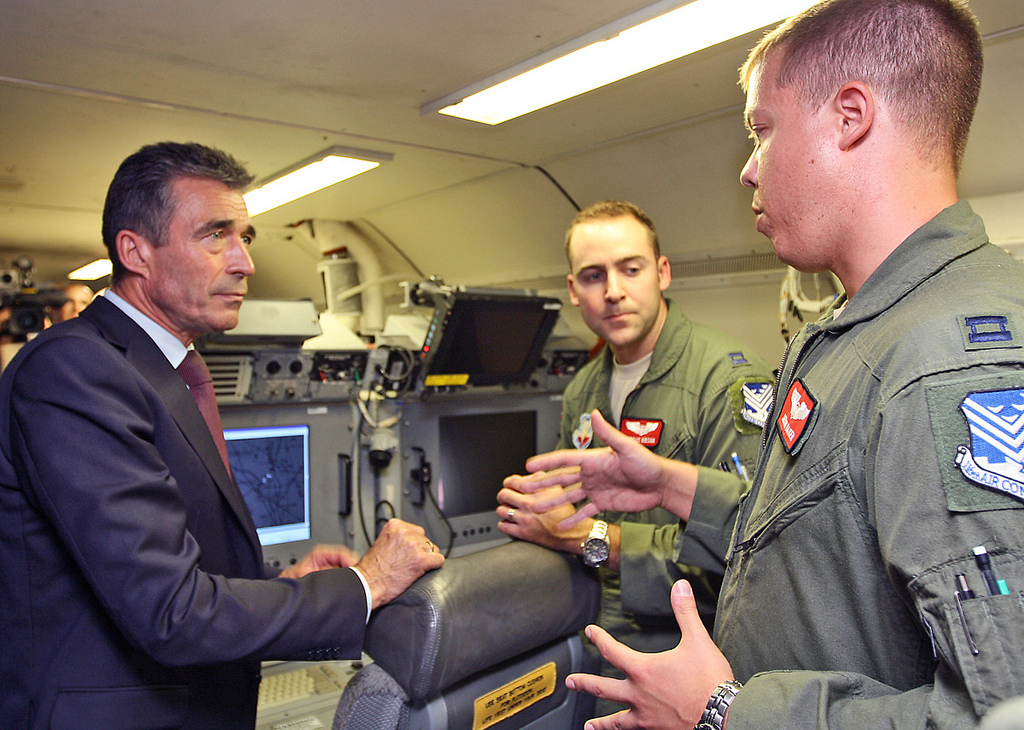
The Georgia National Guard played host to NATO Secretary General Anders Fogh Rasmussen, who took time to honor Georgia Army and Air Guardsmen for their service with NATO forces in the Global War on Terror, as well as for their work with the nation of Georgia in the State Partnership Program.

Here, Rasmussen (left) talks with two air weapons operations officers about their jobs aboard the Georgia Air Guard’s E-8C Joint Surveillance Target Attack Sytem, or JSTARS, aircraft flown by Warner Robins’ 116th Air Control Wing.

Before moving to the flight line outside the Air Force Reserve’s 94th Airlift Wing, where he looked over an Army Guard UH-60 Black Hawk helicopter and a C-130 Hercules cargo aircraft, the secretary general talked with more than 60 Soldiers, Airmen and Georgia Department of Defense civilians about the Guard’s service along side NATO forces in Afghanistan, saying of the Citizen-Soldiers in the room, "It takes a special kind of man or woman to make that kind of commitment."

With the secretary general throughout his visit were Georgia's Adjutant General, Maj. Gen. William T. Nesbitt; Maj. Gen. Maria L. Britt, Georgia Army Guard Commander; and Maj. Gen. Thomas Moore, Georgia Air Guard Commander.

Thursday, May 05, 2011

Division Commander Reflects on Afghanistan Tour

By Jian DeLeon
Emerging Media, Defense Media Activity

WASHINGTON, May 4, 2011 – When Operation Moshtarak in Marja, Afghanistan, was not meeting its security and development goals according to plan, Marine Corps Maj. Gen. Richard P. Mills was brought in to help in moving the situation along.

Mills served as commander of the International Security Assistance Force’s Regional Command Southwest in Afghanistan from April 2010 until last month. He now serves as the commanding officer of 1st Marine Division.

During his tenure, Mills kept intense pressure on insurgents while nurturing close working relationships with Afghan allies in Helmand and Nimruz provinces, ensuring their involvement and commitment in developing national security.

“The year that we were there, I think we saw a remarkable change in the situation on the ground,” Mills said during a “DOD Live” bloggers roundtable yesterday. “I inherited a situation that was improving every day.”

Mills’ eclectic command was made up mainly of British forces, with support from forces from Georgia, Estonia, Denmark, United Arab Emirates, Bahrain, and Tonga.

“During the year that we were there, I saw a remarkable increase in the capability and confidence of the Afghan security forces -- both the police and the army -- and when we left, the Afghan army forces were about three brigades, all capable of semi-independent operation,” Mills said.

Among the successes of Operation Moshtarak were the force’s victories against insurgent operations, pushing them back and separating them from society to lessen their influence on the population and empower the burgeoning security force.

“Highlights of our time over there were the culmination of the battle of Marja, the battle of Sangin, and several other fights that took place along the Helmand River to push the insurgents away from the final areas they occupied [and to] separate them from the population and reduce the impact that they would have,” he said.

The victory at Marja was important for several reasons, Mills explained. From a psychological standpoint, it is Helmand’s provincial capital, so holding the city meant the insurgents had less of an influence on the Pashtu community and general population. It also served as a great resource of funding the insurgency, as Marja sits in an area with a high volume of drug production.

By targeting areas where drug production was taking place, Mills said, his forces slowly but successfully pushed insurgents out of downtown Marja and took the fight to the enemy, building on momentum and turning the tide of battle by getting the insurgents on the defensive. They also worked with local elders to establish a good working relationship with the police force and security forces, he added, and eventually these well-nurtured relationships led to establishing local police forces.

Over time, Mills said, he saw development improve in roads, phone systems and other areas important to infrastructure and self-sustainability, as well as a decrease in poppy growth that undermined insurgents’ opium trade.

The general said he also saw several positive elections take place, including national parliamentary elections in September and five district community councils elected throughout the province. And thanks to an education program, he said, 125,000 students are now enrolled in school, about 20,000 of them female.

And the gains show signs of sustainability, the general said.

“I think some of the indicators that these gains would be long-lasting was the commitment by the Helmand population to the government of Afghanistan, as exemplified by their support of the education initiatives,” he said. “I think that indicated a real investment by the population in the future of the province.”

Monday, December 29, 2008

U.S. Team Helps to Boost Bee Business in Afghanistan

By Navy Lt. j.g. James Dietle
Special to American Forces Press Service

Dec. 29, 2008 - Many Afghans are subsistence farmers who teeter on the edge of malnutrition or starvation every year. In Afghanistan's Konar province, one of the most violent provinces in the country, an American provincial reconstruction team is working with the Afghan government on a unique solution to help feed its people: bees.

Experts from the Konar Department of Agriculture maintain a number of small beehives throughout Konar Valley and are working to expand the reach of the pollinators. They hope not only to breed more bees, but also to build more beehives to be distributed among more farmers, officials said. With the help of the Konar PRT and the U.S. Department of Agriculture, the Afghan government has been distributing sugar to existing beehives to increase their population.

The Afghan government has provided more than 300 pounds of sugar to local beekeepers and farmers, officials said. Government officials expressed the hope that with pollination help from the bees in the spring, crop yields in the immediate area might go up by at least 10 percent.

The idea is not as far-fetched as it may sound. Beekeeping is a $9 billion industry in the United States, according to the University of
Georgia's Web site. Bee hives are bought, sold and rented out across the country.

In Canada, if a blueberry farmer hopes to increase profit, he reportedly can get a return of $41 per every dollar spent on renting bees for pollination, and an apple farmer can get upwards of $192 per dollar. The Konar government hopes to get a similar return for its investment.

Through pollination, bees have been known to increase crop yields by as much as 25 percent. Other plants, such as almond trees, must have a pollinator to even produce.

Bees also produce raw materials for the Afghan people to trade and barter. Honey is an obvious product of successful hives, and is especially valuable in Afghanistan because it is one of the few agricultural products that does not have to be stored in cold temperatures. Honey can be easily consumed, sold or exported to nearby provinces.

Beeswax -- a primary component in candles, cosmetics, polishes and pharmaceuticals -- also is a valuable commodity, officials noted.

(
Navy Lt. j.g. James Dietle serves with the Konar Provincial Reconstruction Team.)