Showing posts with label reserve. Show all posts

Monday, March 26, 2012

Afghanistan: EOD active duty, Guard, Reserve save lives, deny terrorists victory


By Air Force Staff Sgt. Sara Csurilla
U.S. Air Forces Central

BAGRAM AIR FIELD, Afghanistan (3/26/12) — It’s midnight at Bagram Air Field, Afghanistan and the team leader for the Explosive Ordnance Disposal flight is running from door to door in his PT gear yelling “get up, it’s go time!”

Warnings are coming over the giant voice system outside, exclaiming “incoming, incoming, incoming.” Two rockets have been fired onto the base, shaking the Airmen rooms as they lace up their boots.

It takes the EOD techs no more than 10 minutes after getting out of bed to be fully geared up and ready to go on their next mission, and four more rockets have already been fired into areas where they will be headed next.

There are two three-man EOD teams and a team leader at Bagram. They are a part of the 966th Air Expeditionary Squadron, and support Combined Joint Task Force Paladin.

As EOD technicians, responding to indirect fire or rocket attacks on base is just one of their many inherently dangerous jobs.

EOD techs are experts in chemical, biological, radiological, and nuclear materials and explosive devices. The unit helps insure freedom of operations in a deployed environment by locating, identifying, disarming, neutralizing, recovering and disposing of hazardous explosives, CBRNE and incendiary items.

They neutralize criminal and terrorist bombs, clear areas of explosives-related contamination; perform post-blast analysis after improvised explosive device attacks and dispose of unserviceable and outdated munitions.

By providing their EOD capabilities, the teams make it possible for service members deployed to Bagram to complete their missions with confidence, knowing EOD is only one call away.

“We can’t do our job without EOD, there’s just no way,” said Air Force Tech Sgt. Eric Fox, team leader with the 455th Expeditionary Security Forces Squadron Quick Reaction Team known as the Reapers.

“For example, we called them out for a rocket we found, and it’s the same type of ordnance I’ve seen used in IEDs in the past,” he said. “By them coming out and destroying it, that’s one less IED [the enemy] can use against BAF or us. Not to mention the multiple IEDs they can diffuse, saving our lives, before the enemy can diffuse them on us.”

To be an EOD tech, the Airmen went through a rigorous nine-month course where they had to pass more than 50 tests that challenged not only their intelligence and attention to detail, but their physical endurance and mental capacity. Throughout their careers they constantly train and try to stay one step ahead of the enemy.

“The EOD school was definitely a challenge to get through,” said Air Force Capt. Dan O’Neil, EOD tech deployed to Kabul, Afghanistan from the 158th Fighter Wing with the Vermont Air National Guard. “The standards are very high and it takes a very well rounded and motivated individual to get through that type of training.”

EOD techs make up less than one percent of the Air Force with a little more than 900 Airmen on active duty status, not even 170 positions in the Air National Guard and even less in the Reserve. However, EOD Airmen account for 17 percent of casualties during Operation Enduring Freedom and Operation Iraqi Freedom in the Air Force.

There are currently more than 70 EOD Airmen deployed to Afghanistan supporting CJTF Paladin, 18 of them are Guard, five of which are assigned to Bagram.

Apart from deploying and completing their various missions throughout the area of responsibility or any country they are needed in, the EOD Guard provides their expertise to their home bases in the states and the surrounding area.

“Guard EOD is important because we provide a cost effective solution to the high operations tempo of overseas deployments, while conducting a robust portion of stateside EOD missions,” O’Neil said.

“Especially in the States - we conduct range clearances; we travel with political dignitaries to ensure they’re safe from explosive hazards, we respond to bomb threats and provide training and advisory support to civilian authorities,” he said. “Most importantly, when aircraft are loaded with munitions and countermeasures, they need EOD techs there to support the flying mission.

“Active duty EOD is already struggling to achieve all of its mission set with its current manpower, with help from the Reserve and Guard,” he continued. “I don’t know how they would do it without the support from the Guard.”

Whether they are active duty, Guard or Reserve, EOD Airmen fill a much-needed role here in Afghanistan that not only keep the airfield clear, but makes service members, coalition forces and the local Afghan population feel safer knowing EOD is there.

Wednesday, January 25, 2012

Marine Casualty

The Department of Defense announced today the death of a Marine who was supporting Operation Enduring Freedom.

Capt. Joshua C. Pairsh, 29, of Equality, Ill., died Jan. 22 in the United States of a non-combat related illness.  He was assigned to 4th Civil Affairs Group, Marine Forces Reserve, based out of Washington, D.C.

For additional background information on this Marine, news media representatives may contact the Marine Forces Reserve public affairs office at 504-697-8309.

Friday, December 16, 2011

Face of Defense: Reservists Make Engagement in Afghanistan

By Air Force Tech. Sgt. Tammie Moore
376th Air Expeditionary Wing Public Affairs Office

TRANSIT CENTER AT MANAS, Kyrgyzstan  – People often say, "You should never make a life-changing decision while you are deployed." But two Air Force reservists, one from the Pentagon and the other from Minnesota, chose to defy this adage when they got engaged in a combat zone.

Before deploying to the transit center here to become the 376th Air Expeditionary Wing vice commander, Col. David Pond knew when he returned home he was going to ask his girlfriend to marry him.

Two weeks prior to Pond’s departure, his girlfriend, Lt. Col. Sherry Hemby, left for Bagram Airfield, Afghanistan, where she would become the 455th Expeditionary Aeromedical Evacuation Flight commander.

"I guess from the time I put her on an airplane, I started to question whether I wanted to wait until we got home from deployment," Pond said. "The more I thought about it, I knew I would probably get the chance to fly with our crews and go through Bagram [Airfield]. So, I decided that whenever I had the first opportunity to go there I was going to ask her as soon as I saw her."

Pond was slated to go on an Army support mission moving troops across Afghanistan. As fate would have it, a short-notice change to the itinerary routed the mission through Bagram Airfield to refuel. Before the crew departed, he called Hemby to let her know he would be passing through and that he would love to see her, even for a few minutes.

"This is our first deployment as a couple," Hemby said. "We hoped there would be an opportunity during the deployment to see each other, but we weren't sure. Dave called the morning he was supposed to fly through. He always teases me. He said, 'Guess what?' And I said, 'You are taking me to dinner.' He laughed and said he didn't know if he would be on the ground long enough. I was teasing him and didn't realize he was really coming through."

The C-17 Globemaster III from the transit center ended up landing on the Bagram Airfield flightline directly in front of the 455th’s tents.

"I hadn't even unstrapped from my seat, and Sherry was already up on the flight deck," Pond said. "I took one look at her and I just wanted to blurt out, right at that moment, 'Marry me,' but I didn't want to do it in front of the crew."

Since the crew had about an hour on the ground, Pond asked Hemby to show him her squadron.

"We got off the airplane and we were maybe 25 to 50 feet from it when I stopped and snapped my fingers like maybe I had forgotten something, then I said, 'Oh, by the way, there is something I have been meaning to ask you,'" he said. "Sherry looked at me, and I just said two words, 'Marry me.'"

Hemby had a simple one-word reply.

"I said 'Yes,' as soon as I could catch my breath," she said. "I knew he was thinking about marriage. He had dropped a few hints. I figured he would ask me on our vacation in November. He really did surprise me. One of the things I love about him is his ability to surprise. He has a saying, 'Buckle up, Honey. It's going to be an awesome ride.' And I believe him. He is an awesome man and I look forward to that ride."

When Pond was sharing the story with a group of airmen at the transit center, Col. Philip Greco, the 376th Expeditionary Maintenance Group commander, presented him with two rings. Staff Sgt. Adam Lo Bianco, a 376th Expeditionary Aircraft Maintenance Squadron metals technology craftsman, made the rings from a solid-steel core and laser-engraved them.

"I tell you, I have been at this game for a long time, and it takes a lot to catch me off guard, and this left me absolutely speechless," Pond said after he received the rings. "For anyone who has known me any amount of time, I'm never speechless.”

The couple plans to marry in the summer in Tennessee.

"I'm a blessed man," Pond said. "It is just so absolutely wonderful and peaceful to find the person you want to spend your life with.”

Thursday, December 15, 2011

Marine Casualty

The Department of Defense announced today the death of a Marine who was supporting Operation Enduring Freedom.

Maj. Samuel M. Griffith, 36, of Virginia Beach, Va., died Dec. 14 while conducting combat operations in Helmand province, Afghanistan.  He was assigned to 4th Air-Naval Gunfire Liaison Company, Marine Forces Reserve, West Palm Beach, Fla.

For additional background information on this Marine, news media representatives may contact the Marine Forces Reserve public affairs office at 504-697-8192.

Tuesday, December 06, 2011

Iraq: Virginia National Guard Calvary unit makes final preparations to leave Iraq

By Army Reserve Spc. Anthony Zane
Army Reserve

CONTINGENCY OPERATING BASE ADDER, Iraq – With Operation New Dawn coming to an end, the Virginia Army National Guard exited Iraq in its final convoy out of here Friday.

"We were a convoy escort team," said Army Staff Sgt. Raymond Bunch, a convoy commander with Able Troop, 2nd Squadron, 183rd Cavalry Regiment.

"We would pick up logistic supplies … and escort them from one base to another to their final destination."

Soldiers' equipment and vehicles were inspected and made ready for the final journey.

Able Troop prepared to leave the base and head south across the border into Kuwait, and start turning in all of our gear for our end of deployment, said Bunch.

The mine-resistant, ambush-protected vehicles the unit will convoy out of the country in had been lined up just outside the Soldier living area.

"Our squadron was all housed here," Bunch said. "Our squadron tactical operation center was right across the road, and the main motor pool was behind there. That's why we've moved all the vehicles over here – to be closer to the containerized housing units and [to] get everything out."

The unit was scheduled to leave earlier, but stayed on after being tasked with a few last missions.

"Things got pushed along," said Bunch. "We ended up having to run a few more missions, and it seems like every time we thought we were running our last mission, they said, 'We need you to run one more.' And of course, the needs of the Army come first."

The convoys throughout the deployment were successful, although Soldiers had to learn new tasks and responsibilities for the mission.

"Able Troop itself is just a conglomeration of where they pulled a whole bunch of people from across the state to make this [mission] come together," Bunch said. "Military occupational specialties and people [who] aren't necessarily used to working together had to come together quick and learn a whole new role than what any of us were trained for. I think we did an excellent job in doing that."

This is the final mission preparation for Able Troop.

"Today is a culmination of everything we've done," said Army Cpl. Josh Brainard, a vehicle commander, 2nd Squadron, 183rd Cavalry Regiment here Friday. "Now, it's our final convoy to Kuwait, to leave today."

Essentially what they did to prepare for departure was like a regular mission preparation, Brainard said.

They had to inspect the vehicles, lay out medical equipment, organize their weapons cleaning kits, and everything else – safety gear, meals-ready-to-eat and water – to be inspected for this mission, he said.

All of this is ultimately for the trip home, for which many are ready for.

"I'm very, very excited," Brainard said. "My wife actually had our first child, so I'm really very anxious to get home."

The Soldiers are hopeful to be home before the holidays, Bunch said.

"Of course here at the end [the mission] is to get everybody out," he said. "And then today is the end for us. We're basically escorting ourselves out. Everybody's pumped and excited about that because we're done. We're getting ready to go home."

Monday, November 14, 2011

Logistical Drawdown Progressing Smoothly in Iraq

By Donna Miles
American Forces Press Service

WASHINGTON, Nov. 14, 2011 – The logistical drawdown in Iraq is progressing well and on track to meet the Dec. 31 deadline, the commander of the unit that oversaw the mission since January reported as he and his soldiers prepared to return home early this week.

Army Col. Stephen Falcone, commander of the Army Reserve’s 77th Sustainment Brigade, said his troops faced tough demands in Iraq as they supported two seemingly opposite requirements: keeping troops on the ground supplied while orchestrating the United States’ largest logistical drawdown since World War II.

“It’s been a big balancing act,” Falcone told American Forces Press Service from Camp Virginia, Kuwait, as he and his soldiers awaited their flight home to Joint Base Maguire-Dix-Lakehurst, N.J. “And it’s something we’ve had to focus on every day to make sure we give [troops on the ground] just enough, but not too much.”

So as convoys arrived at bases throughout Iraq delivering food, water, fuel, ammunition and other staples, Falcone and his soldiers ensured they left filled to the brimming point with equipment destined for Kuwait and ultimately, the United States.

The 77th Sustainment Brigade was among the last units to deploy to Iraq as the United States began the process of handing over operations to Iraqi forces and other U.S. agencies. Its 300 soldiers arrived in January to serve as the headquarters element for an additional 3,500 soldiers and airmen assigned to put the logistical plan into action.

During their deployment, they ran more than 1,700 convoys, traveled more than 4.2 million miles, issued more than 120 million gallons of fuel, moved out 2,700 tons of ammunition and transported 20 million pounds of incoming and outgoing mail, Falcone reported.

As they closed warehouses and scaled back support operations, they transitioned more than $238 million in equipment, repair parts and other supplies to the Defense Department inventory, he said.

Good planning, hard work and favorable weather came together to move the transition of bases to Iraqi government control on or ahead of schedule, Falcone said. He noted that three of the largest bases transitioned earlier than planned, including the most recent, Joint Base Balad, which was transferred to the Iraqis three weeks ahead of schedule.

“We have done an orderly and responsible progression of how we transferred those bases,” Falcone said, giving some welcome breathing room in the schedule to complete the process by the year’s end.

As daunting as the logistical drawdown may be, Falcone said it is complicated by the fact that U.S. forces remaining on the ground for the duration of Operation New Dawn still require beans, bullets and other essentials.

Falcone said he didn’t want them “living in tents and eating [Meals, Ready to Eat] every day,” and took pains to provide them the best quality of life for as long as possible while still adhering to the drawdown schedule.

As bases prepared to close and contractors who had been assigned to them returned home, military members stepped up to conduct missions the contractors had done. They took over the dining facilities, laundry and other services.

In some cases, they cross-trained into other jobs to keep vital services flowing. Falcone’s water purification specialists, for example, served as fuel handlers as well. Other service members volunteered to become crane operators, positions contractors had held.

“The good part is that they stepped up to the plate and did a fantastic job,” Falcone said. “We had absolutely no problems.”

Falcone called the evolution taking place in Iraq a throwback to the earliest days of Operation Iraqi Freedom, or “OIF in reverse.”

“When we first went into Iraq in 2003, it was kind of an austere environment,” he said. “And as we transfer those bases over, we go back to that austere environment for the soldiers.”

Falcone acknowledged that in the weeks leading up to Dec. 31, conditions will become increasingly austere as the last U.S. forces in Iraq wind down their operations.

With the 77th Sustainment Brigade now redeploying, the active-component 4th Sustainment Brigade from Fort Hood, Texas, will oversee the completion of the mission.

Many of the 77th Brigade soldiers elected to extend their deployments to join the 4th Brigade in seeing the mission to completion, he said.

Together, “they are going to do it the right way, they are going to do it on time and more than likely, ahead of time, and then they are going to go home,” he said.

Unlike past rotations in Iraq, no replacement unit will be arriving to take their places. “This is the first time when there is no unit following us,” Falcone said. “So when we leave, the job we were asked to do is done. It’s not left to someone else to finish up.”

Falcone said his soldiers are excited about their role in the historic drawdown mission in Iraq. “They’ve gone a yeoman’s job, working very long hours conducting the largest retrograde operation since World War II,” he said.

“I tell them that when they go home, they need to be proud of what they have done here, to stick their chests out farther and to hold their heads high,” he said. “They need to walk down the streets of America knowing they have truly ended this operation the way it should have been ended. They did a great job, and they did everything the country asked them to do.”

Monday, September 26, 2011

AFN-Iraq ‘Freedom Radio’ Goes Off Air

Check out these Second Gulf War books written by veterans of Operations Iraqi Freedom and New Dawn.

By Terri Moon Cronk
American Forces Press Service

WASHINGTON, Sept. 26, 2011 – The soundboard lights went dark for the last time when American Forces Network Radio–Iraq “Freedom Radio” went off the air at midnight Sept. 23, after an eight-year run in Baghdad.

The station’s ending closed a chapter in the final 100 days of the U.S. drawdown of Operation New Dawn in Iraq.

Operated by Army Reserve broadcasters, AFN-Iraq hit the airwaves in March 2003, when a U.S.-led coalition invaded Iraq to oust dictator Saddam Hussein.

Since that time, the team of Army announcers kept service members entertained and informed with a variety of music, chat and news.

“It’s … a morale boost for the troops,” Army Staff Sgt. Brad Ruffin, an AFN-Iraq announcer, said of the broadcasts. “That why we’re here. We do it for them.”

Army Sgt. Adam Prickel called entertainment an important factor in AFN-Iraq programming, “to get [the troops’] minds off something that might be stressing them out a little too much.”

Emails from listeners came in every day to say they enjoyed the music AFN-Iraq played, announcer Army Staff Sgt. Jay Townsend said.

The final broadcast that began at 6 a.m. Sept. 23 was filled with listener requests, entertainment and special interviews.

“We had shout-outs from celebrities, interviews with military leaders and the famed Adrian Cronauer,” Sgt. 1st Class Don Dees said during his on-air shift.

Cronauer is the former AFN radio broadcaster who was the inspiration for the 1987 Hollywood film, "Good Morning, Vietnam."

Coming up on midnight for the final time, AFN-Iraq Freedom Radio played its most-requested song: “Courtesy of the Red, White and Blue,” by Toby Keith, Dees said.

Radio programming now gives way to AFN signals from other locations, he said.

AFN-Iraq, an Army Reserve 206th Broadcast Operation Detachment in Texas, will become AFN-Europe out of Germany, officials said.

“We lived by the motto, ‘Always there, on the air,’” Dees said.

The station also plans to keep its Facebook page, which has 5,400 “friends,” active. “We have decided to keep this page running indefinitely,” according to a post on its wall.

Thursday, July 14, 2011

Civil Affairs Troops Train for Afghanistan Duty

By Donna Miles
American Forces Press Service

JOINT BASE MCGUIRE-DIX-LAKEHURST, N.J., July 13, 2011 – The situation had become dire. A broken pipe was spilling raw sewage through a fictional Afghan village. Its well was now contaminated, leaving three babies dead and sickening scores of other villagers. Fear gripped the village as the region’s only tiny clinic struggled to keep up with the demand for medical care.

Army Staff Sgt. Larry Marquez knew he had his hands full as he led a team of civil affairs soldiers into the mock village to meet with the provincial governor and village elders to discuss possible remedies.

Marquez and his fellow Army Reservists with the Encino, Calif.-based 425th Civil Affairs Battalion were midway through a three-day mission rehearsal exercise last week at this joint base deep in the heart of New Jersey’s “Pine Barrens” forest.

They’d already completed their pre-deployment combat skills training, including the combat lifesaver course, and been to the firing ranges. Now, they were getting a week of concentrated civil affairs training, including a five-day exercise that would be their test before being declared ready to deploy this week to Afghanistan’s Kandahar province.

Once in Afghanistan, the soldiers will fan out in small teams across the province to conduct a broad range of civil affairs missions, helping the Afghans build and strengthen government institutions so they can deliver education, medical care and other services to the population.

Trainers from U.S. Army Civil Affairs and Psychological Operations Command’s 1st Battalion, 1st Training Brigade -- many just back from their own deployments -- had thrown the soldiers every curve ball they could come up with to make the training realistic and challenging.

“The scenarios are based on what is actually going on in the theater,” said Army Sgt. Maj. Robert Matthews, the training battalion’s first sergeant. “What we are putting them through here is as close as we can get to what they are going to encounter when they go downrange.”

It hadn’t always been that way. Matthews remembers his frustration when he went through the training himself in 2006 before deploying to Iraq.

“It all was based on very generic scenarios,” he said, many of them no different than what he trained for before deploying to Bosnia years earlier. “The complaint we had when we were going through [the training] was that nobody was actually training us for what we were going to be doing.”

So after returning from his deployment, Matthews volunteered to return to the training brigade to revamp the instruction and increase its relevance for deploying troops. Now, scenarios vary significantly, depending on whether a unit is headed to Afghanistan, Iraq, the Horn of Africa or elsewhere, and are updated regularly based on input from troops on the ground.

“This is the only exercise in all the training [deploying civil affairs and psychological operations soldiers] do that brings together everything they do: the medical play, their actual [military occupational specialty] skills, the tactical skills, the convoy stuff, the communications,” he said. “This is as realistic as we can possibly make things without actually being downrange.”

Just as in real life, the outcome of each scenario sets the stage for the one to follow, Matthews explained. A mistake made here -- an offending remark or promise not kept during a training scenario -- carries over to complicate follow-on engagements.

Army Maj. Brad Cary, commander of the training battalion, said the goal is to impart critical lessons before the soldiers deploy to the combat zone.

“It is better to screw up here, because here, we can pause and reset. We can say, ‘Stop what you are doing. You are going down the wrong path,’” he said. “Here, you can learn from your mistakes. You can say, ‘I didn’t mean to say or do that, to upset that sheik or imam or business leader.’ And then you can start again and set things right.”

Army Sgt. George Rodriguez was experiencing the realism of the training firsthand last week as his security detail led Marquez’s team through into the mock village to meet with Prawiz Ali-Shah, a native of Kabul, Afghanistan, role-playing the provincial governor.

Afghan villagers, role players from the local community dressed in Afghan garb and many speaking Farsi or Pashtun, offered mixed greetings as the soldiers stepped from their armored vehicles and entered the village on foot. Some extended their hands in welcome, some peeked curiously from windows and doorways and others warily diverted their eyes altogether.

Wails echoed from the medical clinic as the soldiers approached, water purification tablets in hand to offer the health director as a temporary fix to the contamination problem. Army Staff Sgt. Nancy Gonzalez tried to comfort mothers who had just lost their babies. Meanwhile, Marquez met with Shah and the elders to discuss remediation plans. What was needed, they agreed, was a new well away from the sewage lines and an education program to teach villagers how to treat contaminated water until it could be dug.

They also discussed expanding the medical clinic and moving it to a larger, larger, more central location where it could better serve the community.

As they talked, confusion within the building escalated into a frenzy as a fourth baby died. Some of the villagers pointed to the Americans as the source of their problems.

Army Spc. Rene Ruiz, sensing trouble, issued the previously agreed-upon call -- “Burger King” -- that notified his fellow soldiers that it was time to leave. The troops repeated the call to each other to ensure all had gotten the message, and Marquez wrapped up his deliberations and joined them in slowly exiting the village.

Shots rang out as the soldiers were ambushed during the walk to their assembly area. They returned fire, some chasing after their attackers and others remaining behind to treat five soldiers wounded in the attack.

Gathering the soldiers for an after-action review, three 1st Training Brigade observer-controllers, all with civil affairs experience in Iraq or Afghanistan, offered their assessments.

Army Sgt. 1st Class Willie Williams, noncommissioned officer in charge of the training lanes, reviewed the encounter step by step from a civil affairs standpoint, from how the soldiers had engaged the Afghans and expressed concern about their losses to how they responded when things began to go wrong.

Ruiz had made “a good call” in identifying when it was time to cut the engagement short. “Things may have escalated and gotten a little crazy,” Williams said. “Now you can come back and conduct business another day.”

Army Staff Sgt. Pete Hoffman critiqued the medical aspects of the scenario. The soldiers had made good decisions in identifying the source of the water contamination and recommending ways to provide better medical care for the villagers. When ambushed leaving the village, they had responded quickly to evacuate the wounded, but hadn’t taken the time to triage them before beginning combat lifesaver care.

Army Sgt. Kevin Parra discussed the tactics, from the pre-mission briefing and inspections to how they had led their convoys into the village and set up security. One glitch he identified: when enemy shots came from the right, the left side of the formation had responded rather than remaining vigilant for the attack from the left that soon followed.

“Remember, no matter what happens, you are soldiers first,” he reminded them. “But I will tell you: the way you guys are moving and communicating, it’s spot on. So keep doing what you are doing.”

Ultimately, the goal of the civil affairs mission is to get to the point where it’s no longer needed, explained Army Maj. Tim Brooke, the training battalion’s executive officer.

“What we are always trying to do is get out of the business of being in business,” he said. “We want to transition those functions normally done by civil government back to the host nation.”

“The big thing we push to the guys coming through the pipeline is that, in order for us to be able to get out of Afghanistan or out of Iraq completely, we have to legitimize the local governments,” Matthews said. “We want to put an Afghan face or an Iraqi face on everything that is done over there. … We are trying to stand up the government and legitimize the local government and give the people that they govern confidence that their government can work for them.”

Tuesday, June 07, 2011

Gates Says Guard, Reserve Roles Need Examining

By Jim Garamone
American Forces Press Service

FORWARD OPERATING BASE SHARANA, Afghanistan, June 6, 2011 – The Defense Department is taking a look at the roles of the National Guard and reserve components, Defense Secretary Robert M. Gates said here today.

Gates spoke to the men and women of Task Force Currahee, a unit built around the 101st Airborne Division’s 4th Brigade, and based in Paktika province.

The secretary thanked the soldiers for their service during a town hall meeting and took questions. One soldier asked about the future of the reserve components.

Gates said he has been concerned about the Guard and reserves since he took office in 2006. “One of my concerns when I took the job was my concern that after 9/11, we pulled a kind of bait and switch on the National Guard,” he said.

Since World War II, the National Guard always had been a strategic reserve, and those signing up for service generally trained one weekend a month and two weeks in the summer. They understood they would be called up for national disasters or great national crises. Instead, they “found themselves ultimately being deployed for 15 months in the field,” the secretary said.

Since then, of course, the reality is that everyone who has joined the Guard and reserve has known they were going in to the fight, he said.

But this is an issue for reservists. The department is asking what are the right roles for the Guard and reserve going forward, Gates said.

One suggestion is that the Guard be divided into a strategic reserve and an operational reserve, with each group trained, paid and equipped differently, the secretary said.

Another suggestion calls for moving more of the Army’s heavy infantry brigade combat teams into the National Guard.

“These are questions we are looking at, but we need to do some hard thinking,” he said, “because we could not have done what we did in Iraq and do what we’re doing here in Afghanistan without the operational engagement of the Guard.”

Whatever happens, the Guard is going to continue to have an operational role, Gates said. “How much of the Guard that involves, and how we situate the Guard and reserve going forward is still a question everybody is looking at,” he said.

Friday, May 13, 2011

Face of Defense: Guard Pilot Serves Third Iraq Deployment

By Army Capt. R.L. “Ed” Edwards
40th Combat Aviation Brigade

CONTINGENCY OPERATING BASE SPEICHER, Iraq, May 13, 2011 – You can see the twinkle in his eye as he sits down.

Army Chief Warrant Officer Wayne Wade — father, husband and pilot — would rather spend this interview talking about his 18-month-old twins, Ross and Sydney, or his wife, Samantha, and how he is going on two weeks of rest and recuperation leave.

“I’m going back to Fulton, Miss., spending time with my wife and kids,” he said. “I think we are getting a family portrait done, but that is it.”

Wade is on his third tour to Iraq — this time with the Mississippi National Guard’s 1st Assault Helicopter Battalion, 185th Aviation Regiment. The battalion is attached to the 40th Combat Aviation Brigade, which is deployed to Iraq in support of Operation New Dawn.

Wade has flown a different type of helicopter on each of his tours in Iraq. On his first tour, he flew OH-58 Kiowa Warrior scout helicopters. He then moved over to AH-64 Apache attack helicopters, and now he flies UH-60 Black Hawk utility helicopters.

When he enlisted in the Army Reserve in 1987, Wade spent five years as a crew member and crew chief onboard UH-1 Huey helicopters. This was enough, he said, to start him down what he called “the road to ruin” to becoming an accomplished helicopter pilot.

He flew as a UH-1 medical evacuation pilot for the Army Reserve in Mississippi, followed by specialized training on the OH-58. After moving from the Reserve to the Mississippi National Guard, he was cross-trained on the AH-64 Apache.

Wade finished his training on Apaches just in time for the buildup before the start of the Iraq invasion in 2003. But the Army’s needs took precedence, and Wade became an individual augmentee with 3rd Infantry Division, flying OH-58s.

Ten months of boots on the ground and in the air as a scout for tanks was very different from today’s environment, Wade said. “Back then, there was almost no electricity in Iraq,” he explained. “We would land next to a [heavy expanded mobility tactical truck], fill up the bird and take off again. When we got tired, we would stop, sleep in the dirt, get up and do it again.”

Wade said he was part of the invasion all the way to Baghdad.

“I looked at one of my journals from that time a while back and saw that it was several weeks into flying missions before there was an entry of, ‘Didn’t get shot at today,’” he said.

In 2006, he was deployed as an Apache pilot with the 36th Combat Aviation Brigade at the height of the surge. His flight company was based in Balad, but as a core asset, they were moved around a lot. Wade said he worked everywhere from Contingency Operating Base Speicher and south.

He also spent some time in Basra supporting the British, he said.

“In ’06 and ’07, there were aircraft and people everywhere,” he recalled. “There were so many aircraft in the air you had to be careful that you didn’t run into each other.”

Following his second tour in Iraq, Wade attended the Black Hawk transition course at Fort Rucker, Ala., eventually becoming an instructor pilot at a flight facility in Tupelo, Miss. He flew a civilian helicopter ambulance for a while out of Oxford, Miss. “But I decided that with the little ones on the way, the Army made better sense for us as a family,” he said.

This third tour has been spent at the controls of a Black Hawk utility helicopter. As a senior aviator with more than 3,400 hours, Wade said, he likes the theory behind the use of the Black Hawk to move assets around the country instead of by convoy.

Wade became reflective when asked the differences between now and the beginning of the war in Iraq.

“Now it seems that there is really a much greater sense of normalcy throughout the entire country,” he said. “The people in the country seem to be moving forward. Now it seems like the land is lush and there is farming, whereas before, when there was no electricity, all of the irrigation was gravity-fed, and there was a lot less farming going on.”

Tuesday, May 10, 2011

NATO

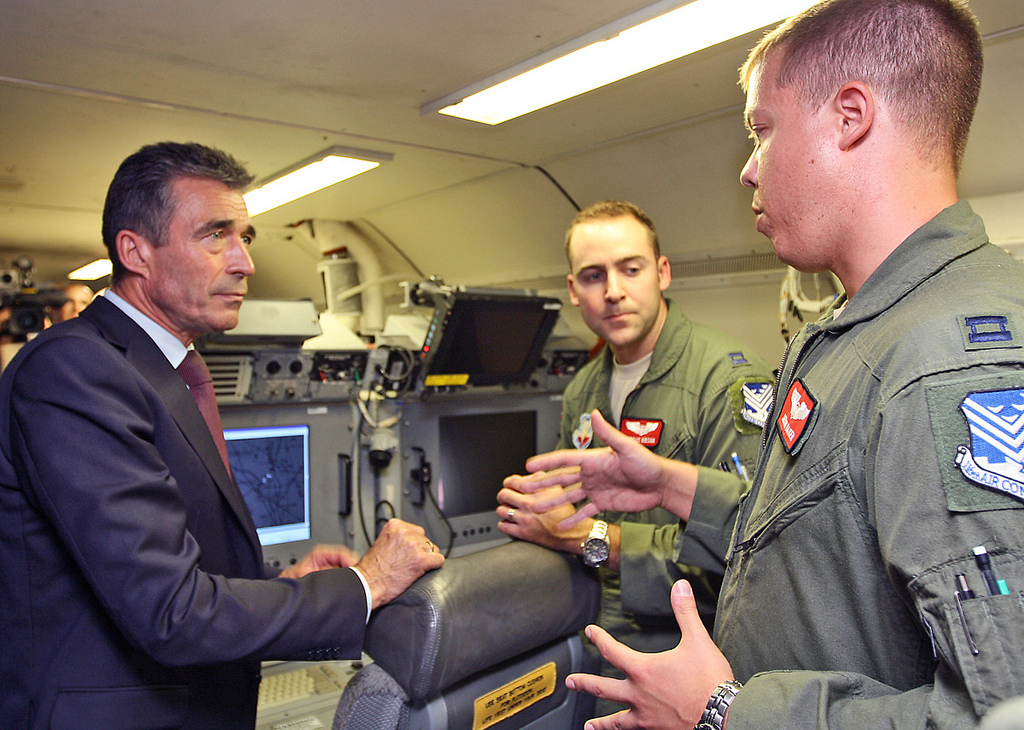
The Georgia National Guard played host to NATO Secretary General Anders Fogh Rasmussen, who took time to honor Georgia Army and Air Guardsmen for their service with NATO forces in the Global War on Terror, as well as for their work with the nation of Georgia in the State Partnership Program.

Here, Rasmussen (left) talks with two air weapons operations officers about their jobs aboard the Georgia Air Guard’s E-8C Joint Surveillance Target Attack Sytem, or JSTARS, aircraft flown by Warner Robins’ 116th Air Control Wing.

Before moving to the flight line outside the Air Force Reserve’s 94th Airlift Wing, where he looked over an Army Guard UH-60 Black Hawk helicopter and a C-130 Hercules cargo aircraft, the secretary general talked with more than 60 Soldiers, Airmen and Georgia Department of Defense civilians about the Guard’s service along side NATO forces in Afghanistan, saying of the Citizen-Soldiers in the room, "It takes a special kind of man or woman to make that kind of commitment."

With the secretary general throughout his visit were Georgia's Adjutant General, Maj. Gen. William T. Nesbitt; Maj. Gen. Maria L. Britt, Georgia Army Guard Commander; and Maj. Gen. Thomas Moore, Georgia Air Guard Commander.

Monday, April 18, 2011

Guard part of Total Force 'calico' wing supporting worldwide operations

Air Force News Service report

WESTERN EUROPE (4/18/11) - Airmen serving in the 313th Air Expeditionary Wing at an air base here are from myriad places, but they are "one team."

Those Airmen – and the planes they use for air refueling and airlift during Operation Unified Protector – are not only active duty, but also Air National Guard and Air Force Reserve, a Total Force effort.

It's an effort that is supporting the international response to the unrest in Libya and enforcement of United Nations Security Council Resolution 1973 of a no-fly zone over Libya.

If a person were to gaze out on the flightline of this base, they might make an observation similar to that of Air Force Brig. Gen. Roy Uptegraff, the 313th AEW commander. When looking at the multitude of colors of tail flashes on the 313th AEW ramp, "General Uptegraff said the ramp looked like a 'calico cat,'" said Air Force Col. Dave Cohen, the 313th AEW vice commander.

"Thus, the 'calico wing' was born," Cohen said.

A calico cat is a domestic cat with a spotted or parti-colored coat. As an example, a recently published photo illustration from 313th AEW Public Affairs shows the various tail flash colors of the aircraft that might resemble the "spotted" coat of a calico cat.

That illustration features the colors of aircraft tails from Air National Guard units in Nebraska, Utah, Ohio, Arizona, Tennessee, Illinois, Iowa and Pennsylvania. It also shows Air Force Reserve aircraft from Indiana and North Carolina and active-duty aircraft from California, Kansas, North Dakota, Washington, Florida and New Jersey.

"You can't tell us apart," said Air Force Reserve Master Sgt. William Buckley, a 916th Aircraft Maintenance Squadron flight chief from Seymour-Johnson Air Force Base, N.C.

"We're proud to be able to do any mission the Air Force needs us to do," Buckley said.

The aircraft belonging to the 313th AEW include the KC-135 Stratotanker and the KC-10 Extender. Both aircraft help keep the NATO aircraft covering the no-fly zone over Libya constantly refueled through a coordinated aerial refueling campaign.

On any day, aircrew and maintenance Airmen combine in caring for those tankers and in flying each plane on refueling missions. For example, there could be an aircrew from the Air Force Reserve, flying a tanker owned by the Air National Guard, but maintained by active-duty Airmen.

In addition to its "calico" colors, the 313th AEW also may be reflective of the Air Force's leadership vision of the total force enterprise.

"The ability to fashion a powerful combination of active, Air National Guard and Air Force Reserve components has been one of our great strengths," Secretary of the Air Force Michael Donley said in a September 2010 speech at the Air Force Association Conference and Technology Exposition, National Harbor Center at Oxon Hill, Md.

"We have undertaken a comprehensive review of our 142 Total Force initiatives to establish the business case analyses, combining operational effectiveness and efficiency, which will help us further leverage the Total Force concept," Donley said in the speech. "In mission sets old and new, we'll continue to look for ways to employ Total Force initiatives when they bring more capacity, more capability and efficiency to our Air Force."

Supporting those new mission sets might also be what is being done today in the 313th AEW and for Operation Unified Protector. Through the Total Force, it's a "calico" wing making Air Force history.

– Senior Airman David Dobrydney, 313th AEW Public Affairs, Air Force News and Master Sgt. Scott Sturkol, Air Mobility Command Public Affairs, contributed.