Showing posts with label explosive ordnance disposal. Show all posts

Thursday, September 18, 2025

Groundbreaking Explosive Ordnance Disposal Concussion Study Nears Enrollment Goal

 Sept. 18, 2025 | By Office of the Assistant Secretary of War for Health Affairs/Military Health System

Researchers at the War Department's premier explosive ordnance disposal training school are making major strides in a landmark study focused on the effects of concussions and blast exposures among explosive ordnance disposal technicians.
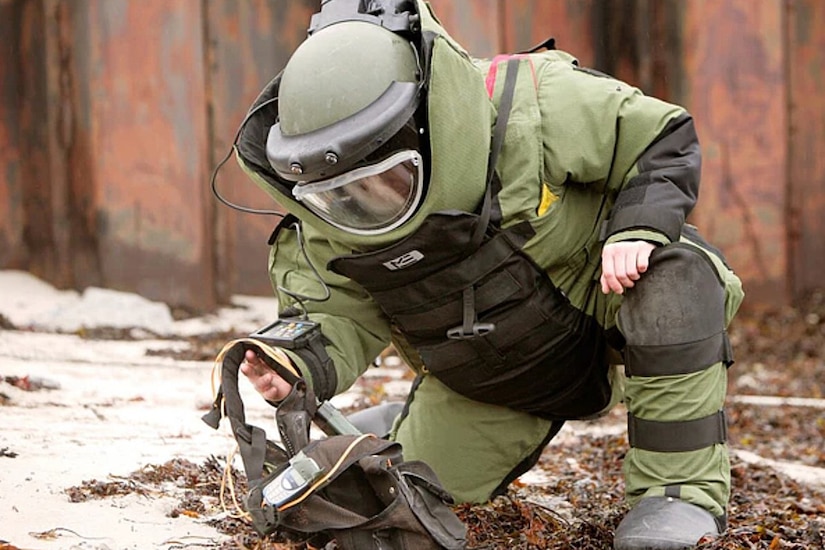
A person in a bomb suit kneels down to pick up a bag lying on the ground.

 
Working directly with students at the Naval School Explosive Ordnance Disposal at Eglin Air Force Base, Florida, the study has enrolled 1,908 participants since October 2022 — 95% of its target goal of 2,000. 
 
The school, which trains approximately 1,350 students annually from all branches of the military, runs a rigorous eight-month training pipeline. The course is divided into eight technical divisions, with an additional underwater component for Navy students. The demanding physical and intellectual challenges of the program mirror the intensity of the EOD career field itself. 
 
The enrollment strategy is tailored to this unique environment. The study team conducts recruitment briefings at multiple places, including Army, Marine, and Air Force indoctrinations, range indoctrination, and the Advanced Improvised Explosive Devices Division course for operational EOD technicians. They also partner annually with the local base EOD shop to engage service members after permanent change of station. 
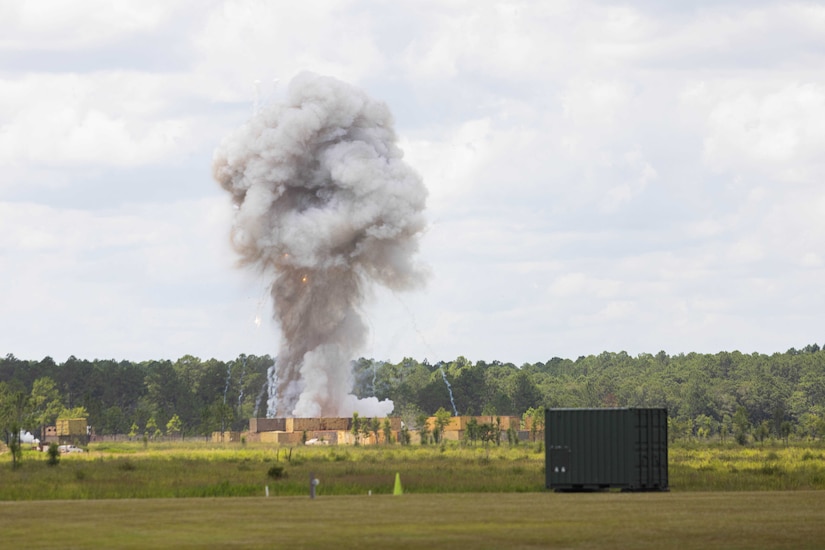
A plume of gray smoke rises from an explosion in the distance. There are trees in the background and shipping containers surrounding the area where the explosion occurred.

 
"Meeting students where they are — literally and figuratively — has been critical," said Sarah Delgado, one of the researchers supporting the study. "The training schedule is relentless, and even small barriers, like running across campus to our office, can make follow-up participation difficult." 
 
Currently, the study maintains a 36% follow-up rate. While distance and the high demands of the curriculum pose challenges, the team is countering them through consistent community engagement. Staff members volunteer at major schoolhouse functions and teach classes tied directly to their research expertise, building credibility and trust within the EOD community. 
 
This study group is the newest addition to the Concussion, Assessment, Research and Education Consortium's service member initiative, otherwise known as the CARE Consortium. Unlike previous groups, the EOD cohort represents enlisted service members with high cumulative exposure to blast and explosions over the course of their careers — making them a particularly important population for understanding brain health risks. 

In a field, a person in a bomb suit kneels in front of a drone. The person is holding a tool in their right hand.

 
Leaders and instructors at the school are key partners in reinforcing the importance of the study. 
 
"EOD technicians are expected to perform at the highest levels in some of the most dangerous environments imaginable," said Navy Lt. Colin McNamara, senior medical officer at the school. "Supporting this research is about more than collecting data — it's about protecting the long-term health and readiness of our force." 
 
With recruitment nearing completion, these efforts mark a significant step forward in addressing one of the most pressing health concerns for today's warfighters: the long-term effects of concussions and blast exposure. 

Saturday, May 05, 2012

Army Casualty


The Department of Defense announced today the death of a soldier who was supporting Operation Enduring Freedom.

Staff Sgt. Zachary H. Hargrove, 32, of Wichita, Kan., died May 3 in Bagram, Afghanistan.  He was assigned to the 84th Explosive Ordnance Disposal, 1st Sustainment Brigade, 1st Infantry Division, Fort Riley, Kan.

For more information the media may contact 1st Infantry Division Public Affairs Office at 785-240-1796.

Monday, March 26, 2012

Afghanistan: EOD active duty, Guard, Reserve save lives, deny terrorists victory


By Air Force Staff Sgt. Sara Csurilla
U.S. Air Forces Central

BAGRAM AIR FIELD, Afghanistan (3/26/12) — It’s midnight at Bagram Air Field, Afghanistan and the team leader for the Explosive Ordnance Disposal flight is running from door to door in his PT gear yelling “get up, it’s go time!”

Warnings are coming over the giant voice system outside, exclaiming “incoming, incoming, incoming.” Two rockets have been fired onto the base, shaking the Airmen rooms as they lace up their boots.

It takes the EOD techs no more than 10 minutes after getting out of bed to be fully geared up and ready to go on their next mission, and four more rockets have already been fired into areas where they will be headed next.

There are two three-man EOD teams and a team leader at Bagram. They are a part of the 966th Air Expeditionary Squadron, and support Combined Joint Task Force Paladin.

As EOD technicians, responding to indirect fire or rocket attacks on base is just one of their many inherently dangerous jobs.

EOD techs are experts in chemical, biological, radiological, and nuclear materials and explosive devices. The unit helps insure freedom of operations in a deployed environment by locating, identifying, disarming, neutralizing, recovering and disposing of hazardous explosives, CBRNE and incendiary items.

They neutralize criminal and terrorist bombs, clear areas of explosives-related contamination; perform post-blast analysis after improvised explosive device attacks and dispose of unserviceable and outdated munitions.

By providing their EOD capabilities, the teams make it possible for service members deployed to Bagram to complete their missions with confidence, knowing EOD is only one call away.

“We can’t do our job without EOD, there’s just no way,” said Air Force Tech Sgt. Eric Fox, team leader with the 455th Expeditionary Security Forces Squadron Quick Reaction Team known as the Reapers.

“For example, we called them out for a rocket we found, and it’s the same type of ordnance I’ve seen used in IEDs in the past,” he said. “By them coming out and destroying it, that’s one less IED [the enemy] can use against BAF or us. Not to mention the multiple IEDs they can diffuse, saving our lives, before the enemy can diffuse them on us.”

To be an EOD tech, the Airmen went through a rigorous nine-month course where they had to pass more than 50 tests that challenged not only their intelligence and attention to detail, but their physical endurance and mental capacity. Throughout their careers they constantly train and try to stay one step ahead of the enemy.

“The EOD school was definitely a challenge to get through,” said Air Force Capt. Dan O’Neil, EOD tech deployed to Kabul, Afghanistan from the 158th Fighter Wing with the Vermont Air National Guard. “The standards are very high and it takes a very well rounded and motivated individual to get through that type of training.”

EOD techs make up less than one percent of the Air Force with a little more than 900 Airmen on active duty status, not even 170 positions in the Air National Guard and even less in the Reserve. However, EOD Airmen account for 17 percent of casualties during Operation Enduring Freedom and Operation Iraqi Freedom in the Air Force.

There are currently more than 70 EOD Airmen deployed to Afghanistan supporting CJTF Paladin, 18 of them are Guard, five of which are assigned to Bagram.

Apart from deploying and completing their various missions throughout the area of responsibility or any country they are needed in, the EOD Guard provides their expertise to their home bases in the states and the surrounding area.

“Guard EOD is important because we provide a cost effective solution to the high operations tempo of overseas deployments, while conducting a robust portion of stateside EOD missions,” O’Neil said.

“Especially in the States - we conduct range clearances; we travel with political dignitaries to ensure they’re safe from explosive hazards, we respond to bomb threats and provide training and advisory support to civilian authorities,” he said. “Most importantly, when aircraft are loaded with munitions and countermeasures, they need EOD techs there to support the flying mission.

“Active duty EOD is already struggling to achieve all of its mission set with its current manpower, with help from the Reserve and Guard,” he continued. “I don’t know how they would do it without the support from the Guard.”

Whether they are active duty, Guard or Reserve, EOD Airmen fill a much-needed role here in Afghanistan that not only keep the airfield clear, but makes service members, coalition forces and the local Afghan population feel safer knowing EOD is there.

Monday, February 13, 2012

Kuwait: Army Guard members try unique mission of “disposing”

34th Red Bull Infantry Division Courtesy report

CAMP BUEHRING, Kuwait (2/13/12) -- Recently, military police Soldiers from the Tennessee Army National Guard’s 268th Military Police Company were selected as part of a unique Explosive Ordinance Disposal mission that very few Soldiers have the opportunity to experience.

The Soldiers from the 268th MP Company were assigned to the EOD mission for five months. During that time, the Soldiers were afforded the chance to gain valuable and exciting experience working with trained EOD technicians tasked with destruction of ammunition and explosives that have become damaged or otherwise not suitable to retain in the inventory.

The MP Soldiers assigned to the detail were responsible for the safe preparation of “shot holes,” - the manner in which selected explosives are positioned for safe destruction, either by burning or by detonating with explosives.

One of the most enjoyable aspects of the job was that “they [EOD Cadre] trusted us enough – as non- EOD techs – to prepare our own shot holes,” said Army Spc. Charles Smith, a member of the 268th MP Company. “It says a lot about us as Soldiers.”

The MPs were able to learn highly technical aspects of handling explosive in a short amount of time. The Soldiers learned the proper methods of preparing explosives and detonating devices safely and efficiently.

Smith, having no prior experience with explosives, said “I learned enough to want to join an EOD unit” upon reenlistment.

Army Sgt. Daniel Rowden, a fellow Soldier assigned to the 268th MP Company echoed the sentiment.

It was the “opportunity of a lifetime, especially for an MP. The relationships were inspiring, and we looked forward to going to work every day,” he said.

In addition to destroying dangerous munitions, the Soldiers were also responsible for checking training areas for unexploded ordinance in order to ensure a safe training environment for Soldiers assigned to the area.

Despite the heavy physical demands of the job, the Soldiers thoroughly enjoyed the work. “It’s a lot of work, but when you hear the boom, it’s worth it,” Rowden said.

Saturday, January 28, 2012

Face of Defense: Lieutenant Leads EOD Unit in Afghanistan

By Navy Chief Petty Officer Oscar Troncoso
International Security Assistance Force Regional Command North

CAMP MARMAL, Afghanistan  – Leading one of the most dangerous units in northern Afghanistan typically includes a heavy burden of responsibility for its company commander.

Navy Lt. Eric R. Bond, a 2007 graduate of the U.S. Naval Academy, understands this better than most as the officer in charge of the Combined Joint Task Force Explosive Ordnance Disposal unit based in Camp Shaheen.

Bond, an Ashburn, Va., native, is responsible for the safety and readiness of his special forces team, which is trained and equipped to take on life or death missions in a multitude of tactical environments, such as onboard ships, underwater, and in urban areas, minefields and battlefields.

As if this was not enough, Bond decided to take on the additional responsibility of training Afghan security forces so they can properly dispose of explosives after the U.S. military leaves Afghanistan.

“Our direct task is to defeat the [improvised explosive device] threat,” he said. “But it became clear to me that if we intended to leave responsibly, we needed to do partnerships. One of my major initiatives is to partner any time we could with the Afghans.”

To facilitate collaborative efforts with the Afghan National Army, Bond needed the support of a top-level Afghan leader. This led him to Capt. Islamudin Behaddu, who is tasked to lead Afghanistan’s EOD unit.

“The first thing I did is foster a relationship with Captain Behaddu,” Bond said. “As the appointed team leader, he had not gone through the training himself. But he completed the training … and graduated. He earned the respect of his EOD team by completing the same training they did.”

Bond also worked to form partnerships with EOD teams from other International Security Assistance Forces, such as Germany, Sweden, Norway, Finland, Netherlands and Latvia. However, these ISAF countries focus more on removing the IED threats that are littered across Afghanistan due to many years of war.

“It just made sense to me to establish partnerships,” he said.

The CJTF Paladin EOD unit, based out of Camp Shaheen, southwest of the city of Mazar-e Sharif, includes six teams with three EOD technicians. It serves as the only IED/EOD school for Afghan National Security Forces in the country.

“We have trained and validated four Afghan National Army EOD teams that can now go out on their own,” Bond said. “Before they were rag-tag groups, but now they have come back with dozens of success stories.”

Bond’s six-month tour in Afghanistan comes to an end in mid-January, and the former midshipman with a bachelor’s degree in oceanography is set to return to his EOD Mobile Unit 1 at San Diego’s Naval Amphibious Base Coronado. He said he’s proud that his unit of 20 sailors, which also includes two support personnel, has maintained their safety and that of the northern region of Afghanistan.

He’s equally proud that he can leave the war-torn country knowing that trained Afghan EOD teams will use the knowledge and skills he taught them to protect their population long after he is gone.

“Their EOD teams have exceeded all our expectations,” Bond said.” It’s unbelievable what they can do now on their own. Once we are gone, they can handle it by themselves.”

Tuesday, June 28, 2011

Gates Thanks Troops, Bids Farewell

By Jim Garamone
American Forces Press Service

WASHINGTON, June 23, 2011 – It’s 110 degrees in the shade, and Defense Secretary Robert M. Gates is answering questions from about 200 soldiers at a bleak U.S. installation near Kandahar, Afghanistan, in mid-June.

At the end of the session, he tells them he has one more thing to say: “I’ve come out here to thank you for the last time for your service and for your sacrifice. More than anybody except the president, I’m responsible for you being here. I’m the person that signed the deployment papers that got you here. And that weighs on me every day.”

It’s tough for the secretary to get through this statement. He steps away from the microphone, and there are tears in his eyes. The soldiers in the audience -- from the 4th Infantry Division’s 1st Brigade -- are moved, as well. Gates receives prolonged applause. As he hands out commemorative coins to the troops, they thank him for his service and all he has done for them.

“I’ve told friends that I would be more than happy if the only legacy I took away from this job is those kids out there in the field knew they had someone who was looking after them, all the time,” Gates said in a recent interview with American Forces Press Service during his last trip to visit deployed troops.

Gates will retire as defense secretary June 30. The U.S. Senate has confirmed CIA Director Leon E. Panetta to take his place.

It has been a sacred trust for the secretary to ensure the troops fighting the nation’s wars have what they need to succeed.

“If I had the knowledge that those [privates first class] and lance corporals, petty officers and airmen knew, that way up there in the chain of command there was somebody watching their back all the time, trying to figure out what they needed, that was most important to me,” he said.

When Gates became defense secretary at the end of 2006, Iraq was gripped by a growing insurgency, and U.S. casualties were mounting. The Army and Marine Corps were being stretched almost to the point of breaking to maintain the level of forces in Iraq and, to a lesser degree, in Afghanistan.

Something had to be done -- quickly. The secretary said he had to make four decisions very soon after taking office that still have ramifications.

“The first was the decision, which I actually discussed in my interview with President [George W.] Bush, to increase the Army by 65,000 and the Marine Corps by 27,000 to bring relief,” Gates said. The Army and Marine Corps, he added, simply weren’t big enough at that time to handle all the missions assigned to them.

The second decision was part and parcel of the Iraq surge, and that was extending all Army deployments in U.S. Central Command to 15 months.

“That was a really difficult decision and the [Joint Chiefs of Staff] chairman, [Marine Corps Gen.] Pete Pace, the vice chairman, [Navy Adm.] Ed Giambastiani, the Army chief of staff, everybody was telling me that I had to do this to provide some stability for the troops,” he said.

Gates was convinced that the only way he could give the troops a year at home, given the surge, was to extend the deployed tour to 15 months. “If we didn’t do that,” he explained, “we would be down to six or seven months at home and still have a year to 15-month tours.”

Gates knew this decision would be hard on the troops and their families, and even today, he thinks officials underestimated how painful and difficult that was for everybody.

“That decision is a burden that I’ve never put down,” he acknowledged.

The secretary’s next decision was to “regularize” the use of the National Guard and to try to get it to the point where they were being deployed as units.

“I particularly personalized it with the [explosive ordnance disposal] guys,” the secretary said. “You know, if I’m in that kind of a business, I’d sure as hell like to know the guy next to me, and have trained with him and have confidence and trust in him, instead of some guy from a different state I just met two weeks before we deployed.”

Gates’ final decision at that time involved the cessation of the so-called stop -loss policy which involuntarily extended service members’ time in the military, the secretary recalled.

“I said, ‘We have to get rid of stop-loss,’ and I kind of tied it to the increase in the end strength of the Army,” which had almost 25,000 soldiers stop-lossed, he said.

“I felt that stop-loss was a break in the contract, a breach of trust,” Gates said. “As far as I’m concerned, once we announce a decision, it’s a commitment to the troops. Then, for bureaucratic reasons, someone will come back later and try to make exceptions -- extending this or doing that. That’s breaking our word to the troops. No wonder none of them trust any one of us up the chain of command, because we can’t be counted on to keep our word once we’ve given it to them.

“So, I have felt very, very strongly about that the whole time I’ve been in this job,” he added. “Once we’ve made a commitment to these men and women, we have a huge obligation to keep.”

Thursday, April 21, 2011

EOD Sailor Awarded Purple Heart

By Zona T. Lewis, Navy Safe Harbor Public Affairs

BETHESDA, Md. (NNS) -- An explosive ordnance disposal (EOD) Sailor was awarded a Purple Heart medal during a ceremony aboard National Naval Medical Center (NNMC) in Bethesda, Md., April 19.

Rear Adm. Frank A. Morneau, deputy director for Expeditionary Warfare Division (N85B), presented the Purple Heart to Explosive Ordnance Disposal Technician 1st Class Todd E. Hammond, in recognition of injuries he sustained while serving in Afghanistan.

"The selflessness of this wounded warrior and what he has done for this country will never be lost or forgotten," said Morneau. "We know that you are going to continue to serve with the brilliance, the professionalism, the valor, and fidelity which has distinguished your service to our country."

During the ceremony, Hammond was joined by his wife, Christine, their two-year-old daughter, Samantha, and his mother, Janet. Additional relatives and members of his EOD family also attended the event.

Hammond was wounded April 6, by an improvised explosive device. He sustained injuries that required the amputation of his right leg below the knee and severely injured his left leg.

Hammond spoke about the outpour of support he has received since his injury.

"Most people would think that losing a limb wound be a horrible experience, but in some weird way it actually has been one of the greatest experiences of my life," Hammond said.

Hammond is enrolled in Navy Safe Harbor, the Navy and Coast Guard's wounded warrior support program, which provides non-medical care to seriously wounded, ill, and injured service members and their families.

"Navigating the waters of recovery following a serious illness or injury often is overwhelming for a service member and his or her caregivers," said Chief Master-at-Arms Master Douglas Garner, a surge team member of the Navy Safe Harbor program at NNMC. "Questions about pay and benefits, travel orders for family members, and employability muddy the waters of the recovery process; and while providing bedside care for their loved-ones, families often don't have the resources or time to manage these concerns. Navy Safe Harbor helps wounded warriors focus on getting well while we strive to handle whatever accompanying non-medical issues may arise."

Hammond said he is anxious to return to his unit.

"I wish more than anything I could be back in Afghanistan right now with my team doing what I am supposed to be doing instead of sitting here," said Hammond, who has served his country for 16 years.

The Purple Heart is the oldest military decoration being awarded. Originally called the Badge of Military Merit, it was designed by Gen. George Washington during the American Revolution. Initially, it was only awarded to soldiers serving in the Army. Eventually, President John F. Kennedy extended the medal to cover all service members in all future wars. In 1984, President Ronald Reagan extended eligibility to service members wounded or killed by international terrorists' attacks.

Thursday, February 10, 2011

EODMU 6 Sailors Deploy to Afghanistan
From Navy Expeditionary Combat Command Public Affairs

VIRGINIA BEACH, Va. (NNS) -- Twenty-seven Sailors from Explosive Ordnance Disposal Mobile Unit (EODMU) 6 deployed to Afghanistan in support of counter-improvised explosive device (CIED) task force in southwest Afghanistan, Feb. 9.

The unit's primary mission for this deployment will be to defeat the IED threat while protecting coalition forces. EODMU 6 technicians are called upon to render safe conventional ordnance, neutralize IEDs and landmines, as well as conduct force protection diving and underwater mine countermeasures.

EODMU 6 personnel are responsible for analyzing and handling foreign, domestic and homemade explosives in order to render them safe and dispose of the explosive material.

"Ours is primarily responding to explosives of one sort or another," said Cmdr. Dean Muriano, EODMU 6 commanding officer. "Obviously now the focus is really on the counter IED fight."

U.S. Navy EOD is the world's premier combat force for countering IEDs, weapons of mass destruction, and all other types of weaponry. Navy EOD technicians are the "first in" – enabling access for further combat operations in every environment – on the ground, in the air and under the sea.