Monday, December 04, 2017

Mattis, Defense Leaders Meet to Discuss Countering Radicalization, Terrorism


WASHINGTON, Dec. 3, 2017 — Defense Secretary James N. Mattis attended the Aqaba Process today, a conference held in Aqaba, Jordan, focused on countering radicalization, Pentagon chief spokesperson Dana W. White said in a readout following the conference.

The conference, hosted by Jordan’s King Abdullah II in partnership with Nigeria, brought together leaders from Africa, Europe, Asia, South America, the United States and international organizations to discuss shared challenges and strategies to counter radicalization and terrorism in West Africa, she said.

During the conference, Mattis discussed DoD’s partnership-driven approach and emphasized the need for whole-of-government efforts to combat terrorism, White said. He also reiterated U.S. support for African-led regional security efforts in western Africa, such as the Multinational Joint Task Force and the G5 Sahel Joint Force, she said.

“In addition, the secretary expressed appreciation to Jordan for supporting hosting this important forum, and for its strong security partnership with the U.S.,” White said.

Friday, December 01, 2017

Military Strikes Continue Against ISIS Terrorists in Syria, Iraq


SOUTHWEST ASIA, Dec. 1, 2017 — U.S. and coalition military forces have continued to attack the Islamic State of Iraq and Syria, conducting 19 strikes consisting of 24 engagements between Nov. 27 and yesterday, Combined Joint Task Force Operation Inherent Resolve officials reported today.

Officials reported details of the most recent strikes, noting that assessments of results are based on initial reports.

Strikes in Syria

Yesterday near Abu Kamal in Syria, coalition military forces conducted five strikes that engaged five ISIS tactical units and destroyed an ISIS fighting position, a tactical vehicle and an explosive hazard.

On Nov. 29 near Abu Kamal, coalition military forces conducted three strikes that engaged two ISIS tactical units and destroyed a tactical vehicle, two ISIS watercraft, a heavy weapon, five ISIS vehicles and four supply routes.

On Nov. 28 near Abu Kamal, coalition military forces conducted five strikes that engaged five ISIS tactical units and destroyed three ISIS watercraft, an ISIS barge, a weapons cache and 11 ISIS vehicles.

On Nov. 27 near Abu Kamal, coalition military forces conducted three strikes that engaged three ISIS tactical units and destroyed a tactical vehicle, two ISIS watercraft, a rocket system and five ISIS vehicles.

Strikes in Iraq

Yesterday in Iraq, coalition military forces conducted two strikes consisting of two engagements against ISIS targets.

-- Near Rawah, a strike destroyed an ISIS construction vehicle.

-- Near Rutbah, a strike destroyed an ISIS bunker.

There were no reported strikes conducted in Iraq on Nov. 29.

On Nov. 28 near Qaim in Iraq, coalition military forces conducted a strike that destroyed an ISIS fighting position.

There were no reported strikes conducted in Iraq on Nov. 27.

Part of Operation Inherent Resolve

These strikes were conducted as part of Operation Inherent Resolve, the operation to destroy ISIS in Iraq and Syria. The destruction of ISIS targets in Iraq and Syria also further limits the group's ability to project terror and conduct external operations throughout the region and the rest of the world, task force officials said.

The list above contains all strikes conducted by fighter, attack, bomber, rotary-wing or remotely piloted aircraft; rocket-propelled artillery; and some ground-based tactical artillery when fired on planned targets, officials noted.

Ground-based artillery fired in counterfire or in fire support to maneuver roles is not classified as a strike, they added. A strike, as defined by the coalition, refers to one or more kinetic engagements that occur in roughly the same geographic location to produce a single or cumulative effect.

For example, task force officials explained, a single aircraft delivering a single weapon against a lone ISIS vehicle is one strike, but so is multiple aircraft delivering dozens of weapons against a group of ISIS-held buildings and weapon systems in a compound, having the cumulative effect of making that facility harder or impossible to use. Strike assessments are based on initial reports and may be refined, officials said.
The task force does not report the number or type of aircraft employed in a strike, the number of munitions dropped in each strike, or the number of individual munition impact points against a target.

FBI Shares Tools, Trains Partner Nations to Fight Terrorists Online


By Christine June George C. Marshall European Center for Security Studies

GARMISCH-PARTENKIRCHEN, Germany, Dec. 1, 2017 — By using the internet, terrorists can quickly and effectively recruit, incite violence, transfer funds and organize attacks with relative freedom and secrecy across borders to an almost limitless audience.

“But, their advantage is not absolute,” said retired Army Lt. Gen. Keith W. Dayton, director of the George C. Marshall European Center for Security Studies, a German-American security and defense institute based here.

“We can use the internet against them,” Dayton said.

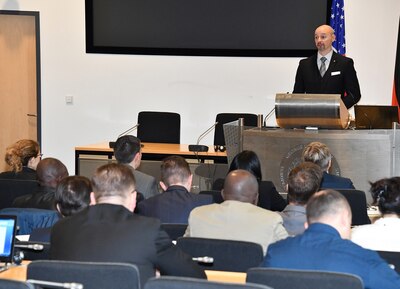
A team of eight experts from the FBI taught 33 participants from 23 countries how to bring the counterterrorism fight to the internet at the Marshall Center’s global counterterrorism workshop titled “Investigating Terrorists Online” held Nov. 27 to 30.

“Working investigations online is really the new world we live in as counterterrorism professionals, and it’s very new and complicated,” said Assistant Special Agent Christopher Serdinak, who is in charge of the counterterrorism program in Chicago for the FBI. “Counterterrorism experts around the world are trying to learn as fast as they can, because it changes so rapidly.”

Counterterrorism Network

That’s why Serdinak, who is an alumnus of the Marshall Center’s Program on Terrorism and Security Studies, asked the PTSS Director Jim Howcroft if he could bring a team of experts to teach how to target terrorists online to fellow alumni and 13 legal attachés from seven countries in the Balkans and Eastern Europe, who routinely work with the FBI.

“Chris’ willingness and initiative to put a team together and teach the latest techniques and tools to our partners around the world in the fight against terrorism was a genius move,” Howcroft said. “This is an evolving and important part of the counterterrorism fight that most people do not know much about, and the FBI has the expertise to teach us how to use this capability.”

Serdinak’s team included FBI agents, analysts and a legal attaché from his unit in Chicago and FBI headquarters in Washington.

“My team is very skilled in counterterrorism investigations,” Serdinak said. “It’s their sole task, and they do it every day.”

Exchanging Ideas

Howcroft said the workshop provided an atmosphere for the participants and FBI agents to discuss and exchange ideas, best practices and recommendations on how to investigate and take action against terrorists online.

“What we’ll do here is explore ways to share and cooperate in cyberspace to address this growing global and transnational problem,” Dayton said at the beginning of the workshop. “By the time you leave here, you will be equipped with knowledge and a renewed and expanded network of partners you can turn to when you need advice or assistance.”

Another important aspect of the workshop was that the partner nation, counterterrorism professionals met and got to know FBI agents, Howcroft said.

“This is important, because they will need to go through the FBI to access the social media companies that are based in the United States, like Twitter, Facebook and Google,” he said.

Interactive sessions dealt with identifying derogatory social media accounts, current trends and evolution of the online environment for recruitment and racialization by the Islamic State [of Iraq and Syria], and how to conduct handoffs from the FBI to foreign partners for targeting social media account users.

“A lot of the information we shared was actual technical skill, almost to the computer science level, like using different social media platforms and encrypted apps frequently used by terrorists,” Serdinak said.

‘Results Were Tremendous’

This information has already helped Ravindar Singh’s counterterrorism police team back in Malaysia.

“We only knew how to use Google to get evidence and information, but after the first day here, I learned from the FBI agents how to use different tools and devices to find other activities, which are linked together,” said Singh, who’s the assistant director of the Narcotics Intelligence Division with the Royal Malaysia Police.

“I called my team that night and told them about these new devices, and I just heard from them that the results were tremendous,” Singh added.