Tuesday, August 07, 2018

California Man Sentenced to 15 Years in Prison for Attempting to Provide Material Support to ISIS


Everitt Aaron Jameson, 27, of Modesto, California, was sentenced today to 15 years in prison, and a life term of supervised release, for attempting to provide material support to the Islamic State of Iraq and al-Sham (ISIS), a designated foreign terrorist organization.

Assistant Attorney General for National Security John C. Demers, U.S. Attorney McGregor W. Scott for the Eastern District of California, and Special Agent in Charge Sean Ragan of the FBI’s Sacramento Field Office made the announcement.  The sentence was issued by U.S. District Judge Lawrence J. O’Neill.

“There is no place in the United States for terrorists and terrorist sympathizers who threaten innocent people, and the National Security Division will relentlessly seek to identify them and bring them to justice,” said Assistant Attorney General Demers.  “Jameson put his fellow Americans at risk by supporting ISIS and planning an attack on behalf of the terrorist organization. This is unacceptable, and I am grateful for the hardworking agents and prosecutors who are responsible for this successful result.”

“This case demonstrates the FBI’s commitment to identifying and disrupting plots to harm the American public. With assistance from our state and local partners, we completed a thorough investigation while ensuring that Jameson would not be able to carry out his plans,” said Special Agent in Charge Ragan.  “The public also plays an active role in ensuring the safety of our communities. We encourage members of the public to always say something if they see or hear anything that raises concerns about a possible attack.”

Jameson pleaded guilty on June 4.  According to the plea agreement, between September 2017 and Dec. 20, 2017, Jameson voiced support for ISIS knowing that the organization was engaging in terrorist activity and terrorism.  Among other things, he had several online interactions with a confidential source, and during those interactions, he stated that he was committed wholeheartedly to “the cause.”  Jameson also expressed support online for the Oct. 31, 2017, terrorist attack in New York City, as well as other terrorist attacks.

In subsequent communications with an undercover agent, Jameson stated that he was ready to do whatever they needed done here and noted that his time in the military had trained him for combat and war.  According to court documents, Jameson joined the Marine Corps and received basic training, including earning a sharpshooter rifle qualification, but was ultimately discharged for failing to disclose his asthma history.

Later, Jameson met with another undercover agent whom he believed to be associated with, and working for, the senior leadership of ISIS, and offered to carry out violent acts and provide financial support for the terrorist organization.

According to court documents, on Dec. 16, 2017, Jameson discussed what he could offer to the cause.  Among other things, Jameson stated that he was well versed in the Anarchist Cookbook, and explained his desire to use explosives in an attack.  He also noted that he could get PVC pipe, nails and powder for explosive devices, and asked for remote timing devices from that person.  Jameson identified Pier 39 as a target location of an attack, noting that it was crowded and explosives could be used to funnel people into an area so that he could inflict casualties by shooting people trying to escape.  Jameson also offered to provide money to the cause.

This case was the product of an investigation by the FBI.  Assistant U.S. Attorneys Dawrence W. Rice Jr. and Christopher D. Baker of the Eastern District of California prosecuted the case with Trial Attorney Brenda Sue Thornton of the National Security Division’s Counterterrorism Section.

101st Resolute Support Sustainment Brigade 'Lifeliners' Train to Sustain Lives


By Army 1st Lt. Verniccia Ford, 101st Sustainment Brigade, 101st Airborne Division

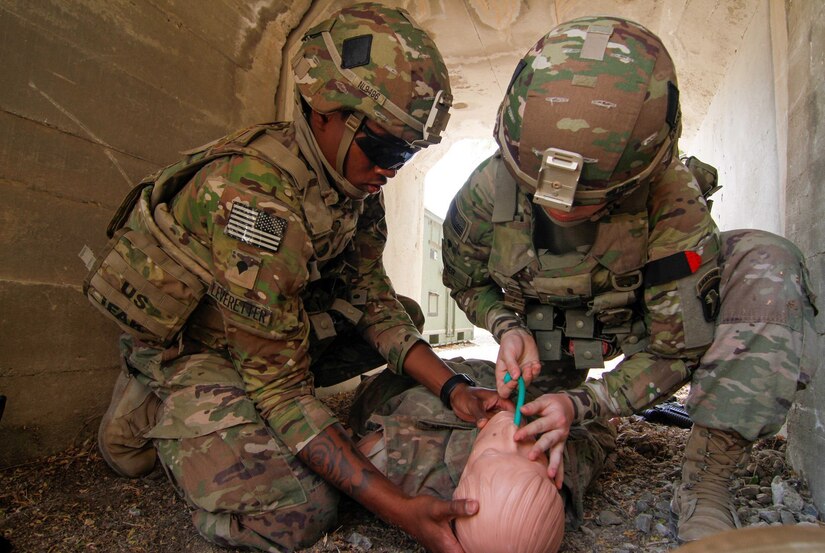
BAGRAM AIR FIELD, Afghanistan -- The 101st Resolute Support Sustainment Brigade medical team consists of three soldiers -- a family practice medical doctor and two combat medic specialists -- who work the unit’s aid station 7 days a week.

This three-man team renders medical support to more than 500 service members. With so few medical experts in the brigade, the medical team’s goal is to thoroughly train as many “Lifeliner” soldiers as possible to become qualified combat lifesavers.

“We focus on training soldiers to the U.S. Army medical school standard,” said Army Spc. Phillips Pounders, a combat medical specialist who helped facilitate the training. “It’s important to ensure that they get in-depth realistic training so in the event they do have to render aid, soldiers in our formation can count on one another to get them back home to their loved ones”.

Training

Soldiers began the training in their full combat uniforms, consisting of body armor, helmet, gloves, eye protection and their assigned weapons. During lane evaluations, soldiers ducked for cover as the sound of weapons fire rang out around them.

“The training was physically fatiguing but overall exciting. The instructors are watching your every move, sometimes screaming to make sure you’re moving in a timely fashion and following all medical guidelines to get our buddy patched up and medically evacuated off the scene,” said Army Pfc. Winshelle Pierre, an automated logistics specialist for the brigade.

“When we conduct lane evaluations, we try to make it as intense as possible to show soldiers that you will be dealing with fear and adrenaline during a real combat related incident,” said Army Staff Sgt. Tyler Rector, a combat medical specialist and course instructor.

“As a force multiplier, medics can only be in one place at a time,” he added. “On the battlefield lifesaving interventions increase the patient’s chances of survival”.

The brigade’s medical team will continue to expand their knowledge base to educate themselves and their soldiers.
“Our goal is to train all service members deployed on the importance of a properly trained combat lifesaver,” Rector said. “Everything taught can save a life and bring our brothers and sisters home safe.”

Monday, August 06, 2018

Coalition Strikes Target ISIS Terrorists in Syria, Iraq


SOUTHWEST ASIA -- Combined Joint Task Force Operation Inherent Resolve and its partners continued to strike Islamic State of Iraq and Syria targets in designated parts of Syria and Iraq between July 30 and Aug. 5, conducting 20 strikes consisting of 27 engagements, Combined Joint Task Force Operation Inherent Resolve officials reported today.

Operation Roundup, which began May 1 to accelerate the defeat of ISIS in the Middle Euphrates River Valley and Iraq-Syria border region, has continued to gain ground and remove terrorists from the battlefield through offensive operations coupled with precision coalition strike support.

Strikes in Syria

Yesterday near Abu Kamal, coalition military forces conducted a strike consisting of one engagement against ISIS targets, destroying two ISIS vehicles.

There were no reported strikes conducted in Syria on Aug. 4.

On Aug. 3 near Abu Kamal, coalition military forces conducted four strikes consisting of six engagements against ISIS targets, destroying five ISIS vehicles.

On Aug. 2 near Abu Kamal, coalition military forces conducted six strikes consisting of six engagements against ISIS targets, destroying six ISIS supply routes.

On Aug. 1 near Abu Kamal, coalition military forces conducted two strikes consisting of three engagements against ISIS targets, destroying an ISIS staging area and an ISIS vehicle-borne improvised explosive device factory.

On July 31 near Abu Kamal, coalition military forces conducted a strike consisting of one engagement against ISIS targets, destroying an ISIS command-and-control center.

There were no reported strikes conducted in Syria on July 30.

Other Strikes in Syria

On July 29, coalition military forces conducted two strikes in Syria that were not reported in the previous release:

-- Near Abu Kamal, coalition forces conducted two strikes consisting of two engagements against ISIS targets, destroying an ISIS supply route and an ISIS vehicle.

Strikes in Iraq

There were no reported strikes conducted in Iraq yesterday.

On Aug. 4 near Dulab, coalition military forces conducted a strike consisting of an engagement against ISIS targets, destroying two ISIS tunnels.

On Aug. 3 near Wadi Ashai, coalition military forces conducted a strike consisting of an engagement against an ISIS tactical unit.

There were no reported strikes conducted in Iraq on Aug. 2.

On Aug. 1 near Wadi Ashai, coalition military forces conducted a strike consisting of five engagements against ISIS targets, destroying two ISIS-held buildings and three ISIS supply caches.

On July 31 near Wadi Ashai and Wadi Zagatoon, coalition military forces conducted two strikes consisting of two engagements against ISIS targets, destroying an ISIS-held building.

On 30 July 30 near Wadi Ashai, coalition military forces conducted a strike consisting of an engagement against ISIS targets. The strike engaged an ISIS tactical unit.

Part of Operation Inherent Resolve

These strikes were conducted as part of Operation Inherent Resolve, the operation to destroy ISIS in Iraq and Syria. The destruction of ISIS targets in Iraq and Syria also further limits the group's ability to project terror and conduct external operations throughout the region and the rest of the world, task force officials said.

The list above contains all strikes conducted by fighter, attack, bomber, rotary-wing or remotely piloted aircraft; rocket-propelled artillery; and ground-based tactical artillery, officials noted.

A strike, as defined by the coalition, refers to one or more kinetic engagements that occur in roughly the same geographic location to produce a single or cumulative effect.

For example, task force officials explained, a single aircraft delivering a single weapon against a lone ISIS vehicle is one strike, but so is multiple aircraft delivering dozens of weapons against a group of ISIS-held buildings and weapon systems in a compound, having the cumulative effect of making that facility harder or impossible to use. Strike assessments are based on initial reports and may be refined, officials said.

The task force does not report the number or type of aircraft employed in a strike, the number of munitions dropped in each strike, or the number of individual munition impact points against a target.