Tuesday, June 15, 2021

Attorney General Merrick B. Garland Remarks: Domestic Terrorism Policy Address Washington, DC


Tuesday, June 15, 2021

Remarks as Delivered

Oh, this is the whole, the whole place is filled. This is good. The Great Hall is beginning to look like a great hall again. This is really good. Well, good morning. I am very happy to be in the Great Hall today with representatives of the FBI, the ATF, the U.S. Marshals Service, the Executive Office for U.S. Attorneys; and with representatives of the National Security Division, Civil Rights Division, the Criminal Division, and the Office of Justice Programs.

I am pleased to announce that the Administration is today releasing the first National Strategy for Countering Domestic Terrorism. Each of your components will play an important role in ensuring its success.

The National Strategy is designed to coordinate and provide a principled path for the federal government’s efforts to counter the heightened domestic terrorism threat, using all available tools. It is the culmination of an effort undertaken at the President’s direction by federal agencies all across the government – from the Justice Department to the Departments of Homeland Security, Defense, State, Health and Human Services, and others.

As part of this effort, our law enforcement and intelligence agencies examined the evolving threat that faces us today. From that base of understanding, we developed this National Strategy to guide the work of a broad set of federal actors.

At the Justice Department, the Deputy Attorney General and I have already begun implementing a range of measures. Among other things, we have begun to reinvigorate the Domestic Terrorism Executive Committee, and we will convene that interagency body in the coming days and months.

Attorney General Janet Reno originally created the Executive Committee in the aftermath of the 1995 Oklahoma City bombing. The investigation of that bombing, which required an enormous commitment of resources from agencies across the federal and state governments, had demonstrated the importance of such a coordination mechanism.

Our current effort comes on the heels of another large and heinous attack – this time, the January 6th assault on our nation’s Capitol. We have now – as we have then – an enormous task ahead: to move forward as a country; to punish the perpetrators; to do everything possible to prevent similar attacks; and to do so in a manner that affirms the values on which our justice system is founded and upon which our democracy depends.

The resolve and dedication with which the Justice Department has approached the investigation of the January 6th attack reflects the seriousness with which we take this assault on a mainstay of our democratic system: the peaceful transfer of power.

Over the 160 days since the attack, we have arrested over 480 individuals and brought hundreds of charges against those who attacked law enforcement officers, obstructed justice, and used deadly and dangerous weapons to those ends.

That would have not been possible without the dedication of our career prosecutors and agents, as well as the critical cooperation of ordinary Americans, who in acts large and small have shown that they are our best partners in keeping America safe. Within the very first week following the attack, members of the public took it upon themselves to submit over 100,000 pieces of digital media to the FBI.

Unfortunately, we know from experience that domestic terrorism and violent extremism comes in many forms.

Six years ago, nine Black men and women were shot and killed while praying at their church in Charleston. Four years ago this week, an attacker shot four people at a Congressional baseball practice, after confirming that the players were Republicans. Two months later, a man drove his car into a crowd of peaceful protesters against white supremacism in Charlottesville, murdering one and injuring many more.

In 2018, 11 Jewish worshippers were shot and killed at their synagogue in Pittsburgh. And two summers ago, 23 people, most of whom were Latino, were gunned down while shopping at a Walmart in El Paso.

Such attacks are not only unspeakable tragedies for the victims’ loved ones; they are also a tragedy for our country, an attack on our core ideals as a society. We must not only bring our federal resources to bear; we must adopt a broader, societal response to tackle the problem’s deeper roots.

*****

This effort begins with taking a rigorous look at the problem we face.

During President Biden’s first week in office, he directed the Administration to undertake an assessment of the domestic terrorism threat, and then to use that assessment to develop the National Strategy being released today.

Our intelligence and law enforcement agencies undertook that assessment in the first several weeks of this Administration. In March, they concluded that domestic violent extremists “pose an elevated threat to the Homeland in 2021.” Our experience on the ground confirms this. The number of open FBI domestic terrorism investigations this year has increased significantly.

According to an unclassified summary of the March intelligence assessment, the two most lethal elements of the domestic violence extremist threat are “racially or ethnically motivated violent extremists, and militia violent extremists.” In the FBI’s view, the top domestic violent extremist threat comes from “racially or ethnically motivated violent extremists, specifically those who advocated for the superiority of the white race.”

The March assessment concluded that the militia violent extremist threat, which it describes as those who “take overt steps to violently resist or facilitate the overthrow of the United States Government in support of their belief that the United States Government is purportedly exceeding its Constitutional authority,” also “increased last year and . . . will almost certainly continue to be elevated throughout 2021.”

Particularly concerning is the March assessment’s observation that the threat from lone offenders or small cells poses “significant detection and disruption challenges because of those actors’ capacity for independent radicalization to violence, ability to mobilize discretely, and access to firearms.”

The domestic violent extremist threat is also rapidly evolving. As FBI Director Wray has noted, we continue to observe actors driven by a diverse set of violent motivations — sometimes personalized and developed from a mix of violent ideologies.

Developments in technology exacerbate the overall threat. Today, people may be drawn to social media and then to encrypted communications channels.

There, they may interact with like-minded people across the country, and indeed the world, who want to commit violent attacks. And they may then connect with others who are formulating attack plans, as well as mustering the resources – including firearms and explosives – to execute them.

Technology has amplified and enabled transnational elements of the threat. In earlier days, foreign terrorist groups had to board airplanes to conduct attacks in America. Now, they take advantage of technology to inspire others already located in the U.S. to violence.

The same is true for domestic violent extremists, who increasingly take common cause and inspiration from events and actions around the world, indicating an important international dimension to this problem.

The man who allegedly killed one person and injured three in an April 2019 attack on a synagogue in Poway, California, cited as inspiration an attack that took place a month before halfway across the world in Christchurch, New Zealand. That attack killed 51 people and injured dozens more at two mosques.

*****

In response to these many and serious challenges, the National Strategy today seeks to confront the threat from all angles. The Strategy rests on four “pillars,” each of which is essential to support the whole:

“First are efforts to understand and share information regarding the full range of domestic terrorism threats. Second are efforts to prevent domestic terrorists from successfully recruiting, inciting, and mobilizing Americans to violence. Third are efforts to deter and disrupt domestic terrorist activity before it yields violence. And finally, the long-term issues that contribute to domestic terrorism in our country must be addressed to ensure that this threat diminishes over generations to come.”

The National Strategy recognizes that we cannot prevent every attack. The only way to find sustainable solutions is not only to disrupt and deter, but also to address the root causes of violence.

We have not waited until completion of the National Strategy to begin implementing it. At the Justice Department, for example:

  • The FBI has increased the domestic threat information it provides to our state, local, Tribal, and territorial partners; is enhancing training provided to these important partners; and continues to work closely with them in our Joint Terrorism Task Forces.
  • Through the Anti-Terrorism Advisory Councils that we have established in every U.S. Attorney’s Office across the country, we are strengthening our domestic terrorism-related prosecutorial resources and expertise.
  • Our Civil Rights and National Security Divisions are working more closely than ever in determining whether a given investigation should be handled as a hate crime, an incident of domestic terrorism, or both. This will ensure that we consider all appropriate criminal offenses and that, whenever we encounter domestic terrorism, we treat it for what it is.
  • Through a directive we issued earlier this year, we are ensuring that we carefully track investigations and cases with a domestic terrorism nexus.
  • And our grant-making components are dedicating additional resources to helping states, localities, and others focus on the threat. The Office of Community Oriented Policing Services, for example, has started prioritizing grants to local law enforcement agencies committed to community-based approaches to combating racially motivated violence and domestic terrorism.

And we will seek to determine whether there are any gaps in our capabilities that should, consistent with our needs and our shared values, be addressed through legislation.

To support these efforts, the President’s discretionary budget request for Fiscal Year 2022 seeks over $100 million in additional funds for the Justice Department to address the threat of domestic violent extremism and domestic terrorism.

*****

The actions that agencies are taking in support of the National Strategy are held together by several core principles.

First, we are focused on violence, not on ideology.

In America, espousing a hateful ideology is not unlawful. We do not investigate individuals for their First Amendment-protected activities.

In 1976, Attorney General Levi established the guidelines that form the foundation for a detailed set of rules that continue to govern the FBI’s conduct of investigations today. In doing that, he made clear that “Government monitoring of individuals or groups because they hold unpopular or controversial political views is intolerable in our country.”

As the National Strategy makes clear, safeguarding our country’s civil rights and liberties is itself a vital national security imperative.

We do not prosecute people for their beliefs. Across the world, “extremist” or “terrorist” labels have at times been affixed to those perceived as political threats to the ruling order. But there is no place for partisanship in the enforcement of the law. This Justice Department will not tolerate any such abuse of authority.

The National Strategy explains that “it is critical that we condemn and confront domestic terrorism regardless of the particular ideology that motivates individuals to violence.” Although we often describe violent extremist motivations by reference to different violent ideologies, the purpose of those characterizations is to help us categorize and understand motivations.

That is why, even as we’re here today to discuss domestic terrorism-related violence, we are addressing violent crime more broadly, including through a directive to reduce violent crime that the Deputy Attorney General and I announced last month in the form of a new initiative.

It is also why, even as we augment our efforts against domestic terrorism, we remain relentless in our focus on international terrorism perpetrated by foreign terrorist organizations like al-Qa’ida and ISIS.

Our focus, as members of the Department of Justice – and as a federal government – is to prevent, disrupt, and deter unlawful acts of violence, whatever their motive. As the National Strategy makes clear, there is no place for “violence as a means of resolving political differences in our democracy.”

The second principle is that we need, not only a whole-of-government, but also a whole-of-society approach to domestic terrorism. Implementation of the National Strategy will therefore occur across the federal government and beyond.

The State Department will focus on the transnational aspects of domestic terrorism, including mapping links between foreign and domestic terrorists. And, with the Department of the Treasury, it will assess whether foreign organizations and individuals linked to domestic terrorism can be designated as terrorists under existing authorities.

The Department of Homeland Security is expanding its intelligence analysis, production, and sharing. It is prioritizing relevant grant funding to support state and local partners. It is enhancing its collaboration with community-based organizations, and state, and local, and industry partners, to address domestic terrorism threats while protecting privacy, civil rights, and civil liberties. And is working to support the development of resources that enhance critical thinking and media literacy as a mechanism to strengthen resilience to misinformation and disinformation.

The Department of Homeland Security is also focused on community-based violence prevention programs in order to empower and revamp support to community partners who can help to prevent individuals from ever reaching the point of committing a terrorist attack.

The Department of Defense will train service members on the potential targeting of current and former military members by violent extremists in order to help prevent radicalization.

The Department of Health and Human Services will work with the Departments of Education, Homeland Security, and Justice to develop a website that aggregates and publicizes information on federal resources – including grants, training, and technical assistance – that can assist state and local authorities and the general public in identifying the resources they need to implement their own counter domestic terrorism programs.

And those are just a few examples.

We have a track record of successful collaborative approaches to the challenges posed by terrorism – not just at the federal level, but also with our state, local, Tribal, and territorial partners.

The Justice Department’s first Joint Terrorism Task Force, for example, was established in New York in 1980. At the time, it was staffed with just 11 FBI investigators and 11 members of the New York City Police Department.

Today, our approximately 200 Joint Terrorism Task Forces have over 4,300 officers from more than 550 local, state and federal agencies, who work together every day as our first line of defense against terrorist attacks. The work that we do to support and enhance the resource and capabilities of our local partners, who are on the front lines of our counterterrorism efforts, is vital to our success.

Nearly every day, I get a briefing from the FBI Director and his team. In those briefings, I am struck by the frequency with which a critical tip or lead in an investigation comes from a state or local law enforcement member or from a member of the public. The FBI reports that roughly 50 percent of our cases originate from tips and leads from law enforcement or private sector partners and private citizens, who identify potential threats and report them to the FBI or our partners.

Creating and maintaining an environment in which individuals, community groups, and others continue to come to us depends on the extent to which we can continue to merit their trust. This includes making sure that our determinations are made free from bias. So that, too, must be part of our long-term approach.

Equally important is our work with private industry and with international partners. The National Strategy emphasizes that the government should continue to enhance the domestic terrorism-related information it offers to the private sector.

The technology sector is particularly important to countering terrorist abuse of internet-based communication platforms to recruit, incite, plot attacks, and foment hatred.

Along with more than 50 other countries, the United States has joined the Christchurch Call to Action to collaborate with each other and relevant stakeholders – including tech companies, NGOs, and academics – to tackle the on-line aspects of this threat. The Christchurch Call is just one example of the many productive engagements we have had with our international partners.

Our third principle is that we build upon, and learn from, the past.

A look at our past efforts to combat terrorism teaches valuable lessons about what can go right and what can go wrong. It should also give us hope about our ability to rise, and adapt, to the challenge.

I am personally struck by three events that occurred not far from each other at different points in the last one hundred years.

When I visited the Greenwood District in April of this year, where Black Wall Street once thrived in Tulsa, Oklahoma, I was struck by the failure to do justice after the 1921 Tulsa Race Massacre. Over 1,250 homes were burned down; some 10,000 people were left homeless; businesses, schools, houses of worship, and 35 city blocks were destroyed. The number of people killed is estimated in the hundreds.

All that destruction and death, and not a single person was prosecuted for it.

Almost 75 years later, just over 100 miles southwest of Tulsa in Oklahoma City, after an attack that resulted in the deaths of 168 people, the Justice Department successfully apprehended, prosecuted, and convicted the men responsible for the bombing of the Murrah Federal Building.

And five years ago, across Oklahoma’s northern border in Kansas, federal authorities disrupted a plot to bomb an apartment complex and its mosque and to kill its residents – immigrants from Somalia. Working with Joint Terrorism Task Force partners, the government prevented the bombing. No one died, and those who sought to commit it were convicted of their crimes.

Since the tragedy of 9/11, we have changed our intelligence community infrastructure, created national mechanisms for coordinating counterterrorism efforts across the government, and disrupted and prosecuted hundreds of terrorism-related offenses through a legal system that has proven resilient and just.

We cannot promise that we will be able to disrupt every plot, defuse every bomb, or arrest every co-conspirator before they manage to wreak unspeakable horror. But we can promise that we will do everything in our power to prevent such tragedies. And we can further promise that we will never again fail, as we did after Tulsa, to pursue justice.

Finally, the long-term issues that contributed to domestic terrorism in America must be addressed to ensure that this threat diminishes over generations to come. To defuse the underlying causes of domestic terrorist attacks, we must promote a society that is tolerant of our differences and respectful in our disagreements.

*****

The Justice Department remains acutely aware of the continuing threat posed by international terrorist organizations. We will never take our eyes off the risk of another devastating attack by foreign terrorists. At the same time, we must respond to domestic terrorism with the same sense of purpose and dedication.

Attacks by domestic terrorists are not just attacks on their immediate victims. They are attacks on all of us collectively, aimed at rending the fabric of our democratic society and driving us apart.

To confront the menace they pose, we must: (i) understand and share information regarding the full range of threats we face; (ii) prevent domestic terrorists from successfully recruiting, inciting, and mobilizing Americans to violence; (iii) redouble and expand our efforts to deter and disrupt domestic terrorism activity before it yields violence; and (iv) address the long-term issues that contribute to domestic terrorism in our country.

The National Strategy for Countering Domestic Terrorism is a key step in our efforts. We have much work ahead. Thank you all for joining me today and for the work you will do to put this Strategy into action. Thank you.

Statement by Secretary of Defense Lloyd J. Austin III on the National Strategy for Countering Domestic Terrorism

 June 15, 2021


The release today of the first-ever National Strategy for Countering Domestic Terrorism is a milestone in our country’s efforts to address a serious and growing security threat. While domestic law enforcement agencies take the lead, the Department of Defense will do our part to support this important strategy. That includes maintaining the Department’s robust relationship with federal law enforcement as well as refining our policies to better address this issue within the Department. 

20 years post-9/11: Crisis management lessons learned from the horrific events at Ground Zero

 Wed, Sep 1, 2021 10:00 AM - 11:15 AM PDT

The events of 9/11 created permanent changes in the provision of emergency services. Remembering the lives lost, recovery efforts and long-term influences are essential for emergency service professionals in all disciplines. Major incident response has been a discussion for decades, but what have fire, EMS and law enforcement learned from these events?

This webinar will discuss the lessons learned at what took place after the 9/11 attack, the logistics and the aftermath on the victims and the community response from a historical and 20 years later perspective. Remember, it’s not just the response, it’s the recovery process.

Some of the lessons that will be shared will discuss the ever-changing environment, the tasking and the sheer magnitude of the event that would require a constant shifting and reevaluation of the process.

The presenters will deliver a close look at behind the scenes of Ground Zero as well as a look at the golden hour that must be explored for success. The webinar presenters will:

•             Describe the complex sociopolitical environments created at Ground Zero and in other large-scale disasters.

•             Share lessons from operational decision-making at Ground Zero to promote learning for future decision-making in events.

•             Describe the importance of decision made in the golden hour.

•             Explore tools to enhance the preparedness, recovery, and resilience capabilities of responders.

•             Reinforce the importance of meeting the physical and mental health needs of responders.

Presenters Mike Fagel and Greg Benson will share their experiences. Fagel was assigned to FDNY at Ground Zero for 100 Days in 2001. Dr. Fagel spent 40 years in public safety (fire, EMS, law enforcement and emergency management). Chief Benson has spent over 30 years in the fire service and has helped to establish two brand new fire departments in the last 15 years. Fagel and Benson teach at the Illinois Institute of Technology, Master of Public Policy Program.

Register

Statement from Secretary Mayorkas on the National Strategy for Countering Domestic Terrorism

 With today’s release of the first-ever National Strategy for Countering Domestic Terrorism, President Biden is demonstrating his steadfast commitment to addressing the most significant and persistent terrorism-related threat to the homeland today.


In furtherance of the National Strategy, the Department of Homeland Security (DHS) will remain focused on addressing violence, while at the same time protecting privacy, civil rights, and civil liberties.


DHS is undertaking a number of actions as part of an all-of-government effort to fight domestic terrorism. DHS is enhancing its analysis of open-source information to identify threats and leverage credible threat-analysis produced by others. The Department is continuing its efforts to provide timely and useful information to state, local, tribal, and territorial law enforcement as well as international and private sector partners. DHS is developing key partnerships with local stakeholders through the Center for Prevention Programs and Partnerships (CP3) to identify potential threats and prevent terrorism. For the first time, the Department designated domestic violent extremism as a “National Priority Area” within DHS’s Homeland Security Grants, which will provide local partners with more than $77 million to prevent, protect against, and respond to domestic violent extremism. 


We must and we will remain vigilant in our steadfast efforts to safeguard our Nation and our democratic principles.

Friday, June 11, 2021

DOD Identifies Army Casualty

 June 11, 2021


The Department of Defense announced today the death of a soldier who was supporting Operation Inherent Resolve.

Spc. Joshua S. Robinson, 22, of Baton Rouge, Louisiana, died Jun. 10, 2021, at Camp Buehring, Kuwait, as a result of a non-combat related incident. The incident is under investigation.

Robinson was assigned to 3rd Battalion, 156th Infantry Regiment, Louisiana Army National Guard, Lake Charles, Louisiana.

For more information about Spc. Joshua Robinson, members of the media may contact Maj. Noel Collins, Public Affairs Officer, Louisiana National Guard, Pineville, Louisiana at 318-290-5027 or by email at elizabeth.n.collins.mil@mail.mil.

Thursday, June 10, 2021

Guantanamo Periodic Review Board Media Invitation Announced

 June 10, 2021


The Department of Defense will allocate seats for news media at the Pentagon satellite viewing location on June 22, 2021, to cover unclassified portions of the Guantanamo Periodic Review Board for Suhayl Abdul Anam al Sharabi (ISN - 569).

Due to limited space availability, selection is not guaranteed. Upon selection, additional information on meeting time and location will be provided.

Media desiring to observe the hearing should send requests via email to osd.pentagon.pa.mbx.gtmo-press@mail.mil.

All requests must be received no later than noon ET June 17, 2021. Media members should include their name, position, sponsoring organization and contact information (cell phone and email address) in their request. Multiple names from the same organization may be submitted.

Further information, including media ground rules, can be viewed at the Periodic Review Secretariat website at https://www.prs.mil/.

Third And Final Lansing Defendant Convicted Of Terrorism Charge

 Defendants Muse Muse, Mohamud Muse, and Mohamed Haji Conspired to Provide Material Support to ISIS

          GRAND RAPIDS, MICHIGAN — United States Attorney Andrew Birge announced today that three residents of Lansing, Michigan have been convicted of conspiring to provide material support to a designated foreign terrorist organization, namely the Islamic State of Iraq and al-Sham (“ISIS”).  Today, the third and final defendant in the case, Mohamed Haji, pleaded guilty to the federal crime of conspiring to provide material support to a designated foreign terrorist organization. In January 2020, his co-defendants Muse Muse and Mohamud Muse pleaded guilty to the same offense. 

          On January 21, 2019, special agents of the Federal Bureau of Investigation (FBI) and members of its Joint Terrorism Task Force arrested defendant Muse Muse at the Gerald R. Ford International Airport in Grand Rapids, Michigan, after he checked in for a flight to the first of a series of destinations on his way to Mogadishu, Somalia, with the goal of joining ISIS.  Shortly thereafter, his brother Mohamud Muse and cousin Mohamed Haji were arrested as co-conspirators. According to court documents, between December 2018 and January 2019, Muse Muse coordinated with an individual he believed to be a Somali ISIS fighter to wire funds to be used to purchase airline tickets for travel to Mogadishu, Somalia, where he believed he would meet an ISIS representative. All three defendants picked up money to provide Muse Muse the funds to travel to join ISIS, all three defendants pledged allegiance to ISIS in recorded videos, and all three submitted their videos to individuals they believed were associated with ISIS.  Additionally, throughout the conspiracy, all three defendants participated in numerous discussions during which they discussed traveling overseas to join ISIS and even adopted fighter aliases by which they would be known when fighting for ISIS.

          Muse, Mohamud Muse, and Haji were indicted by a federal grand jury on multiple charges, including conspiracy to provide material support to a designated foreign terrorist organization.  This federal offense required the government to prove that Haji: (1) agreed with one or more individuals to provide material support or resources (which includes personnel) to ISIS, a foreign terrorist organization; (2) knew that ISIS was a designated foreign terrorist organization or had engaged or engages in terrorist activity or terrorism; and (3) is a U.S. national or some part of the offense occurred in the United States.  At his change of plea hearing before Chief United States District Judge Robert J. Jonker, Haji admitted each of those elements of the crime.

          All three defendants will be sentenced by Chief Judge Jonker at a later date.  The crime is punishable by up to 20 years in federal prison.  The Court will determine the ultimate sentence to be imposed after evaluating the applicable federal Sentencing Guidelines and considering the statutory sentencing factors, including the nature and circumstances of the offense; the history and characteristics of each defendant; the seriousness of the offense; and the need to promote respect for the law, to provide just punishment, and protect the public from future crimes of each defendant.

          United States Attorney Andrew Birge stated, “There is no priority higher for my Office than detecting, preventing and prosecuting terrorism. With this successful investigation and prosecution, the United States Attorney’s office and its law enforcement partners prevented these young men from assisting a dangerous international terrorist organization and held them accountable for conspiring to do so. Nearly 80 countries around the globe have committed to eliminating the threat ISIS poses. Every person and every resource bound for a terrorist organization that we intercept impacts the ability of that organization to carry out attacks here and overseas.  Every conviction sends a powerful message of deterrence.”

          “As this case demonstrates, the threat from foreign terrorist organizations has not ended. The FBI works every day to identify and disrupt those acting in support of these groups both in the United States and throughout the world. The FBI will continue to aggressively pursue these investigations and hold accountable those who provide material support to foreign terrorist groups,” said Timothy Waters, Special Agent in Charge of the FBI’s Detroit Field Office. “The successful disruption of Muse Muse’s plan to travel overseas, and the conviction of those who aided him in that plan, is the result of the hard work and dedication of the FBI’s Joint Terrorism Task Force, which remains committed to protecting the public from terror attacks.”

          The FBI’s investigation was assisted by the Michigan State Police, Kent County Sheriff’s Office, Eaton County Sheriff’s Office, Michigan State University Police Department, Lansing Police Department, Grand Rapids Police Department, Gerald R. Ford Airport Police, the U.S. Marshals Service, and the Department of Homeland Security Transportation Security Administration, Federal Air Marshals, and Customs and Border Protection.

          Assistant United States Attorneys Clay West and Christopher O’Connor are prosecuting the case with assistance from the National Security Division Counterterrorism Section.

DOD Identifies Army Casualty

 June 10, 2021


The Department of Defense announced today the death of a soldier who was supporting Operation Inherent Resolve.

1st Sgt. Casey J. Hart, 42, of Baton Rouge, Louisiana, died Jun. 8, 2021, at Walter Reed National Military Medical Center, Bethesda, Maryland, as a result of a non-combat related incident May 9, 2021, at Al-Tanf Garrison, Syria. The incident is under investigation.

Hart was assigned to 256th Infantry Brigade Combat Team, Louisiana Army National Guard, Lafayette, Louisiana.

For more information about 1st Sgt. Casey Hart, members of the media may contact Maj. Noel Collins, Public Affairs Officer, Louisiana National Guard, Pineville, Louisiana at (318) 290-5027 or by email at elizabeth.n.collins.mil@mail.mil.

Wednesday, June 09, 2021

Third and Final Defendant Pleads Guilty to Conspiring to Provide Material Support to ISIS

 Today, Mohamed Haji, 28, of Lansing, Michigan, pleaded guilty to conspiring to provide material support to a designated foreign terrorist organization, namely the Islamic State of Iraq and al-Sham, aka ISIS. In January 2020, his co-defendants Muse Muse and Mohamud Muse pleaded guilty to the same offense.

According to court documents, between December 2018 and January 2019, co-defendant Muse Muse coordinated with an individual he believed to be a Somali ISIS fighter to wire funds to be used to purchase airline tickets for travel to Mogadishu, Somalia, where he believed he would meet an ISIS representative. All three defendants: picked up money to provide Muse Muse the funds to travel to join ISIS, pledged allegiance to ISIS in recorded videos, and submitted their videos to individuals they believed were associated with ISIS. Additionally, throughout the conspiracy, all three defendants participated in numerous discussions regarding traveling overseas to join ISIS and even adopted fighter aliases by which they would be known when fighting for ISIS.

On Jan. 21, 2019, special agents of the FBI and members of its Joint Terrorism Task Force (JTTF) arrested defendant Muse Muse at the Gerald R. Ford International Airport in Grand Rapids, after he checked in for a flight to the first of a series of destinations on his way to Mogadishu with the goal of joining ISIS. Shortly thereafter, his brother Mohamud Muse and cousin Mohamed Haji were arrested as co-conspirators.

Muse, Mohamud Muse and Haji were indicted by a federal grand jury on multiple charges, including conspiracy to provide material support to a designated foreign terrorist organization. This federal offense required the government to prove that Haji: (1) agreed with one or more individuals to provide material support or resources (which includes personnel) to ISIS, a foreign terrorist organization; (2) knew that ISIS was a designated foreign terrorist organization or had engaged or engages in terrorist activity; and (3) is a U.S. national or some part of the offense occurred in the United States. Haji admitted each of those elements of the crime. He is scheduled to be sentenced on Sept. 22 and faces a maximum of 20 years in prison. A federal district court judge will determine any sentence after considering the U.S. Sentencing Guidelines and other statutory factors.

Assistant Attorney General John C. Demers of the Justice Department’s National Security Division and U.S. Attorney Andrew Birge for the Western District of Michigan made the announcement.

The FBI is investigating the case, with valuable assistance provided by the Michigan State Police, Kent County Sheriff’s Office, Eaton County Sheriff’s Office, Michigan State University Police Department, Lansing Police Department, Grand Rapids Police Department, Grand Rapids Airport Police, the U.S. Marshals Service, and the Department of Homeland Security's Transportation Security Administration, Federal Air Marshals, and U.S. Customs and Border Protection.

Trial Attorney David Smith of the National Security Division’s Counterterrorism Section and Assistant U.S. Attorneys Clay M. West and Christopher M. O’Connor of the Western District of Michigan are prosecuting the case.

Monday, June 07, 2021

Military Commissions Media Invitation Announced for United States v. Majid Shoukat Khan Pre-Sentencing Motions Hearing

 June 7, 2021


The Department of Defense and the Office of Military Commissions will allocate seats for news media aboard a military-chartered aircraft for travel from Joint Base Andrews (JBA) in Maryland to Naval Station Guantanamo Bay (NSGB) Cuba to cover military commission proceedings scheduled for United States v. Majid Shoukat Khan, July 27 – 28, 2021.

Currently, the tentative flights will be available as follows:

  • July 25 – Joint Base Andrews to Naval Station Guantanamo Bay
  • July 29 – Naval Station Guantanamo Bay to Joint Base Andrews

Please note that the flight schedule, to include departure and arrival locations, is subject to change. Media desiring to view this hearing from NSGB must complete the registration form. All requests must be received no later than noon EST, Friday, June 11. Multiple requesters from the same organization must register separately via the form.

Due to a limited number of seats aboard the flight and limited accommodations at NSGB, selection is not guaranteed. Additionally, all traveling media shall have printed proof of a negative polymerase chain reaction COVID-19 viral test within 72 hours prior to departing the national capital region. A test is not required for media who have a confirmed COVID positive test result within 90 days of travel if written proof from a medical provider can be provided no later than July 9.

Media who can provide proof of being fully vaccinated will be allowed on the OMC charter flight. Media who are fully vaccinated (post 14-days from receiving complete COVID 19 vaccination) are not required to quarantine upon arrival at NSGB. Media who are not fully vaccinated may not view the hearing from NSGB. All media are subject to surveillance testing while on NSGB and will adhere to personal protective equipment (PPE) requirements directed by the NSGB Commanding Officer.

Additional viewing is available for media via Closed Circuit Television (CCTV) from a media work center at Fort George G. Meade, in Maryland. Regular COVID-19 mitigation protocols, such as mask wearing and social distancing may apply at all locations depending on local guidance and vaccination status, although media viewing from Fort Meade are not subject to COVID-19 testing or ROM requirements.

Media desiring to view this hearing from Fort Meade must send their requests via email to osd.mc-alex.OMC.mbx.omc-pa@mail.mil with the following information (multiple requesters from the same organization must send separate emails):

Subject Line: Khan 27-28 JULY 2021

  • Individual's full name
  • Individual's occupation/position
  • Sponsoring organization (News Outlet)
  • Contact information (cell phone and email)

NOTE 1: The primary purpose of travel to Guantanamo Bay, Cuba is courtroom reporting. Tours of the detention facilities are not available. Requests for reporting on Guantanamo topics unrelated to the military commissions must be coordinated in advance through the respective Public Affairs Officers of the Office of the Secretary of Defense, U.S. Southern Command, and/or NSGB.

NOTE 2: All media must ensure their passports and visas (foreign press) are up-to-date and eligible to enter and exit the United States.

View Expeditionary Legal Complex – B-roll 2017 

View Expeditionary Legal Complex – Photos 2014

Further information including the media ground rules can be viewed at the Office of Military Commissions website at https://www.mc.mil.

Wednesday, June 02, 2021

Military Leaders Plan for Post-Withdrawal Financial Support for Afghans

 June 2, 2021 | BY C. Todd Lopez , DOD News

Following the withdrawal from Afghanistan, the U.S. plans to continue providing financial support to the Afghans and to build on existing "over-the-horizon" anti-terrorism capacity in the region.

"I want to stress ... that, right now, the focus of the post-withdrawal support to the Afghan ... National Defense and Security Forces is going to be largely through financial means, with some over-the-horizon logistical support," Pentagon Press Secretary John F. Kirby said during a media briefing today. "For example, aircraft maintenance, that's really where the focus of the efforts are."

A combat vehicle along a gravel road with mountains in the background.  A soldier sits atop the vehicle near a gun that is mounted on the roof.

Marine Corps Gen. Kenneth F. McKenzie Jr., the commander of U.S. Central Command, and his staff are working now to develop that plan in Afghanistan before the U.S. leaves, Kirby said. The Defense Department is also working with the State Department regarding the diplomatic efforts required for over-the-horizon basing opportunities in the region.

Financial support for the Afghan National Defense and Security Forces — meant to provide resources for such things as salaries for soldiers and police — is expected to continue much as it has for most of the last 15 years, Kirby said.

Over-the-horizon capacity includes the ability to continue to protect the United States from the terrorist threats that exist in any nation in the region, even if the U.S. is not specifically in that country. The U.S. already has such capabilities in the Middle East, and more will come.

Housing, walls and other structures are nestled in a valley.

"We already have at our disposal over-the-horizon counterterrorism capabilities to support our desires that no additional threats to our homeland can emanate from Afghanistan," Kirby said. "That said ... we want to have additional capabilities, and we're working through that."

Kirby also explained why it's important, once the U.S. leaves Afghanistan, that the airport in Kabul remains secure and open to operations.

"The airport would provide, obviously, aside from the transportation support for people and for equipment ... it would also provide a needed logistical hub, not just for our embassy, but for the embassies of other nations that want to maintain diplomatic presence there in Afghanistan," he said. "Obviously, in a country like Afghanistan, security of that logistical hub is important, and you want to make sure that, that it can ... be properly ensured and protected."

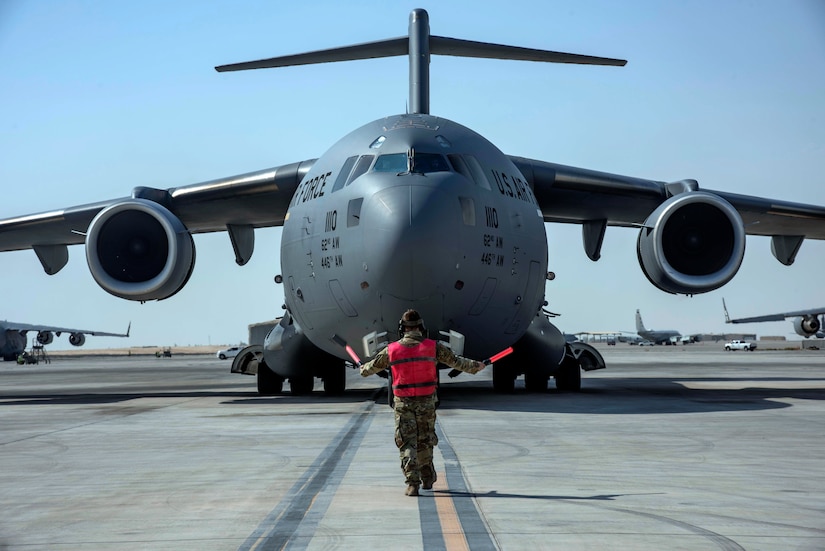
A large military aircraft is on an airfield. A service member uses hand wands to guide the aircraft.

Centcom is now working to get U.S. forces out of Afghanistan. Yesterday, the command reported that nearly 13,000 pieces of gear have been turned into the Defense Logistics Agency there, and around 300 C-17 loads of materiel have been moved out of the country. The command has also turned six facilities over to the Afghan Ministry of Defense. The command estimates that the retrograde from Afghanistan is between 30% and 44% complete.

Tuesday, June 01, 2021

Man Charged with Attempting to Provide Material Support to a Foreign Terrorist Organization

 WASHINGTON – A Washington man was arrested on Friday, May 28, at Seattle-Tacoma International Airport on criminal charges related to his alleged efforts to join Islamic State of Iraq and al-Sham (ISIS), a designated foreign terrorist organization, in order to engage in violent acts of terrorism in the Middle East or the United States.

According to court documents, Elvin Hunter Bgorn Williams, 20, of Seattle, was arrested as he prepared to board an international flight following a lengthy investigation into his efforts to join ISIS.

“As alleged, Williams was determined to support ISIS either by traveling overseas to join and fight with the terrorist organization, or by conducting an attack here in the United States,” said Assistant Attorney General John C. Demers for the Justice Department’s National Security Division. “The FBI was just as determined to stop him, and he was intercepted as he tried to make his way abroad. The threat of terrorism at home and abroad remains, and the National Security Division is committed to holding accountable those who would provide material support to foreign terrorist organizations. I want to thank the agents, analysts, and prosecutors who are responsible for this case.”

“This defendant proved persistent in his efforts to join ISIS – speaking with enthusiasm about acts of horrific bloodshed in the Middle East and here at home,” said Acting U.S. Attorney Tessa M. Gorman for the Western District of Washington. “I want to commend those citizens who contacted law enforcement – including his family and faith community - expressing concerns about the defendant’s radicalization. Their courage to speak up and work with law enforcement was important to ensure public safety.”

“This individual self-radicalized, pledged loyalty to ISIS, and became consumed with activities to join the cause overseas,” said Special Agent in Charge Donald M. Voiret of the FBI Seattle Field Office. “We are grateful for the concerned citizens and family members who reported his behavior on multiple occasions and all of the law enforcement agencies who worked tirelessly on this case. These combined efforts no doubt saved lives.”

In November 2020, a member of a Seattle-area mosque contacted the FBI with concerns about Williams. The mosque had attempted to provide support and guidance to Williams, but members became aware he was deeply involved in ISIS propaganda. Williams was using mosque-provided electronic devices to engage in online chats with ISIS radicals and to view ISIS propaganda videos of beheadings and other acts of violence. In November 2020, Williams allegedly swore an oath of allegiance to ISIS.

Using confidential sources close to Williams, the FBI monitored his activity and became aware of his efforts to travel to the Middle East and join ISIS. Williams expressed to his associates that if he could not travel overseas, he would commit an attack in the U.S. on behalf of ISIS. Williams began communicating with those he believed were ISIS recruiters who could get him to an ISIS terror cell in the Middle East or other parts of the world.

In early May 2021, Williams booked airline travel from Seattle to Amsterdam and on to Egypt to join ISIS. On Friday May 28, 2021, he went to Sea-Tac Airport to catch the first leg of his international flight. Williams was arrested at the departure gate.

Williams is charged with attempting to provide material support to a foreign terrorist organization. If convicted, he faces up to 20 years in prison. A federal district court judge will determine any sentence after considering the U.S. Sentencing Guidelines and other statutory factors.

The FBI’s Joint Terrorism Task Force in Seattle with assistance from the King County Sheriff’s Office; U.S. Customs and Border Protection; Homeland Security Investigations; Federal Air Marshals; U.S. Citizenship and Immigration Services; U.S Marshals Service; U.S. Postal Inspection Service; Transportation Security Administration; Bureau of Alcohol, Tobacco, Firearms and Explosives; Naval Criminal Investigative Service; Seattle Police Department; Bellevue Police Department; and Port of Seattle Police Department are investigating the case.

Assistant U.S. Attorney Todd Greenberg of the Western District of Washington’s Violent Crimes and Terrorism Unit, and Trial Attorney Andrew Sigler of the National Security Division’s Counterterrorism Section are prosecuting the case.

A complaint is merely an allegation and all defendants are presumed innocent until proven guilty beyond a reasonable doubt in a court of law.

Military Commissions Media Invitation Announced for United States v. Abd al Hadi al Iraqi Pre-Trial Motions Hearing

 June 1, 2021


The Department of Defense and the Office of Military Commissions (OMC) will allocate seats for news media aboard a military-chartered aircraft for travel from Joint Base Andrews (JBA) in Maryland to Naval Station Guantanamo Bay (NSGB) Cuba to cover military commission proceedings scheduled for United States v. Abd al Hadi al Iraqi, July 13 – 14, 2021.

Currently, the tentative flight will be available as follows:

  • July 10 – Joint Base Andrews to Naval Station Guantanamo Bay
  • July 15 – Naval Station Guantanamo Bay to Joint Base Andrews

Please note that the flight schedule, to include departure and arrival locations, is subject to change. Media desiring to view this hearing from NSGB must complete the registration form. All requests must be received no later than noon EST, Friday, June 4. Multiple requesters from the same organization must register separately via the form.

Due to a limited number of seats aboard the flight and limited accommodations at NSGB, selection is not guaranteed. Additionally, all traveling media shall have printed proof of a negative polymerase chain reaction COVID-19 viral test within 72 hours prior to departing the national capital region. A test is not required for media who have a confirmed COVID positive test result within 90-days of travel if written proof from a medical provider can be provided no later than June 25.

Media who can provide proof of being fully vaccinated will be allowed on the OMC charter flight. Media who are fully vaccinated (post 14-days from receiving COVID 19 vaccination) are not required to quarantine upon arrival at NSGB. Media who are not fully vaccinated may not view the hearing from NSGB. All media are subject to surveillance testing while on NSGB and will adhere to personal protective equipment (PPE) requirements directed by the NSGB Commanding Officer.

Additional viewing is available for media via Closed Circuit Television (CCTV) from a media work center at Fort George G. Meade, in Maryland. Regular COVID-19 mitigation protocols, such as mask wearing and social distancing may apply at all locations depending on local guidance and vaccination status, although media viewing from Fort Meade are not subject to COVID-19 testing or quarantine requirements.

Media desiring to view this hearing from Fort Meade must send their requests via email to osd.mc-alex.OMC.mbx.omc-pa@mail.mil with the following information (multiple requesters from the same organization must send separate emails):

Email Subject Line: Hadi 13-14 JULY 2021

  • Individual's full name
  • Individual's occupation/position
  • Sponsoring organization (News Outlet)
  • Contact information (cell phone and email)

NOTE 1: The primary purpose of travel to Guantanamo Bay, Cuba is courtroom reporting. Tours of the detention facilities are not available during military commission proceedings. Requests for reporting on Guantanamo topics unrelated to the military commissions must be coordinated in advance through the respective Public Affairs Officers of the Office of the Secretary of Defense, U.S. Southern Command, and/or NSGB.

NOTE 2: All media must ensure their passports and visas (foreign press) are up-to-date and eligible to enter and exit the United States.