Friday, August 13, 2021

Pentagon Press Secretary John F. Kirby Holds a Press Briefing on Afghanistan

 Aug. 12, 2021

Pentagon Press Secretary John F. Kirby

PRESS SECRETARY JOHN F. KIRBY: Afternoon, everybody. Just a couple of things at the top here. As you know, and I'm sure you heard from my colleague over at the State Department, the president has ordered the reduction of civilian personnel at our embassy in Kabul and the acceleration of the evacuation of Afghan Special Immigrant Visa applicants from the country.

To enable this safe, orderly reduction, the Secretary of Defense has directed the department to position temporary enabling capabilities to ensure the safety and security of U.S. and partner civilian personnel. I'm going to break this down for you just real quick.

The first movement will consist of three infantry battalions that are currently in the Central Command area of responsibility. They will move to Hamid Karzai International Airport in Kabul within the next 24 to 48 hours. Two of those battalions are United States Marines and one is a U.S. Army battalion.

The next movement will consist of a joint U.S. Army-Air Force support element of around 1,000 personnel to facilitate the processing of SIV applicants. Initial elements of this movement -- of this element will arrive in Qatar in the coming days.

The third movement is to alert and to deploy one infantry brigade combat team out of Fort Bragg to Kuwait, where they will be postured and prepared, if needed, to provide additional security at the airport. We anticipate those forces will reach Kuwait sometime within the next week.

Now, I want to stress that these forces are being deployed to support the orderly and safe reduction of civilian personnel at the request of the State Department and to help facilitate an accelerated process of -- of working through SIV applicants. This is a temporary mission with a narrow focus. As with all deployments of our troops into harm's way, our commanders have the inherent right of self defense and any attack on them can and will be met with a forceful and an appropriate response.

As Ned Price, my colleague at the State Department, highlighted earlier, Secretary Austin did join Secretary Blinken in a phone call this morning with President Ghani. These conversations with allies and partners will continue to ensure close coordination going forward.

With that, we'll take questions. Bob, I think you're first.

Q: Thank you, John. Thank you for spelling out some of the -- breaking down some of the numbers. With regard to those forces that are going into Afghanistan to work specifically on supporting the removal or evacuation or whatever you call it of personnel from the embassy, is that about 3,000 people? And also, is that in addition to the 600 or 650 who are already there doing that sort of work?

MR. KIRBY: Yes, Bob, the -- those three infantry battalions will comprise approximately 3,000 personnel and they will be in addition to those troops that are already in -- in Kabul as we conduct -- as -- you know, in the process of conducting our drawdown. So we still have more than 650 troops in -- in Kabul right now. These 3,000 will join them there.

Q: Can I do a quick follow up?

MR. KIRBY:  Sure.

Q:  Thank you.  Does the military mission include flying U.S. civilian personnel, the -- the embassy personnel out of the country or only processing and securing them at the airport?

MR. KIRBY: We certainly anticipate being postured to support airlift, as well, for not only the reduction of civilian personnel from the embassy, but also in the forward movement of Special Immigrant Visa applicants. So we do anticipate that there will be airlift required of us and we are working through the -- the final plans right now to -- to put that into place.

Q: Thank you.

MR. KIRBY: Yeah. Tom?

Q: Thanks, John. In regards to what you just said to Bob about the possible airlifting out of individuals, in regards to the Special Immigrant Visa applicants, what – has it been decided yet where they will be airlifted to? And if so, where, please?

MR. KIRBY: We're still working through a series of options here, Tom. We anticipate that we'll be looking at locations overseas, outside of the United States, as well as U.S. installations that -- you know, that belong to the United States, either overseas and/or here at home.

We don't have -- I -- I don't have a list for you right now, but -- but I think it'll be a -- a mix of both. And as we get more clarity on that, we'll certainly update you.

Q: And just to -- just to be clear, with all of the same criteria you've outlined earlier, those who have passed the security clearance could come within the United States and those without at other locations?

MR. KIRBY: I'm going to defer to the -- my State Department colleagues to talk to the SIV process more specifically. Our job will be in locating and helping secure facilities and installations that can be used. And as we did with Fort Lee, I think you can expect the Defense Department will lean in, to the degree possible that we can, to help facilitate this movement and relocation.

Q: Thanks.

MR. KIRBY: David?

Q: John, will those -- these infantry battalions help with the movement of diplomats from the embassy to the airport, as well as moving them out of the country? And if so, will that movement be done by convoy or will it be done by helicopter?

And let me just add one more question.

MR. KIRBY: Sure.

Q: You say "temporarily" ...

MR. KIRBY: I do.

Q: ... but aren't they going to remain there in case further drawdowns are ordered?

MR. KIRBY: So let me take the first one first. These infantry battalions will be there to help facilitate this safe and orderly reduction. And -- and I don't want to get into too much tactical detail about what that would require.

Commanders on the ground will be working with the State Department to determine what is -- what's -- what's most needed. And if it is to help facilitate and secure transportation to the airport, then our troops will be postured to do that.

But again, I -- I -- I can't speak here today when they're not even there yet about what that's going to look like -- what the transportation's going to look like, and -- and some of this, David, is going to depend on the degree of permissibility and the environment and the security environment, but these are infantry battalions that are highly trained and will have the capabilities to support in any manner what the State Department needs to facilitate this reduction.

Your second question on the temporary nature. As the State Department has said, they're going to try to complete this reduction of their personnel by the end of this month and these troops are being ordered in to help facilitate that purpose, that mission along that timeline.

I won't speculate beyond August 31st as to what the footprint’s going to look like or how many troops are going to be there and what they're going to be doing. What I can tell you is, we're focused on trying to get them there as soon as possible to facilitate this mission, which is the reduction of civilian personnel by the end of the month.

Q: And one follow-up, was there a specific event, which triggered this decision?

MR. KIRBY: It would be wrong to conclude that there was one specific event that led to this decision that we believe this is the prudent thing to do given the rapidly deteriorating security situation in and around Kabul. So I think there's a confluence of things you guys have all been reporting over the last 24 to 36 hours, the Taliban's advances and where they are.

And I think again, cognizant of that security situation, this administration believed that this was a prudent action to take.

Q: One math question.

MR. KIRBY: Sure.

Q: 3,650 and then another 1,000 of this joint task force to process. So --

MR. KIRBY: It’s joint Army, Air Force. Yes, that's about 1,000 personnel. It’s engineers, it’s medical personnel, it’s military police, that kind of thing. And they -- they are going to Qatar right now because, as you know, we've been working with countries in the region, to Tom's question, to try to find processing sites outside Afghanistan. So I would just tell you they're going to Qatar for now and then we'll see what the need is after that.

But we want to be flexible and we want to get them close by and in the region. And that's why they're going there right now.

Courtney.

Q: And then there's one infantry BCT that's going to Kuwait, you said. And that's only if things go bad you have like a QRF basically, right?

MR. KIRBY: They'll be there postured, as prepared, if there's a need for additional security at the airport. They'll be -- they'll be in the region and a lot more accessible.

Q: OK. So -- and then the ones who are going to Qatar, that's specifically for SIV applicants. I mean it sounds like engineers, medical, and MPs; they're going to -- it sounds like to build --

MR. KIRBY: No, when I say engineers actually we're talking about a very small number of engineers and it's largely for electrical power. It's to make sure that we actually have, you know, power to do the processing of -- of applicants. I don't -- by engineers I didn't mean construction and that kind of thing.

Q: So the -- the BCT going to Kuwait, that's like what, a roughly 3,000 to 3,500 people, right, total?

MR. KIRBY: A common infantry, combat brigade is about 3,500 to 4,000 people.

Q: So why is it -- I'm unclear why -- so it's 3,000 people that are going to HKIA right away in the coming days. And then you have another 3,500 who will be there on standby in case, all for security. I'm unclear what they're doing.

I'm mean, if the 3,000 going to HKIA, it's like a couple of miles from the embassy to HKIA. What exactly are -- are 3,000 people doing? Are they -- are they just there securing the airport then?

MR. KIRBY: They'll be there to provide safety and secure -- and secure movement of the reduction of civilian personnel out of the embassy to help -- to help facilitate their departure from the country, to also help with the process of moving special immigrant visa applicants out of the country, and to provide additional security at the airport. Again, we believe this a prudent measure, given the deteriorating security situation.

Q: You're talking a lot of people though. I mean I'm still -- what is -- I -- I -- can you give any better sense of like on a day to day what are they doing. I mean it sounds like they must be -- that number of people of people they must be responsible for getting people to the airport and then actually -- it almost sounds as they're coming in and taking over security at the airport if it's that --

MR. KIRBY: I wouldn't go that far, Courtney. The -- the Turkish forces are still at the airport. The Turks are still in the lead of security at the airport. We already have some security forces, United States security forces at the airport, including some aviation elements.

These 3,000 would be going to bolster that presence and to make sure that -- that the airport is secure enough to facilitate the movement of all these people over the next couple of weeks.

Again, this is about prudent preparation. And we want to make sure that we've got enough on hand to -- to adapt to any, you know, contingencies. So I -- your question about the numbers being too high, we believe it's appropriate to the security situation that we see now and that we can anticipate possible in the -- possibly in the future, which is again why we're going to flow a brigade combat team into the theater to be ready in case we need even more.

Now hopefully, Courtney, this will be an incredibly permissive environment and we won't need these additional capabilities. But the secretary believes the safety and security of our people, not just American troops, but our allies and partners and our State Department colleagues, is of paramount concern and he's not going to add additional risk to that -- to that safe movement.

Q: Just very quickly; Kandahar city and Heart city, can you confirm what the Taliban are reporting, that they've taken it?

MR. KIRBY: I can't. And I'm not going to do battlefield assessments here from the Pentagon podium. Yes. Let me go back to the phones. I know we got lots to get through.

Tara Kopp.

Q: Hey, John. Thanks for doing this. A couple questions. The infantry battalions, where are they coming from?

MR. KIRBY: The three infantry battalions that I talked about are already coming from inside the Central Command area of responsibility and I think I'd rather leave it at that for now. They're already in theater.

Q: OK. Thank you. And then the 1,000 that will be at Qatar, is the intent that they will stay at Qatar or would they also be flying in to Kabul to provide additional support if needed?

MR. KIRBY: Yes, as I -- as I mentioned it to David, right now the plan is to get them to Qatar because, again, we were looking at regional sites for processing of SIV applicants. Qatar is one of those sites that we are looking at potentially being able to use. If they need to move in part or in whole elsewhere to do this job to help with the application process, we'll deal with that at the right time. But for right now, in the coming days, they'll be heading to Qatar.

Q: OK. And last one, besides the increase in troops, it becomes kind of a logistics issue if you don't have enough, I guess, airlift support. Is the U.S. also going to send addition planes or get additional contracted air to be able to, I guess, increase the throughput of people that can leave Kabul?

MR. KIRBY: As I said earlier, we do anticipate an increase need for U.S. airlift and -- and the secretary has already had conversations with the chairman and with Transportation Command about these potential needs.

So we do fully expect that they'll be additional United States military airlift required. I just don't have the details here today for you exactly what that's going to look like, how many tails and what the sorties are going to look like. But we absolutely anticipate being more involved in -- in the airlift – airlift element of this mission.

Lucas?

Q: John, what about the close air support? Are you going to increase the number of drones or fighter jets overhead to protect these troops?

MR. KIRBY: We still have -- yesterday we have and today we have the authority and capabilities in the region to conduct air strikes if needed. That's not going to change as a result of these new mission sets.

Q: Does this mean the U.S. military withdrawal is not going to be complete by Aug. 31st?

MR. KIRBY: Again, what I said was, we're aiming to facilitate the reduction of these civilian personnel by Aug. 31st. So it's all lining up on the same timeline. I won't speculate about what the footprint's going to look like post Aug. 31st, because there's this additional mission set of helping process special immigrants. So we're just going to have to wait and see.

But the drawdown, itself, is still on-track to be complete by Aug. 31st.

Q: That makes no sense, John.

MR. KIRBY: I know, I know what --

(CROSSTALK)

Q: …you’re putting 3,000 troops --

MR. KIRBY: I know what you're saying, Lucas. I'm saying of the -- of the original footprint plans that's still continuing. But, yes, we are adding additional troops for this specific and narrow focus.

Q: Are you hoping to get them all out by the end of the month?

MR. KIRBY: I'm not going to speculate beyond Aug. 31st. Our job here, right now with this additional plus up, is to help facilitate the safe movement of civilian personnel out of Afghanistan. And the president's been very clear that he wants that reduction complete by the end of August, that's what we're focused on.

Q: Have you spoken to the Taliban, that they know that you're doing this and that you have some assurances or maybe guarantees that they will not attack these additional forces moving in?

MR. KIRBY: The Defense Department has not spoken to the Taliban about this.

Q: So are you concerned they're going to be under attack?

MR. KIRBY: As I said, we've made it very clear, as I just did a few minutes ago, that as in all cases our commanders will have the right of self-defense. And any attack upon our forces will be met with a swift and appropriate response.

Q: Do you consider this a combat mission?

MR. KIRBY: This is a very narrowly focused mission of safeguarding the orderly reduction of civilian personnel out of Afghanistan and that's what we're going to be focused on.

Q: It's not a combat mission?

MR. KIRBY: Lucas, I've already described this mission now three times. We're mindful that the security situation continues to deteriorate in Afghanistan. And as I said before, our troops will, as always, have the right of self defense. But this is a narrowly focused mission to help -- to help safeguard an orderly reduction of civilian personnel.

Jeff Seldin.

Q: John, thanks very much. If I could follow-up a little bit on Lucas' question. With all these new troops, resources going into Kabul, is there any consideration of using the Kabul airport as a staging point for what had been the over-the-horizon capabilities? And has there also been any progress on securing anything closer to Afghanistan in terms of staging or basing for the over-the-horizon air strikes?

And then secondly, how worrisome is it that a city like Herat, city like Kandahar which -- where U.S. air power has been focused in recent weeks in an attempt to assist the Afghan security forces are either falling or have fallen to the Taliban despite the additional U.S. support?

MR. KIRBY: I'm sorry, I didn't get that -- what the question was on your second one.

Q: Sorry, over the last couple -- a week or so the U.S. we're told has focused some of its air strike capability on cities like Herat on Kandahar in an effort to bolster the efforts of Afghan security forces there. How worrisome is it that those cities appear to be falling or have fallen into Taliban hands despite the fact that the U.S. has focused what capabilities it has on those areas?

MR. KIRBY: Obviously no one's pleased to see that the security situation in Afghanistan continues to deteriorate. And that the Taliban continues to act as if they believe the only path to governance is through violence and brutality and oppression and force. Contrary to what they have said previously at the negotiating table. So of course nobody's happy to see that. And, as we've said before, Jeff, with these air strikes we would -- we would provide support to the Afghan National Security Defense Forces where and when feasible with the expectation and the knowledge that it's not always going to be feasible.

As to your first question about the airport, there is no planning and no discussion of using Hamid Karzai International Airport as a base for conducting air strikes in and around Afghanistan. There is a small aviation element at the airport that is rotary based and it's for the facilitation and logistics and movement and that kind of thing.

Yes, Mike.

Q: John, you have three battalions -- three battalions are at the airport, brigade, they were in Kuwait -- troops in (inaudible). Who's in charge of this? Well what's the chain of command? Do they report -- is there somebody in charge of the collective military effort or do they report to the embassy security officer, the RSO or --

MR. KIRBY: As you said, we have Rear Adm. Vasely who is in Kabul and has been placed in charge by Gen. McKenzie to be the commander of U.S. Forces Afghanistan-Forward.

Q: OK.

MR. KIRBY: Ashley from Janes.

Q: Yes, hi, John. Just to follow-up on some of the other questions. In addition to any additional aircraft, are there -- is there additional equipment that these three battalions are going to need? And then could you just sort of walk us through how you arrived at the need for 3,000 additional troops?

MR. KIRBY: Well I'm not going to get into the deliberations over – over exactly how these particular units were chosen. This was based on consultation by the secretary with the Chairman of the Joint Chiefs of Staff and with Gen. McKenzie. Based on the mission set -- and again it's a narrowly defined mission to safeguard the movement of civilian personnel and to help process, at an accelerated pace, special immigrant visas.

And so based on the mission set, we sourced the mission. And based on consultations with top military leaders, the secretary decided that this was the appropriate amount right now. And to again have additional forces available closer into theater if that was required. I'm sorry, did I  -- missed your other question.

Q: In addition to potential aircraft being sent to the country to help with the evacuation, is there a need -- is there additional equipment being sent in to help with the transportation or anything else at this point in time?

MR. KIRBY: As I said, we anticipate the use of additional military airlift as required and we're working through the requirements for that right now. And these infantry battalions come with some measure of self-defense equipment; mortars, machine guns, and of course personally carried weaponry. So I mean they have self-defense capabilities. But I'm not going to and I'm not able to detail specifically what each battalion will be carrying with them. But they will obviously have the capabilities they need to defend themselves.

Luis.

Q: John, one term that we've heard in the last couple of days is a NEO, noncombatant evacuation operation. Sending 3,000 personnel, another 1,000 in other countries, 4,000 -- another 3,000, too, inside; I mean that's a significant number. Is this a NEO? And if not, why are you not calling it that?

MR. KIRBY: We're not classifying this as a noncombatant evacuation operation. We are, as I said at the very beginning, this is a very narrowly focused temporary mission to facilitate the safe and orderly departure of additional civilian personnel from the State Department. And to help accelerate -- to help the State Department colleagues accelerate the processing of SIV applicants. We are not classifying this as a NEO at this time. Or --

Q: If I can follow-up, I mean there's a certain irony here that the drawdown was for 2,500 troops and you're sending in an additional 3,000 to get out civilians. And ramping it up super quick. And on top of that, another 3,500 in Kuwait.

I mean, what is the irony here if -- for people who might be asking, isn't -- I mean, literally, isn't this ironic that in order to get out the 2,500, you're having to ramp up significantly?

MR. KIRBY: No, I don't see -- I don't share your view of the irony, Luis. This is a very temporary mission for a very specific purpose. That's a -- that's a big difference than saying you're deploying for 8, 9, 12 months, forces to stabilize and secure Afghanistan, which we've been doing for the last 20 years. This is a very narrowly defined, very temporary mission.

Q: One point, so once this mission, this very narrowly defined mission, is over there are only going to be 650 troops to protect the airport and the embassy staff?

MR. KIRBY: Once this mission is over, I won't get into specific numbers here, but we anticipate having less than 1,000 U.S. troops on the ground to support the diplomatic presence in Kabul, which we all agree we still want to be able to have.

Q: And I defer to my colleague who's been very gracious.

MR. KIRBY: After three questions.

Q: Yes.

(LAUGHTER)

Q: Are you considering the need for even more troops if the situation continues to deteriorate? And to follow-up on David's question, if there wasn't one event that led to this, what changed in the last 24 to 48 hours that's led to what appears to be an incredible acceleration of the plans to get out those the U.S. needs to get out.

MR. KIRBY: To you first question, no. I think we laid out pretty clearly that the three infantry battalions on the way now and a brigade combat team being brought over into the region as a reserve. So there's no plans right now for additional forces.

And I can only say what I said before to David. I mean, there wasn't one precipitating event in the last couple of days that led the president and the secretary to make this decision. It's a confluence of events.

And as I've been saying for now for several weeks, we have been watching very closely with concern the security situation on the ground, and far better to be prudent about it and be responsible and watching the trends, to make the best decisions you can for safety and security of our people than to wait until it's too late. So we believe that this is not only the right thing to do, but it's the right time to do it.

Q: At what point is the fall of Kabul inevitable?

MR. KIRBY: I'm -- wouldn't speculate on -- I'm not going to speculate about hypothetical situations in the future and I'm certainly not going to get into intelligence assessments from the podium.

Q: But clearly you think it's close if you're evacuating all these Americans.

MR. KIRBY: I'm not going to speculate about the future of Kabul, Lucas, and I'm certainly not going to talk about intelligence assessments. We believe that this is the right thing to do and this is the right time to do it.

And, as my State Department colleague said earlier today, there's -- there is still a diplomatic presence in Kabul and the intention is to maintain a diplomatic presence in Kabul.

Q: So if the Pentagon isn't talking to the Taliban, is the State Department or any diplomats talking to the Taliban right now?

MR. KIRBY: I'm not -- well -- we have a Special Envoy, Mr. Khalilzad, who routinely talks to leaders of the Taliban in terms of the pursuit of a diplomatic negotiated settlement.

Q: (Inaudible) warning them of massive deployments?

MR. KIRBY: I -- you -- I would refer you to my State Department colleagues to speak to --

(CROSSTALK)

Q: …and why won’t you call this a combat deployment, because it's insulting for Americans watching this right now.

MR. KIRBY: I disagree, Lucas. I don't think that it's insulting and I'm not sure I share that -- that sentiment at all.  This is …

Q: You’re deploying into Kabul. You're telling me that the Marines and the soldiers that are about to strap it on, go into Kabul, that this isn't combat?

MR. KIRBY: Lucas, Lucas, Lucas, what I'm telling you is and I've said it before. They will have the ability to defend themselves. They will be armed, of course, they're going for a security mission.

They're going for a narrowly defined mission to help secure and safeguard the movement of these civilian personnel, as well as the movement of special immigrants -- or men and women and their families who are flying under that process. That's the goal.

Q: It's not a combat mission?

MR. KIRBY: That's the goal.

(CROSSTALK)

Q: … I want to – I’m being clear here -- I'm responding to e-mails I'm getting from people in Afghanistan. This is a narrowly defined mission to, as you just said, for our diplomatic personnel and those in the SIV program.

It is not for any other individuals who are not Afghans in Kabul who may work -- have worked for U.S. agencies or who worked for other governments, and it -- and the follow-up question is, at some point, without you speculating, you know, this is a NATO mission, is it possible that the U.S. could work with other NATO allies to evacuate other personnel?

MR. KIRBY: On your first question, Tom, again I think I've characterized this mission appropriately and I'm going to leave it at that. On your second question, it -- this is a U.S. decision by the commander-in-chief to reduce civilian personnel and to have U.S. military personnel flow in to help with that reduction. So it's not a NATO mission.

That said, we fully anticipate to be in close consultation with our allies and partners going forward. And if we can be of assistance to them, if they desire to make changes in their footprint, then the secretary fully intends to make it clear to them that we'll be ready to help as needed.

Q: Thank you.

MR. KIRBY: Yes. Let's see, Dan Lamothe.

Q: Yes, thank you, John. Can you clarify how this doesn't qualify as a NEO? And can it -- and regardless of that, can you at least make it clear that if a NEO was needed because this speeds up, yet still you've got everything you need in place for one.

MR. KIRBY: Yes, again the -- the purpose here is to help with the reduction of civilian personnel out of the embassy. That is -- that is not the same as a non-combatant evacuation operation where you're moving a massive amount of people who aren't necessarily U.S. government employees. This is a different -- it's a different operation all together and we're just not there.

The other thing that we're going to be doing is helping the State Department, again, accelerate the process for Special Immigrant Visa applicants. That also does not fall under the rubric of what would be a non-combatant evacuation operation.

Jeff Schogol?

Q: Thank you very much. I know you're telling us as much as you can and I know the Pentagon is committed to transparency. It is in that spirit that I ask, can you say where these infantry battalions are coming from? "The New York Times" is reporting the Marines are coming from a Marine Expeditionary Unit. Can you say which MEU?

MR. KIRBY: Jeff, as I said, I'm going to leave it at letting you know that they're coming from within inside a Central Command area of responsibility and I'm just going to leave it at that for right now.

Q: Thank you. Which brigade from Bragg is going?

MR. KIRBY: I'm not going into detail which brigade, but it is a brigade from the 82nd Airborne.

Meghan, did you have a question? OK, Sylvie, and then I'll take one more after that and we'll have to call it a day.

Q: OK, thank you John. You said that you don't want to speak about intelligence, which I understand, but you can speak about image. What do you think the -- the evacuation of civilians by the military will look like? And how do you -- how -- how are you going to avoid the parallel with the fall of Saigon?

MR. KIRBY: Well, what this is going to look like is what it is, Sylvie, and that's -- that's the United States government looking after the safety and security of our people, first and foremost, and making sure that we, the military, are supporting the safe movement of -- of these individuals out of Afghanistan, as I said, which we believe is a -- is a prudent step.

We're not walking away from our commitments to the Afghan forces, we're not completely eliminating our diplomatic presence on the ground. We're still going to have diplomats there, we're still going to be doing work, as Ned Price said earlier, and -- and the military will still remain committed to helping protect the diplomatic presence that remains inside Afghanistan.

So nobody is abandoning Afghanistan, it's not walking away from it, it's doing the right thing at the right time to protect our people.

OK, one more. Anything in here? Jim, you haven't had a question.

Q: It may seem a little strange, but does this operation have a name?

MR. KIRBY: No, it does not.

Q: OK.

Q: ... U.K. announced it’s sending in troops also to help evacuate its people?

MR. KIRBY: You know more than me.

Q: You -- obviously -- say you don't ...

MR. KIRBY: I -- I ...

Q: OK.

MR. KIRBY: No, I wasn't -- I wasn't aware of that.

Q: Are you worried about this triggering panic in the population there in Kabul?

Q: I think that's already happening.

MR. KIRBY: The -- again, this is -- this is about the safe movement of our -- of our people in -- in Afghanistan. And we obviously want ...

Q: I'm referring to the civilians who live there who -- who are going to see a large number of Americans being whisked away by the military while they're stuck there with the Talibran -- Taliban ...

MR. KIRBY: What I'd say, Mike -- what I'd say to that, Mike, is what I've been saying for the last few days, that the Afghan forces have advantages, they have capability to protect their territory and their people, they have the capacity to do that.

What -- what I think the Afghan people want to see and what they deserve to see is the leadership and the will to use those advantages to their benefit.

Thanks, everybody, going to have to go now.

(CROSSTALK)

Q: ... can you clarify the numbers one more time, so I have no mistakes? 3,000 going into the airport, 1,000 first going to Qatar and then to Afghanistan to help with SIVs, or staying in Qatar?

MR. KIRBY: No -- no, I said the -- the 1,000 enablers will go to Qatar for right now. I can't predict whether there'll be onward movement from there. Right now, they're going to Qatar ...

Q: And the 3,500 ...

MR. KIRBY: ... again, for helping process, and then 3,000 to the airport in the next few days and then there'll be a reserve force out of Bragg that will -- that will stage out of Kuwait, and that's roughly 3,500 to 4,000.

Q: And all of that's in addition to the 650 who are there ...

MR. KIRBY: That is correct.

Q: ... (inaudible) in the ballpark?

MR. KIRBY: Yes.

Q: … I’m sorry …

MR. KIRBY:  Thanks, everybody.

Q: ... of the immigrants, though, is that just transportation or are they actually, like, helping ...

MR. KIRBY: No, I mean, processing their applications ...

Q: Really?

(CROSSTALK)

Thursday, August 12, 2021

DOD Deploys Forces to Protect Kabul Embassy Drawdown

 Aug. 12, 2021 | BY Jim Garamone , DOD News

U.S. forces will deploy to Afghanistan and other sites in U.S. Central Command to ensure safety of American embassy personnel and to facilitate the departure of Afghans under the special immigrant visa program, Pentagon Press Secretary John F. Kirby said today.

President Joe Biden ordered the reduction of the staff in the U.S. embassy in Kabul. DOD personnel will deploy to ensure their safety.

"We believe that this is the prudent thing to do given the rapidly deteriorating security situation in and around Kabul," Kirby said. The Taliban has advanced around the nation.

The first movement is of three infantry battalions — two Marine Corps, one U.S. Army — to Hamid Karzai International Airport. This will occur within the next three days, Kirby said. 

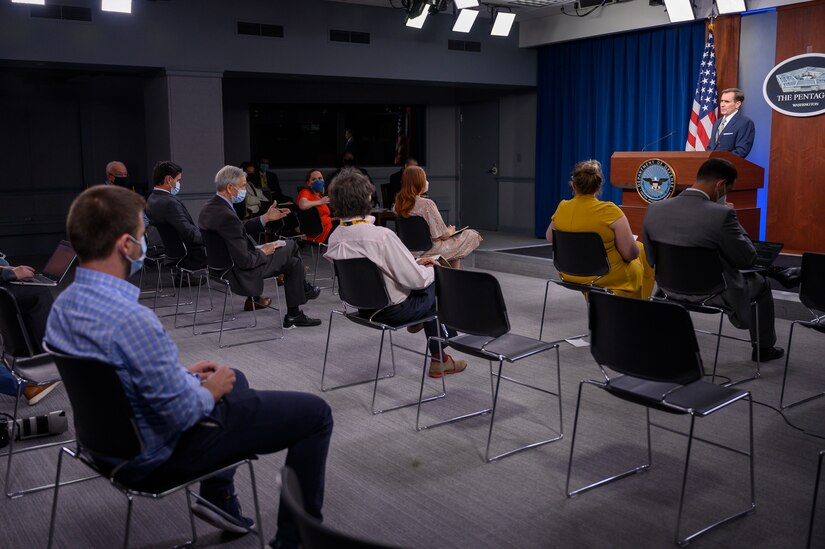
Man speaks to reporters during press conference.

"The next movement will consist of a joint U.S. Army/Air Force support element of around 1,000 personnel to facilitate the processing of SIV [special immigrant visa] applicants," the press secretary said. These personnel will arrive in Qatar in the next few days. Some may deploy to Afghanistan or to other areas where the Afghans will be processed. 

The third movement is to deploy one infantry brigade combat team out of Fort Bragg, North Carolina, to Kuwait. They will be a quick reaction force for security in Kabul if needed. "We anticipate those forces will reach Kuwait sometime within the next week," Kirby said.

Overall, this involves roughly 8,000 U.S. service members. As in all cases, U.S. service members have the right to self-defense if attacked. The troops will be under the command of Navy Rear Adm. Pete Vasely, the commander of U.S. Forces Afghanistan — Forward in Kabul.

Kirby said officials anticipate the increased need for U.S. airlift and, "and the secretary has already had conversations with the chairman and with Transportation Command about these potential needs so we do fully expect that there'll be additional military airlift required."

The press secretary said the idea is still to complete the drawdown in Afghanistan by the end of the month. 

San Fernando Valley Man Found Guilty in Terror Plot to Bomb a Rally in Long Beach

 A federal jury convicted a California man today for attempting to bomb a rally in Long Beach for the purpose of causing mass casualties.

According to court documents and evidence presented at trial, Mark Steven Domingo, 28, of Reseda, was found guilty of providing material support to terrorism and attempting to use of a weapon of mass destruction. The investigation into Domingo was prompted by his online posts and conversations in an online forum in which he expressed support for violent jihad, a desire to seek retribution for attacks against Muslims and a willingness to become a martyr. After considering various attacks – including targeting Jewish people, churches and police officers – Domingo decided to bomb a rally scheduled to take place in Long Beach in April 2019.

As part of the plot, Domingo asked a confederate – who was working with the FBI as part of the investigation – to invite a bomb-maker into the scheme. Domingo then purchased and provided to the confederate and the bomb-maker – who in fact was an undercover law enforcement officer – several hundred 3½-inch nails to be used as shrapnel for the bombs. Domingo specifically chose those nails because they were long enough to penetrate organs in the human body.

Leading up to the attack, Domingo called for another event like the October 2017 mass shooting in Las Vegas. Following an attack on Muslims in New Zealand in March 2019, Domingo called for retribution in an online post.

Domingo selected the Long Beach rally as his target and, in April 2019, drove his confederate and the undercover officer to Long Beach to scout the location he planned to attack. While there, Domingo discussed finding the most crowded areas so he could kill the most people. On April 26, 2019, Domingo received what he thought were two live bombs, but were inert explosive devices delivered by an undercover law enforcement officer. He was arrested that same day with one of the bombs in his hands.

Domingo was convicted of providing material support to terrorism and attempting to use a weapon of mass destruction. He is scheduled to be sentenced on Nov. 1 and faces a statutory maximum sentence of life in federal prison. A federal district court judge will determine any sentence after considering the U.S. Sentencing Guidelines and other statutory factors.

The FBI’s Joint Terrorism Task Force, Los Angeles Police Department, the Naval Criminal Investigative Service, the Los Angeles County Sheriff's Department and the Long Beach Police Department investigated the case.

Assistant U.S. Attorneys Reema M. El-Amamy and David T. Ryan of the Terrorism and Export Crimes Section of the U.S. Attorney’s Office for the Central District of California and Trial Attorneys Lauren Goddard and Joshua Champagne of the National Security Division's Counterterrorism Section are prosecuting the case.

Guantanamo Periodic Review Board Media Invitation Announced August 24,

 Aug. 12, 2021


The Department of Defense will allocate seats for news media at the Pentagon satellite viewing location on August 24, 2021, to cover unclassified portions of the Guantanamo Periodic Review Board for Sanad Ali Yislam Al Kazimi (ISN - 1453).

Due to limited space availability, selection is not guaranteed. Upon selection, additional information on meeting time and location will be provided.

Media desiring to observe the hearing should send requests via email to osd.pentagon.pa.mbx.gtmo-press@mail.mil.

All requests must be received no later than noon ET August 19, 2021. Media members should include their name, position, sponsoring organization and contact information (cell phone and email address) in their request. Multiple names from the same organization may be submitted.

Further information, including media ground rules, can be viewed at the Periodic Review Secretariat website at https://www.prs.mil/.

Friday, August 06, 2021

Two Myanmar Citizens Arrested In Plot To Injure Or Kill Myanmar’s Ambassador To The United Nations

 Audrey Strauss, the United States Attorney for the Southern District of New York, Jacqueline Maguire, the Acting Assistant Director in Charge of the New York Field Office of the Federal Bureau of Investigation (“FBI”), and Dermot Shea, Police Commissioner of the City of New York (“NYPD”), announced the arrests of PHYO HEIN HTUT and YE HEIN ZAW for conspiracy to assault and make a violent attack upon Myanmar’s Permanent Representative to the United Nations.  HTUT and ZAW were charged in two separate complaints and will be presented later today in the U.S. District Court in White Plains before U.S. Magistrate Judge Andrew E. Krause.

U.S. Attorney Audrey Strauss said: “As alleged, Phyo Hein Htut and Ye Hein Zaw plotted to seriously injure or kill Myanmar’s ambassador to the United Nations in a planned attack on a foreign official that was to take place on American soil.  We commend the tireless work of our law enforcement partners at all levels of government to ensure the safety of foreign diplomats and officials.”

FBI Acting Assistant Director Jacqueline Maguire said: “Time was of the essence when we received information about a threat to Myanmar’s Ambassador to the United Nations.  I would like to thank our Westchester Safe Streets Task Force and each of our partner law enforcement agencies that worked quickly and diligently to track down the men allegedly hired in this plot to harm and potentially kill a foreign diplomat on U.S. soil.  Our laws apply to everyone in our country, and these men will now face the consequences of allegedly breaking those laws.”  

NYPD Commissioner Dermot Shea said: “As alleged in today’s federal charges, these defendants reached across borders and oceans in designing a violent plot against an international leader on United States soil.  But our NYPD investigators and prosecutors from the United States Attorney’s Office in the Southern District of New York worked relentlessly with our law enforcement partners to bring them to justice before any harm could be done.”     

According to the allegations in the two Complaints filed today[1]:

Between at least in or about July 2021 through at least on or about August 5, 2021, HTUT and ZAW, citizens of Myanmar currently residing in New York, conspired to injure or kill Myanmar’s Permanent Representative to the United Nations (the “Ambassador”).  During the conspiracy, HTUT communicated with an arms dealer in Thailand (the “Arms Dealer”) who sells weapons to the Burmese military, which overthrew Myanmar’s civilian government in or about February 2021.  In the course of those conversations, HTUT and the Arms Dealer agreed on a plan in which HTUT would hire attackers to hurt the Ambassador in an attempt to force the Ambassador to step down from his post.  If the Ambassador did not step down, then the Arms Dealer proposed that the attackers hired by HTUT would kill the Ambassador.

Shortly after agreeing on the plan, ZAW contacted HTUT by cellphone and transferred approximately $4,000 to HTUT through a money transfer app as an advance payment on the plot to attack the Ambassador.  Later, during a recorded phone conversation with ZAW, HTUT discussed how the planned attackers would require an additional $1,000 to conduct the attack on the Ambassador in Westchester County, and for an additional payment the attackers could, in substance, “finish off” the Ambassador.  In response, ZAW agreed, in substance, to pay the additional $1,000 and to try to obtain the additional money.

HTUT, 28, and ZAW, 20, both citizens of Myanmar, are each charged in separate complaints with one count of conspiracy to assault and make a violent attack upon a foreign official, which carries a maximum sentence of five years in prison.  The maximum potential sentences in this case are prescribed by Congress and are provided here for informational purposes only, as any sentencing of the defendants will be determined by the judge.

Ms. Strauss praised the outstanding investigative work of the FBI’s Westchester Safe Streets Task Force, which comprises special agents and task force officers from the FBI, NYPD, United States Probation Office, New York State Police, New York State Department of Corrections and Community Supervision, Westchester County Department of Public Safety, Westchester County District Attorney’s Office, Putnam County Sheriff’s Office, and the police departments of Yonkers, Mount Vernon, New Rochelle, Greenburgh, White Plains, Peekskill, Ramapo, and Clarkstown.  Ms. Strauss also thanked the Pelham Manor Police Department and the U.S. Department of State’s Diplomatic Security Service for their assistance in the investigation.

Ms. Strauss said that the investigation is ongoing, and asked any individuals with relevant information to contact the FBI at (800)-CALL-FBI.

The prosecution is being handled by the Office’s White Plains Division.  Assistant United States Attorney Nicholas S. Bradley is in charge of the prosecution.

The charges in the Complaints are merely accusations and the defendants are presumed innocent unless and until proven guilty.


[1] As the introductory phrase signifies, the entirety of the texts of the Complaints and the description of the Complaints set forth in this release constitute only allegations, and every fact described should be treated as an allegation.

Thursday, August 05, 2021

Guantanamo Periodic Review Board Media Invitation Announced August 17, 2021

 Aug. 5, 2021


The Department of Defense will allocate seats for news media at the Pentagon satellite viewing location on August 17, 2021, to cover unclassified portions of the Guantanamo Periodic Review Board for Mohammed Ahmad Rabbani (ISN - 1461).

Due to limited space availability, selection is not guaranteed. Upon selection, additional information on meeting time and location will be provided.

Media desiring to observe the hearing should send requests via email to osd.pentagon.pa.mbx.gtmo-press@mail.mil.

All requests must be received no later than 4 p.m. ET August 11, 2021. Media members should include their name, position, sponsoring organization and contact information (cell phone and email address) in their request. Multiple names from the same organization may be submitted.

Further information, including media ground rules, can be viewed at the Periodic Review Secretariat website at https://www.prs.mil/.

Tuesday, July 27, 2021

Secretary Mayorkas Statement on President Biden’s Nominations for Leadership Positions at DHS

 Today, Secretary of Homeland Security Alejandro N. Mayorkas released the following statement on President Biden’s nominations of Bill Valdez as DHS Under Secretary for Management and Erik Hooks as FEMA Deputy Administrator: 


“Bill Valdez and Erik Hooks are distinguished leaders and recognized experts in their respective fields. They are well positioned to help the Department of Homeland Security address the diverse and urgent challenges facing communities across our country. I hope the Senate will swiftly confirm both of these leaders and our other nominees.”

Friday, July 23, 2021

Military Commissions Media Invitation Announced for United States v. Abd al-Rahim al-Nashiri Pre-Trial Hearing

 July 23, 2021


The Department of Defense and the Office of Military Commissions will allocate seats for news media aboard a military-chartered aircraft for travel from Joint Base Andrews (JBA) in Maryland to Naval Station Guantanamo Bay (NSGB) Cuba to cover military commission pre-trial proceedings scheduled for United States v. Abd al-Rahim al-Nashiri, Sept. 20 – Oct. 1, 2021.

Currently, the tentative flights will be available as follows:

  • Sunday, Sept. 19 – JBA to NSGB
  • Saturday, Sept. 25 – NSGB to JBA

Reporters are not required to stay for the entire duration of scheduled hearings. Reporters may request to attend one or both weeks of the hearing. A return flight from NSGB to Joint Base Andrews is scheduled at the conclusion of the hearing:

  • Saturday, Oct. 2

Please note that the flight schedule, to include departure and arrival locations, is subject to change. Media desiring to view this hearing from NSGB must complete the registration form. All requests must be received no later than noon EDT, Friday, July 30. Multiple requesters from the same organization must register separately via the form.

Due to a limited number of seats aboard the flight and limited accommodations at NSGB, selection is not guaranteed. Additionally, all traveling media shall have printed proof of a negative polymerase chain reaction COVID-19 viral test within 72 hours prior to departing the national capital region. A test is not required for media who have a confirmed COVID positive test result within 90 days of travel if written proof from a medical provider can be provided no later than Friday, Sept. 3.

Media who can provide proof of being fully vaccinated will be allowed on the OMC charter flight. Media who are fully vaccinated (post 14-days from receiving complete COVID 19 vaccination) are not required to quarantine upon arrival at NSGB. Media who are not fully vaccinated may not view the hearing from NSGB. All media are subject to surveillance testing while on NSGB and will adhere to personal protective equipment (PPE) requirements directed by the NSGB Commanding Officer.

Additional viewing is available for media via Closed Circuit Television (CCTV) from a media work center at Fort George G. Meade, in Maryland. Regular COVID-19 mitigation protocols, such as mask wearing and social distancing may apply at all locations depending on local guidance and vaccination status, although media viewing from Fort Meade are not subject to COVID-19 testing or ROM requirements.

Media desiring to view this hearing from Fort Meade must send their requests via email to osd.mc-alex.OMC.mbx.omc-pa@mail.mil with the following information (multiple requesters from the same organization must send separate emails):

Subject Line: Abd al-Rahim al-Nashiri 20 SEP – 1 OCT 2021

  • Individual's full name
  • Individual's occupation/position
  • Sponsoring organization (News Outlet)
  • Contact information (cell phone and email)

NOTE 1: The primary purpose of travel to Guantanamo Bay, Cuba is courtroom reporting. Tours of the detention facilities are not available. Requests for reporting on Guantanamo topics unrelated to the military commissions must be coordinated in advance through the respective Public Affairs Officers of the Office of the Secretary of Defense, U.S. Southern Command, and/or NSGB.

NOTE 2: All media must ensure their passports and visas (foreign press) are up-to-date and eligible to enter and exit the United States.

Thursday, July 22, 2021

Guantanamo Periodic Review Board Media Invitation Announced July 29, 2021

 July 22, 2021


The Department of Defense will allocate seats for news media at the Pentagon satellite viewing location on July 29, 2021, to cover unclassified portions of the Guantanamo Periodic Review Board for Guleed Hassan Ahmed (ISN – 10023).

Due to limited space availability, selection is not guaranteed. Upon selection, additional information on meeting time and location will be provided.

Media desiring to observe the hearing should send requests via email to osd.pentagon.pa.mbx.gtmo-press@mail.mil.

All requests must be received no later than 10 a.m. ET July 27, 2021. Media members should include their name, position, sponsoring organization and contact information (cell phone and email address) in their request. Multiple names from the same organization may be submitted.

Further information, including media ground rules, can be viewed at the Periodic Review Secretariat website at https://www.prs.mil/.

Wednesday, July 21, 2021

Afghan Forces Have Capacity to Fight, Defend Country, Milley Says

 July 21, 2021 | BY Jim Garamone , DOD News

The Afghan security forces have the capacity and capabilities needed to fight and defend their country, Army Gen. Mark A. Milley said today, and the United States will continue to support those forces.

The chairman of the Joint Chiefs of Staff spoke during a Pentagon press conference alongside Secretary of Defense Lloyd J. Austin III. "The future of Afghanistan is squarely in the hands of the Afghan people," Milley said. "And there is a range of possible outcomes in Afghanistan. … A negative outcome – a Taliban takeover of Afghanistan – is not a foregone conclusion."

The general said the United States will continue to monitor the situation there and make adjustments to the support as necessary, he said.

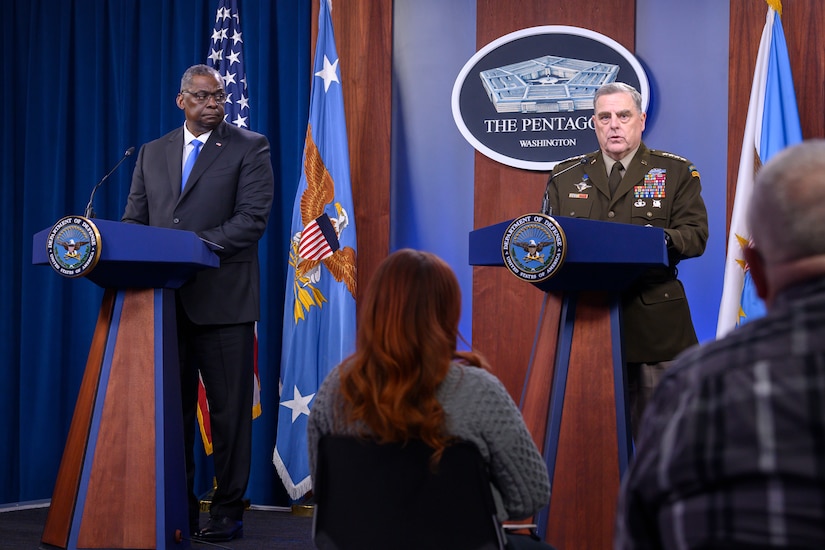
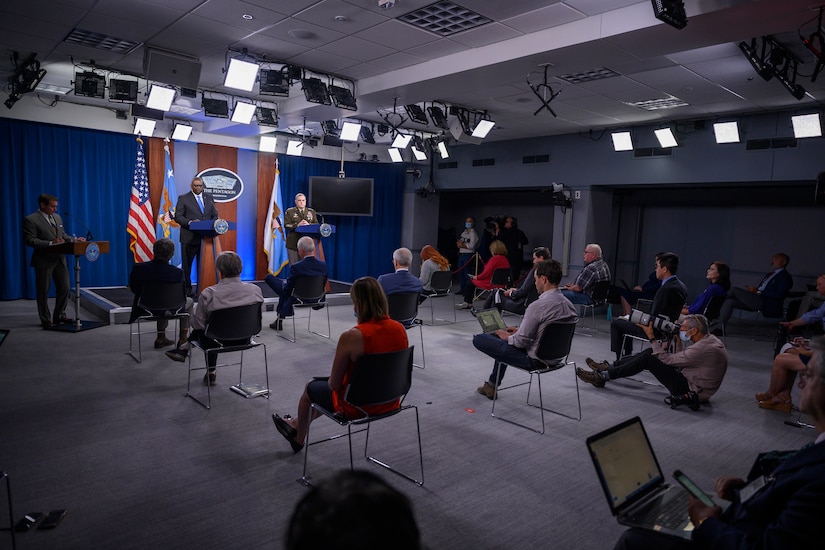
Defense secretary and Joint Chiefs chairman stand at lecterns in front of a seated audience.

Milley gave a quick rundown of the situation in Afghanistan. "There very clearly is a narrative out there that the Taliban are winning – they are propagating an 'inevitable victory'," he said. "As of today, 212 or 213 of the district centers are in Taliban control – it's about half of the 419 that are out there. You've got 34 provincial capitals in Afghanistan. None of them have been seized by the Taliban, although they are putting pressure on the outskirts of about half of them." 

The provincial capitals have most of the population and the Taliban is trying to isolate the major population centers including Kabul, the general said. 

The Taliban has seized a substantial swath of territory and "the strategic momentum seems to be with the Taliban, but the Afghan security forces are consolidating their forces to protect population centers," Milley said. "They are adjusting forces to consolidate forces into the provincial capitals and Kabul. It remains to be seen what will happen. … I don't think the endgame is yet written."

Reporters asked Milley about comments attributed to him in a recent book. While he did not address those directly, he did emphasize that he and the other members of the Joint Chiefs of Staff always provide their best military advice to whoever is president. Any advice given to leaders was "candid, honest in every single occasion," Milley said. "We do that all the time, every time. All of us in uniform take an oath, an oath to a document, an oath [to] the Constitution of the United States. And not one time did we violate that oath. I can say with certainty that every one of [us] maintained our oath of allegiance to that document … and we also maintained the tradition of civilian control of the military … and we also maintained the tradition of an apolitical military."

Defense secretary and Joint Chiefs chairman stand at lecterns in front of a seated audience.

Austin has served alongside Milley in combat. "We fought together, we served a couple of times in the same unit," the secretary said. "I'm not guessing about his character: He doesn't have a political bone in his body. I clearly have tremendous faith and confidence in the chairman and what I want to make sure we do is maintain our focus on the threats ahead."

Friday, July 16, 2021

DHS Announces Funding Allocations for FY 2021 Preparedness Grants


WASHINGTON — Today, Secretary of Homeland Security Alejandro N. Mayorkas announced the final allocations for $475 million for seven Fiscal Year 2021 competitive preparedness grant programs.  These allocations, together with the almost $1.5 billion in non-competitive grant funding announced earlier this year, total nearly $2 billion in FY 2021 to help prepare our Nation against man-made threats and natural disasters.

The grant programs provide funding to state, local, tribal and territorial governments, nonprofit agencies, and the private sector in building and sustaining capabilities to prevent, protect against, respond to, and recover from acts of terrorism and other disasters.  The total amount for each grant program is set by Congress and the allocations are made by the Secretary.

Secretary Mayorkas issued the following statement about this year’s grant awards:

“Through these grant programs, we demonstrate our steadfast commitment to addressing the most significant and persistent terrorism-related threats to the homeland today,” said Secretary Mayorkas.  “Many of the communities and nonprofit organizations receiving these grants have been historically underserved.  The funding allocated for each of the grant programs will allow these communities and organizations to build, sustain, and improve their preparedness and response capabilities.  I look forward to working with our state, local, tribal, and territorial partners to achieve these shared goals.”

For the competitive grant program allocations that are being announced today, DHS identified four critical priority areas for attention: cybersecurity, soft targets and crowded places, domestic violent extremism, and emerging threats. Applicants under the grant programs were provided percentage increases in their competitive scores for aligning their projects around these areas.

All capabilities and programs being built or sustained using homeland security grant funding must have a clear linkage to the core capabilities articulated in the National Preparedness Goal.

Preparedness Grant Program Allocations for Fiscal Year 2021

The following grants are competitive, with awards announced today:

Operation Stonegarden: provides $90 million to enhance cooperation and coordination among state, local, tribal, territorial, and federal law enforcement agencies to jointly enhance security along the United States land and water borders.

Tribal Homeland Security Grant Program: provides $15 million to eligible tribal nations to implement preparedness initiatives to help strengthen the nation against risk associated with potential terrorist attacks and other hazards.

Nonprofit Security Grant Program: provides $180 million to support target hardening and other physical security enhancements for nonprofit organizations that are at high risk of a terrorist attack.  This year, $90 million is provided to nonprofits in Urban Area Security Initiative-designated areas, and $90 million is provided to nonprofits outside those designated urban areas located in any state or territory.

Port Security Grant Program: provides $100 million to help protect critical port infrastructure from terrorism, enhance maritime domain awareness, improve port-wide maritime security risk management, and maintain or re-establish maritime security mitigation protocols that support port recovery and resiliency capabilities.

Transit Security Grant Program: provides $88 million to owners and operators of public transit systems to protect critical surface transportation and the traveling public from acts of terrorism and to increase the resilience of transit infrastructure.

Intercity Bus Security Grant Program: provides $2 million to owners and operators of intercity bus systems to protect surface transportation infrastructure and the traveling public from acts of terrorism and to increase the resilience of transit infrastructure.

The following non-competitive grants were awarded Feb. 25 to recipients based on a number of factors:

State Homeland Security Program: provides $415 million to support the implementation of risk-driven, capabilities-based state homeland security strategies to address capability targets.  Awards are based on statutory minimums and relative risk as determined by DHS/FEMA’s risk methodology.

Urban Area Security Initiative: provides $615 million to enhance regional preparedness and capabilities in 31 high-threat, high-density areas.  Awards are based on relative risk as determined by risk methodology.

Emergency Management Performance Grant: including the funding provided under the American Rescue Plan Act, provides more than $455 million to assist state, local, tribal, and territorial governments in enhancing and sustaining all-hazards emergency management capabilities.  Relative population is considered.

Intercity Passenger Rail: provides $10 million to Amtrak to protect critical surface transportation infrastructure and the traveling public from acts of terrorism and increase the resilience of the Amtrak rail system.  Award made per congressional direction.

Further information on preparedness grant programs is available at www.dhs.gov and http://www.fema.gov/grants.

Monday, July 12, 2021

Miller Transfers Command in Afghanistan to McKenzie

 July 12, 2021 | BY Jim Garamone , DOD News

Army Gen. Austin S. Miller transferred responsibility for U.S. Forces Afghanistan to Marine Corps Gen. Kenneth F. McKenzie in a ceremony in Kabul today.

McKenzie, the commander of U.S. Central Command, praised Miller as "the right leader at the right time" and reassured Afghans of America's continued support.

Two men pass a flag.

Miller has served as the commander of U.S. Forces Afghanistan and the NATO Resolute Support Mission since September 2018. He is the man who implemented the decision to retrograde U.S. and NATO forces from the country.

McKenzie also praised Miller for how he has handled the withdrawal. The general orchestrated moving millions of tons of equipment and thousands of personnel. All of this was done safely, swiftly and sensibly. At the same time, Miller continued advising and assisting Afghan National Security Forces.

Miller spoke after transitioning command over to McKenzie. "It is important that the military sides set the conditions for a peaceful political settlement in Afghanistan," he said. "We can all see the violence that is taking place across the country. But we know that with that violence, what is difficult to achieve is that settlement. What I tell the Taliban is they are responsible, too. The violence that is going on is against the will of the Afghan people. It needs to stop."

McKenzie said the ceremony is not "the end of the story, it is rather the end of a chapter." 

Two men meet near a mud wall.

The Centcom commander said he will remain focused on four things, with the first being to protect U.S. diplomatic presence in Afghanistan. He will also look to enable the safe operation of the airport in Kabul. He will continue to provide appropriate advice and assistance to Afghan National Defense and Security Forces. Finally, he will support counterterrorism efforts.

Following the transition, McKenzie met with Afghan President Ashraf Ghani.

Thursday, July 08, 2021

Guantanamo Periodic Review Board Media Invitation Announced July 15, 2021

 July 8, 2021


The Department of Defense will allocate seats for news media at the Pentagon satellite viewing location on July 15, 2021, to cover unclassified portions of the Guantanamo Periodic Review Board for Zayn al-Ibidin Muhammed Husayn   (ISN - 10016).

Due to limited space availability, selection is not guaranteed. Upon selection, additional information on meeting time and location will be provided.

Media desiring to observe the hearing should send requests via email to osd.pentagon.pa.mbx.gtmo-press@mail.mil.

All requests must be received no later than noon ET July 12, 2021. Media members should include their name, position, sponsoring organization and contact information (cell phone and email address) in their request. Multiple names from the same organization may be submitted.

Further information, including media ground rules, can be viewed at the Periodic Review Secretariat website at https://www.prs.mil/.

Thursday, July 01, 2021

TSA expects high travel volume, shares traveler tips ahead of Fourth of July

 As summer travel volumes continue to rise and the Fourth of July holiday weekend approaches, the Transportation Security Administration (TSA) remains prepared to ensure a secure screening process at airports nationwide.

On Sunday, June 27, TSA screened 2,167,380 people through airport security checkpoints, which was the highest checkpoint volume the agency has seen since the beginning of the pandemic. TSA expects that number to be outpaced over the holiday weekend and advises passengers to arrive to the airport with plenty of time for ticketing, checking baggage, and security screening.

Many airports across the country are seeing passenger travel at pre-pandemic levels, especially in the mornings when flight schedules are compressed.  Some airports are already exceeding 2019 travel volumes, including popular summer travel destinations, such as Nashville International Airport and Myrtle Beach International Airport; while others, like Orlando International Airport, Fort Lauderdale-Hollywood International Airport and Phoenix Sky Harbor International Airport are already close to pre-pandemic volumes ahead of the high-traffic holiday weekend.

“It’s heartening to see the country taking to travel again and travelling to enjoy the weekend and celebrate our nation’s independence,” said TSA Administrator David Pekoske. “We continue to remind passengers to pack their patience and remain calm through the security checkpoint and onboard aircraft. TSA will not tolerate aggressive actions toward our officers; please help us make travel safe, secure and pleasant on this holiday weekend.”

The federal face mask mandate remains in effect on planes, buses, trains, and other forms of public transportation traveling into, within, or out of the United States, and in U.S. transportation hubs such as airports and stations. Face masks are not required in outdoor areas of conveyances (if such outdoor areas exist on the conveyance) or while outdoors at transportation hubs.


Some helpful reminders for the airport security checkpoint include:

  • Arrive early. TSA expects to see the increasing summer travel volumes to continue to rise into the holiday weekend. Although nationally our travel volume remains around 75% of pre-pandemic levels, some airports around the country have already surpassed volumes from 2019. Please arrive at the airport in plenty of time for ticketing, checking baggage, security screening, etc.
  • Wear a face mask. Face masks remain mandatory for employees and passengers, regardless of vaccination status, throughout all domestic transportation modes, including airport security screening checkpoints. Since the implementation of the face mask mandate for travelers on Feb 2, there has been near-total voluntary compliance throughout the entire transportation system.
  • Enroll now in TSA PreCheck® to “Travel with Ease.” By enrolling in TSA PreCheck, airline passengers can avoid removing shoes, belts, liquids, food, laptops and light jackets at the TSA checkpoint. Most new enrollees receive their known traveler number within five days, and membership lasts for five years.  
  • Pack smart; start with empty bags. Those airline passengers who begin packing for travel with empty bags are less likely to bring prohibited items through a TSA checkpoint. Technology and modifications help reduce the need for physical contact with TSA officers, but those who take time to come prepared for the TSA checkpoint are far more likely to avoid physical contact. Check for prohibited items by using the “What Can I Bring?” page on TSA.gov.
  • Consider other ways that might help avoid physical contact at the checkpoint. Prior to entering the line for the TSA checkpoint, take a few minutes to prepare. Place jewelry, keys and other pocketed items into your carry-on bag so they might be scanned with need for fewer bins at the conveyor belt. Have a valid ID card readily available and follow the liquids rule of 3.4 ounces or less, with the exception of hand sanitizer, which has a temporary 12-ounce limit in carry-on baggage.
  • Traveling with Firearms. Unloaded firearms may be transported in a locked, hard-sided container in checked baggage only. Declare the firearm and/or ammunition to the airline when checking your bag at the ticket counter. The container must completely secure the firearm from being accessed. Locked cases that can be easily opened are not permitted. Be aware that the container the firearm was in when purchased may not adequately secure the firearm when it is transported in checked baggage.
  • Contact TSA for help if there are questions or concerns. Passengers with questions about checkpoint procedures and how to prepare for TSA security screening, or who need additional assistance during the security screening process should contact TSA Cares in advance of their travel: (855) 787-2227 (Federal Relay 711). Additionally, they can submit questions to @AskTSA on Twitter or Facebook Messenger on weekdays from 8 a.m. to 7 p.m. and on weekends/holidays from 9 a.m. to 7 p.m. ET.  Information is also available at TSA.gov. If you have any concerns or questions during screening at a TSA checkpoint, or have a disability, medical condition or require additional assistance, please ask for a Supervisor or Passenger Support Specialist.