Aug. 12, 2021
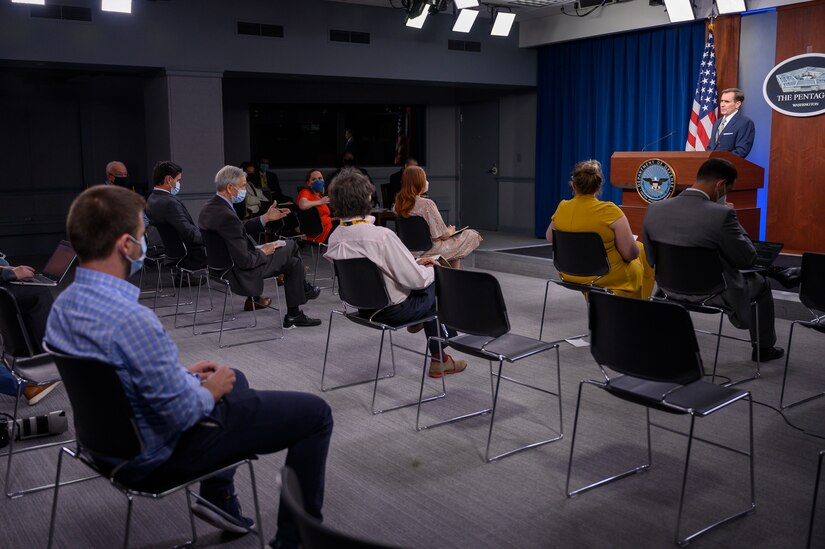
Pentagon Press Secretary John F. Kirby
PRESS SECRETARY JOHN F. KIRBY: Afternoon, everybody.
Just a couple of things at the top here. As you know, and I'm sure you
heard from my colleague over at the State Department, the president has
ordered the reduction of civilian personnel at our embassy in Kabul and
the acceleration of the evacuation of Afghan Special Immigrant Visa
applicants from the country.
To enable this safe, orderly reduction, the Secretary of Defense has
directed the department to position temporary enabling capabilities to
ensure the safety and security of U.S. and partner civilian personnel.
I'm going to break this down for you just real quick.
The first movement will consist of three infantry battalions that are
currently in the Central Command area of responsibility. They will move
to Hamid Karzai International Airport in Kabul within the next 24 to 48
hours. Two of those battalions are United States Marines and one is a
U.S. Army battalion.
The next movement will consist of a joint U.S. Army-Air Force support
element of around 1,000 personnel to facilitate the processing of SIV
applicants. Initial elements of this movement -- of this element will
arrive in Qatar in the coming days.
The third movement is to alert and to deploy one infantry brigade
combat team out of Fort Bragg to Kuwait, where they will be postured and
prepared, if needed, to provide additional security at the airport. We
anticipate those forces will reach Kuwait sometime within the next week.
Now, I want to stress that these forces are being deployed to support
the orderly and safe reduction of civilian personnel at the request of
the State Department and to help facilitate an accelerated process of --
of working through SIV applicants. This is a temporary mission with a
narrow focus. As with all deployments of our troops into harm's way, our
commanders have the inherent right of self defense and any attack on
them can and will be met with a forceful and an appropriate response.
As Ned Price, my colleague at the State Department, highlighted
earlier, Secretary Austin did join Secretary Blinken in a phone call
this morning with President Ghani. These conversations with allies and
partners will continue to ensure close coordination going forward.
With that, we'll take questions. Bob, I think you're first.
Q: Thank you, John. Thank you for spelling out some of the --
breaking down some of the numbers. With regard to those forces that are
going into Afghanistan to work specifically on supporting the removal or
evacuation or whatever you call it of personnel from the embassy, is
that about 3,000 people? And also, is that in addition to the 600 or 650
who are already there doing that sort of work?
MR. KIRBY: Yes, Bob, the -- those three infantry battalions will
comprise approximately 3,000 personnel and they will be in addition to
those troops that are already in -- in Kabul as we conduct -- as -- you
know, in the process of conducting our drawdown. So we still have more
than 650 troops in -- in Kabul right now. These 3,000 will join them
there.
Q: Can I do a quick follow up?
MR. KIRBY: Sure.
Q: Thank you. Does the military mission include flying U.S.
civilian personnel, the -- the embassy personnel out of the country or
only processing and securing them at the airport?
MR. KIRBY: We certainly anticipate being postured to support airlift,
as well, for not only the reduction of civilian personnel from the
embassy, but also in the forward movement of Special Immigrant Visa
applicants. So we do anticipate that there will be airlift required of
us and we are working through the -- the final plans right now to -- to
put that into place.
Q: Thank you.
MR. KIRBY: Yeah. Tom?
Q: Thanks, John. In regards to what you just said to Bob about the
possible airlifting out of individuals, in regards to the Special
Immigrant Visa applicants, what – has it been decided yet where they
will be airlifted to? And if so, where, please?
MR. KIRBY: We're still working through a series of options here, Tom.
We anticipate that we'll be looking at locations overseas, outside of
the United States, as well as U.S. installations that -- you know, that
belong to the United States, either overseas and/or here at home.
We don't have -- I -- I don't have a list for you right now, but --
but I think it'll be a -- a mix of both. And as we get more clarity on
that, we'll certainly update you.
Q: And just to -- just to be clear, with all of the same criteria
you've outlined earlier, those who have passed the security clearance
could come within the United States and those without at other
locations?
MR. KIRBY: I'm going to defer to the -- my State Department
colleagues to talk to the SIV process more specifically. Our job will be
in locating and helping secure facilities and installations that can be
used. And as we did with Fort Lee, I think you can expect the Defense
Department will lean in, to the degree possible that we can, to help
facilitate this movement and relocation.
Q: Thanks.
MR. KIRBY: David?
Q: John, will those -- these infantry battalions help with the
movement of diplomats from the embassy to the airport, as well as moving
them out of the country? And if so, will that movement be done by
convoy or will it be done by helicopter?
And let me just add one more question.
MR. KIRBY: Sure.
Q: You say "temporarily" ...
MR. KIRBY: I do.
Q: ... but aren't they going to remain there in case further drawdowns are ordered?
MR. KIRBY: So let me take the first one first. These infantry
battalions will be there to help facilitate this safe and orderly
reduction. And -- and I don't want to get into too much tactical detail
about what that would require.
Commanders on the ground will be working with the State Department to
determine what is -- what's -- what's most needed. And if it is to help
facilitate and secure transportation to the airport, then our troops
will be postured to do that.
But again, I -- I -- I can't speak here today when they're not even
there yet about what that's going to look like -- what the
transportation's going to look like, and -- and some of this, David, is
going to depend on the degree of permissibility and the environment and
the security environment, but these are infantry battalions that are
highly trained and will have the capabilities to support in any manner
what the State Department needs to facilitate this reduction.
Your second question on the temporary nature. As the State Department
has said, they're going to try to complete this reduction of their
personnel by the end of this month and these troops are being ordered in
to help facilitate that purpose, that mission along that timeline.
I won't speculate beyond August 31st as to what the footprint’s going
to look like or how many troops are going to be there and what they're
going to be doing. What I can tell you is, we're focused on trying to
get them there as soon as possible to facilitate this mission, which is
the reduction of civilian personnel by the end of the month.
Q: And one follow-up, was there a specific event, which triggered this decision?
MR. KIRBY: It would be wrong to conclude that there was one specific
event that led to this decision that we believe this is the prudent
thing to do given the rapidly deteriorating security situation in and
around Kabul. So I think there's a confluence of things you guys have
all been reporting over the last 24 to 36 hours, the Taliban's advances
and where they are.
And I think again, cognizant of that security situation, this administration believed that this was a prudent action to take.
Q: One math question.
MR. KIRBY: Sure.
Q: 3,650 and then another 1,000 of this joint task force to process. So --
MR. KIRBY: It’s joint Army, Air Force. Yes, that's about 1,000
personnel. It’s engineers, it’s medical personnel, it’s military police,
that kind of thing. And they -- they are going to Qatar right now
because, as you know, we've been working with countries in the region,
to Tom's question, to try to find processing sites outside Afghanistan.
So I would just tell you they're going to Qatar for now and then we'll
see what the need is after that.
But we want to be flexible and we want to get them close by and in the region. And that's why they're going there right now.
Courtney.
Q: And then there's one infantry BCT that's going to Kuwait, you
said. And that's only if things go bad you have like a QRF basically,
right?
MR. KIRBY: They'll be there postured, as prepared, if there's a need
for additional security at the airport. They'll be -- they'll be in the
region and a lot more accessible.
Q: OK. So -- and then the ones who are going to Qatar, that's
specifically for SIV applicants. I mean it sounds like engineers,
medical, and MPs; they're going to -- it sounds like to build --
MR. KIRBY: No, when I say engineers actually we're talking about a
very small number of engineers and it's largely for electrical power.
It's to make sure that we actually have, you know, power to do the
processing of -- of applicants. I don't -- by engineers I didn't mean
construction and that kind of thing.
Q: So the -- the BCT going to Kuwait, that's like what, a roughly 3,000 to 3,500 people, right, total?
MR. KIRBY: A common infantry, combat brigade is about 3,500 to 4,000 people.
Q: So why is it -- I'm unclear why -- so it's 3,000 people that are
going to HKIA right away in the coming days. And then you have another
3,500 who will be there on standby in case, all for security. I'm
unclear what they're doing.
I'm mean, if the 3,000 going to HKIA, it's like a couple of miles
from the embassy to HKIA. What exactly are -- are 3,000 people doing?
Are they -- are they just there securing the airport then?
MR. KIRBY: They'll be there to provide safety and secure -- and
secure movement of the reduction of civilian personnel out of the
embassy to help -- to help facilitate their departure from the country,
to also help with the process of moving special immigrant visa
applicants out of the country, and to provide additional security at the
airport. Again, we believe this a prudent measure, given the
deteriorating security situation.
Q: You're talking a lot of people though. I mean I'm still -- what is
-- I -- I -- can you give any better sense of like on a day to day what
are they doing. I mean it sounds like they must be -- that number of
people of people they must be responsible for getting people to the
airport and then actually -- it almost sounds as they're coming in and
taking over security at the airport if it's that --
MR. KIRBY: I wouldn't go that far, Courtney. The -- the Turkish
forces are still at the airport. The Turks are still in the lead of
security at the airport. We already have some security forces, United
States security forces at the airport, including some aviation elements.
These 3,000 would be going to bolster that presence and to make sure
that -- that the airport is secure enough to facilitate the movement of
all these people over the next couple of weeks.
Again, this is about prudent preparation. And we want to make sure
that we've got enough on hand to -- to adapt to any, you know,
contingencies. So I -- your question about the numbers being too high,
we believe it's appropriate to the security situation that we see now
and that we can anticipate possible in the -- possibly in the future,
which is again why we're going to flow a brigade combat team into the
theater to be ready in case we need even more.
Now hopefully, Courtney, this will be an incredibly permissive
environment and we won't need these additional capabilities. But the
secretary believes the safety and security of our people, not just
American troops, but our allies and partners and our State Department
colleagues, is of paramount concern and he's not going to add additional
risk to that -- to that safe movement.
Q: Just very quickly; Kandahar city and Heart city, can you confirm what the Taliban are reporting, that they've taken it?
MR. KIRBY: I can't. And I'm not going to do battlefield assessments
here from the Pentagon podium. Yes. Let me go back to the phones. I know
we got lots to get through.
Tara Kopp.
Q: Hey, John. Thanks for doing this. A couple questions. The infantry battalions, where are they coming from?
MR. KIRBY: The three infantry battalions that I talked about are
already coming from inside the Central Command area of responsibility
and I think I'd rather leave it at that for now. They're already in
theater.
Q: OK. Thank you. And then the 1,000 that will be at Qatar, is the
intent that they will stay at Qatar or would they also be flying in to
Kabul to provide additional support if needed?
MR. KIRBY: Yes, as I -- as I mentioned it to David, right now the
plan is to get them to Qatar because, again, we were looking at regional
sites for processing of SIV applicants. Qatar is one of those sites
that we are looking at potentially being able to use. If they need to
move in part or in whole elsewhere to do this job to help with the
application process, we'll deal with that at the right time. But for
right now, in the coming days, they'll be heading to Qatar.
Q: OK. And last one, besides the increase in troops, it becomes kind
of a logistics issue if you don't have enough, I guess, airlift support.
Is the U.S. also going to send addition planes or get additional
contracted air to be able to, I guess, increase the throughput of people
that can leave Kabul?
MR. KIRBY: As I said earlier, we do anticipate an increase need for
U.S. airlift and -- and the secretary has already had conversations with
the chairman and with Transportation Command about these potential
needs.
So we do fully expect that they'll be additional United States
military airlift required. I just don't have the details here today for
you exactly what that's going to look like, how many tails and what the
sorties are going to look like. But we absolutely anticipate being more
involved in -- in the airlift – airlift element of this mission.
Lucas?
Q: John, what about the close air support? Are you going to increase
the number of drones or fighter jets overhead to protect these troops?
MR. KIRBY: We still have -- yesterday we have and today we have the
authority and capabilities in the region to conduct air strikes if
needed. That's not going to change as a result of these new mission
sets.
Q: Does this mean the U.S. military withdrawal is not going to be complete by Aug. 31st?
MR. KIRBY: Again, what I said was, we're aiming to facilitate the
reduction of these civilian personnel by Aug. 31st. So it's all lining
up on the same timeline. I won't speculate about what the footprint's
going to look like post Aug. 31st, because there's this additional
mission set of helping process special immigrants. So we're just going
to have to wait and see.
But the drawdown, itself, is still on-track to be complete by Aug. 31st.
Q: That makes no sense, John.
MR. KIRBY: I know, I know what --
(CROSSTALK)
Q: …you’re putting 3,000 troops --
MR. KIRBY: I know what you're saying, Lucas. I'm saying of the -- of
the original footprint plans that's still continuing. But, yes, we are
adding additional troops for this specific and narrow focus.
Q: Are you hoping to get them all out by the end of the month?
MR. KIRBY: I'm not going to speculate beyond Aug. 31st. Our job here,
right now with this additional plus up, is to help facilitate the safe
movement of civilian personnel out of Afghanistan. And the president's
been very clear that he wants that reduction complete by the end of
August, that's what we're focused on.
Q: Have you spoken to the Taliban, that they know that you're doing
this and that you have some assurances or maybe guarantees that they
will not attack these additional forces moving in?
MR. KIRBY: The Defense Department has not spoken to the Taliban about this.
Q: So are you concerned they're going to be under attack?
MR. KIRBY: As I said, we've made it very clear, as I just did a few
minutes ago, that as in all cases our commanders will have the right of
self-defense. And any attack upon our forces will be met with a swift
and appropriate response.
Q: Do you consider this a combat mission?
MR. KIRBY: This is a very narrowly focused mission of safeguarding
the orderly reduction of civilian personnel out of Afghanistan and
that's what we're going to be focused on.
Q: It's not a combat mission?
MR. KIRBY: Lucas, I've already described this mission now three
times. We're mindful that the security situation continues to
deteriorate in Afghanistan. And as I said before, our troops will, as
always, have the right of self defense. But this is a narrowly focused
mission to help -- to help safeguard an orderly reduction of civilian
personnel.
Jeff Seldin.
Q: John, thanks very much. If I could follow-up a little bit on
Lucas' question. With all these new troops, resources going into Kabul,
is there any consideration of using the Kabul airport as a staging point
for what had been the over-the-horizon capabilities? And has there also
been any progress on securing anything closer to Afghanistan in terms
of staging or basing for the over-the-horizon air strikes?
And then secondly, how worrisome is it that a city like Herat, city
like Kandahar which -- where U.S. air power has been focused in recent
weeks in an attempt to assist the Afghan security forces are either
falling or have fallen to the Taliban despite the additional U.S.
support?
MR. KIRBY: I'm sorry, I didn't get that -- what the question was on your second one.
Q: Sorry, over the last couple -- a week or so the U.S. we're told
has focused some of its air strike capability on cities like Herat on
Kandahar in an effort to bolster the efforts of Afghan security forces
there. How worrisome is it that those cities appear to be falling or
have fallen into Taliban hands despite the fact that the U.S. has
focused what capabilities it has on those areas?
MR. KIRBY: Obviously no one's pleased to see that the security
situation in Afghanistan continues to deteriorate. And that the Taliban
continues to act as if they believe the only path to governance is
through violence and brutality and oppression and force. Contrary to
what they have said previously at the negotiating table. So of course
nobody's happy to see that. And, as we've said before, Jeff, with these
air strikes we would -- we would provide support to the Afghan National
Security Defense Forces where and when feasible with the expectation and
the knowledge that it's not always going to be feasible.
As to your first question about the airport, there is no planning and
no discussion of using Hamid Karzai International Airport as a base for
conducting air strikes in and around Afghanistan. There is a small
aviation element at the airport that is rotary based and it's for the
facilitation and logistics and movement and that kind of thing.
Yes, Mike.
Q: John, you have three battalions -- three battalions are at the
airport, brigade, they were in Kuwait -- troops in (inaudible). Who's in
charge of this? Well what's the chain of command? Do they report -- is
there somebody in charge of the collective military effort or do they
report to the embassy security officer, the RSO or --
MR. KIRBY: As you said, we have Rear Adm. Vasely who is in Kabul and
has been placed in charge by Gen. McKenzie to be the commander of U.S.
Forces Afghanistan-Forward.
Q: OK.
MR. KIRBY: Ashley from Janes.
Q: Yes, hi, John. Just to follow-up on some of the other questions.
In addition to any additional aircraft, are there -- is there additional
equipment that these three battalions are going to need? And then could
you just sort of walk us through how you arrived at the need for 3,000
additional troops?
MR. KIRBY: Well I'm not going to get into the deliberations over –
over exactly how these particular units were chosen. This was based on
consultation by the secretary with the Chairman of the Joint Chiefs of
Staff and with Gen. McKenzie. Based on the mission set -- and again it's
a narrowly defined mission to safeguard the movement of civilian
personnel and to help process, at an accelerated pace, special immigrant
visas.
And so based on the mission set, we sourced the mission. And based on
consultations with top military leaders, the secretary decided that
this was the appropriate amount right now. And to again have additional
forces available closer into theater if that was required. I'm sorry,
did I -- missed your other question.
Q: In addition to potential aircraft being sent to the country to
help with the evacuation, is there a need -- is there additional
equipment being sent in to help with the transportation or anything else
at this point in time?
MR. KIRBY: As I said, we anticipate the use of additional military
airlift as required and we're working through the requirements for that
right now. And these infantry battalions come with some measure of
self-defense equipment; mortars, machine guns, and of course personally
carried weaponry. So I mean they have self-defense capabilities. But I'm
not going to and I'm not able to detail specifically what each
battalion will be carrying with them. But they will obviously have the
capabilities they need to defend themselves.
Luis.
Q: John, one term that we've heard in the last couple of days is a
NEO, noncombatant evacuation operation. Sending 3,000 personnel, another
1,000 in other countries, 4,000 -- another 3,000, too, inside; I mean
that's a significant number. Is this a NEO? And if not, why are you not
calling it that?
MR. KIRBY: We're not classifying this as a noncombatant evacuation
operation. We are, as I said at the very beginning, this is a very
narrowly focused temporary mission to facilitate the safe and orderly
departure of additional civilian personnel from the State Department.
And to help accelerate -- to help the State Department colleagues
accelerate the processing of SIV applicants. We are not classifying this
as a NEO at this time. Or --
Q: If I can follow-up, I mean there's a certain irony here that the
drawdown was for 2,500 troops and you're sending in an additional 3,000
to get out civilians. And ramping it up super quick. And on top of that,
another 3,500 in Kuwait.
I mean, what is the irony here if -- for people who might be asking,
isn't -- I mean, literally, isn't this ironic that in order to get out
the 2,500, you're having to ramp up significantly?
MR. KIRBY: No, I don't see -- I don't share your view of the irony,
Luis. This is a very temporary mission for a very specific purpose.
That's a -- that's a big difference than saying you're deploying for 8,
9, 12 months, forces to stabilize and secure Afghanistan, which we've
been doing for the last 20 years. This is a very narrowly defined, very
temporary mission.
Q: One point, so once this mission, this very narrowly defined
mission, is over there are only going to be 650 troops to protect the
airport and the embassy staff?
MR. KIRBY: Once this mission is over, I won't get into specific
numbers here, but we anticipate having less than 1,000 U.S. troops on
the ground to support the diplomatic presence in Kabul, which we all
agree we still want to be able to have.
Q: And I defer to my colleague who's been very gracious.
MR. KIRBY: After three questions.
Q: Yes.
(LAUGHTER)
Q: Are you considering the need for even more troops if the situation
continues to deteriorate? And to follow-up on David's question, if
there wasn't one event that led to this, what changed in the last 24 to
48 hours that's led to what appears to be an incredible acceleration of
the plans to get out those the U.S. needs to get out.
MR. KIRBY: To you first question, no. I think we laid out pretty
clearly that the three infantry battalions on the way now and a brigade
combat team being brought over into the region as a reserve. So there's
no plans right now for additional forces.
And I can only say what I said before to David. I mean, there wasn't
one precipitating event in the last couple of days that led the
president and the secretary to make this decision. It's a confluence of
events.
And as I've been saying for now for several weeks, we have been
watching very closely with concern the security situation on the ground,
and far better to be prudent about it and be responsible and watching
the trends, to make the best decisions you can for safety and security
of our people than to wait until it's too late. So we believe that this
is not only the right thing to do, but it's the right time to do it.
Q: At what point is the fall of Kabul inevitable?
MR. KIRBY: I'm -- wouldn't speculate on -- I'm not going to speculate
about hypothetical situations in the future and I'm certainly not going
to get into intelligence assessments from the podium.
Q: But clearly you think it's close if you're evacuating all these Americans.
MR. KIRBY: I'm not going to speculate about the future of Kabul,
Lucas, and I'm certainly not going to talk about intelligence
assessments. We believe that this is the right thing to do and this is
the right time to do it.
And, as my State Department colleague said earlier today, there's --
there is still a diplomatic presence in Kabul and the intention is to
maintain a diplomatic presence in Kabul.
Q: So if the Pentagon isn't talking to the Taliban, is the State Department or any diplomats talking to the Taliban right now?
MR. KIRBY: I'm not -- well -- we have a Special Envoy, Mr. Khalilzad,
who routinely talks to leaders of the Taliban in terms of the pursuit
of a diplomatic negotiated settlement.
Q: (Inaudible) warning them of massive deployments?
MR. KIRBY: I -- you -- I would refer you to my State Department colleagues to speak to --
(CROSSTALK)
Q: …and why won’t you call this a combat deployment, because it's insulting for Americans watching this right now.
MR. KIRBY: I disagree, Lucas. I don't think that it's insulting and
I'm not sure I share that -- that sentiment at all. This is …
Q: You’re deploying into Kabul. You're telling me that the Marines
and the soldiers that are about to strap it on, go into Kabul, that this
isn't combat?
MR. KIRBY: Lucas, Lucas, Lucas, what I'm telling you is and I've said
it before. They will have the ability to defend themselves. They will
be armed, of course, they're going for a security mission.
They're going for a narrowly defined mission to help secure and
safeguard the movement of these civilian personnel, as well as the
movement of special immigrants -- or men and women and their families
who are flying under that process. That's the goal.
Q: It's not a combat mission?
MR. KIRBY: That's the goal.
(CROSSTALK)
Q: … I want to – I’m being clear here -- I'm responding to e-mails
I'm getting from people in Afghanistan. This is a narrowly defined
mission to, as you just said, for our diplomatic personnel and those in
the SIV program.
It is not for any other individuals who are not Afghans in Kabul who
may work -- have worked for U.S. agencies or who worked for other
governments, and it -- and the follow-up question is, at some point,
without you speculating, you know, this is a NATO mission, is it
possible that the U.S. could work with other NATO allies to evacuate
other personnel?
MR. KIRBY: On your first question, Tom, again I think I've
characterized this mission appropriately and I'm going to leave it at
that. On your second question, it -- this is a U.S. decision by the
commander-in-chief to reduce civilian personnel and to have U.S.
military personnel flow in to help with that reduction. So it's not a
NATO mission.
That said, we fully anticipate to be in close consultation with our
allies and partners going forward. And if we can be of assistance to
them, if they desire to make changes in their footprint, then the
secretary fully intends to make it clear to them that we'll be ready to
help as needed.
Q: Thank you.
MR. KIRBY: Yes. Let's see, Dan Lamothe.
Q: Yes, thank you, John. Can you clarify how this doesn't qualify as a
NEO? And can it -- and regardless of that, can you at least make it
clear that if a NEO was needed because this speeds up, yet still you've
got everything you need in place for one.
MR. KIRBY: Yes, again the -- the purpose here is to help with the
reduction of civilian personnel out of the embassy. That is -- that is
not the same as a non-combatant evacuation operation where you're moving
a massive amount of people who aren't necessarily U.S. government
employees. This is a different -- it's a different operation all
together and we're just not there.
The other thing that we're going to be doing is helping the State
Department, again, accelerate the process for Special Immigrant Visa
applicants. That also does not fall under the rubric of what would be a
non-combatant evacuation operation.
Jeff Schogol?
Q: Thank you very much. I know you're telling us as much as you can
and I know the Pentagon is committed to transparency. It is in that
spirit that I ask, can you say where these infantry battalions are
coming from? "The New York Times" is reporting the Marines are coming
from a Marine Expeditionary Unit. Can you say which MEU?
MR. KIRBY: Jeff, as I said, I'm going to leave it at letting you know
that they're coming from within inside a Central Command area of
responsibility and I'm just going to leave it at that for right now.
Q: Thank you. Which brigade from Bragg is going?
MR. KIRBY: I'm not going into detail which brigade, but it is a brigade from the 82nd Airborne.
Meghan, did you have a question? OK, Sylvie, and then I'll take one more after that and we'll have to call it a day.
Q: OK, thank you John. You said that you don't want to speak about
intelligence, which I understand, but you can speak about image. What do
you think the -- the evacuation of civilians by the military will look
like? And how do you -- how -- how are you going to avoid the parallel
with the fall of Saigon?
MR. KIRBY: Well, what this is going to look like is what it is,
Sylvie, and that's -- that's the United States government looking after
the safety and security of our people, first and foremost, and making
sure that we, the military, are supporting the safe movement of -- of
these individuals out of Afghanistan, as I said, which we believe is a
-- is a prudent step.
We're not walking away from our commitments to the Afghan forces,
we're not completely eliminating our diplomatic presence on the ground.
We're still going to have diplomats there, we're still going to be doing
work, as Ned Price said earlier, and -- and the military will still
remain committed to helping protect the diplomatic presence that remains
inside Afghanistan.
So nobody is abandoning Afghanistan, it's not walking away from it,
it's doing the right thing at the right time to protect our people.
OK, one more. Anything in here? Jim, you haven't had a question.
Q: It may seem a little strange, but does this operation have a name?
MR. KIRBY: No, it does not.
Q: OK.
Q: ... U.K. announced it’s sending in troops also to help evacuate its people?
MR. KIRBY: You know more than me.
Q: You -- obviously -- say you don't ...
MR. KIRBY: I -- I ...
Q: OK.
MR. KIRBY: No, I wasn't -- I wasn't aware of that.
Q: Are you worried about this triggering panic in the population there in Kabul?
Q: I think that's already happening.
MR. KIRBY: The -- again, this is -- this is about the safe movement
of our -- of our people in -- in Afghanistan. And we obviously want ...
Q: I'm referring to the civilians who live there who -- who are going
to see a large number of Americans being whisked away by the military
while they're stuck there with the Talibran -- Taliban ...
MR. KIRBY: What I'd say, Mike -- what I'd say to that, Mike, is what
I've been saying for the last few days, that the Afghan forces have
advantages, they have capability to protect their territory and their
people, they have the capacity to do that.
What -- what I think the Afghan people want to see and what they
deserve to see is the leadership and the will to use those advantages to
their benefit.
Thanks, everybody, going to have to go now.
(CROSSTALK)
Q: ... can you clarify the numbers one more time, so I have no
mistakes? 3,000 going into the airport, 1,000 first going to Qatar and
then to Afghanistan to help with SIVs, or staying in Qatar?
MR. KIRBY: No -- no, I said the -- the 1,000 enablers will go to
Qatar for right now. I can't predict whether there'll be onward movement
from there. Right now, they're going to Qatar ...
Q: And the 3,500 ...
MR. KIRBY: ... again, for helping process, and then 3,000 to the
airport in the next few days and then there'll be a reserve force out of
Bragg that will -- that will stage out of Kuwait, and that's roughly
3,500 to 4,000.
Q: And all of that's in addition to the 650 who are there ...
MR. KIRBY: That is correct.
Q: ... (inaudible) in the ballpark?
MR. KIRBY: Yes.
Q: … I’m sorry …
MR. KIRBY: Thanks, everybody.
Q: ... of the immigrants, though, is that just transportation or are they actually, like, helping ...
MR. KIRBY: No, I mean, processing their applications ...
Q: Really?
(CROSSTALK)




 Posts

