For two decades, Iraqi-born Mohannad Ali stood
shoulder to shoulder with U.S. military forces in Iraq, Syria, Qatar and
Saudi Arabia as a contractor linguist, security specialist and, at
times, the last line of defense.
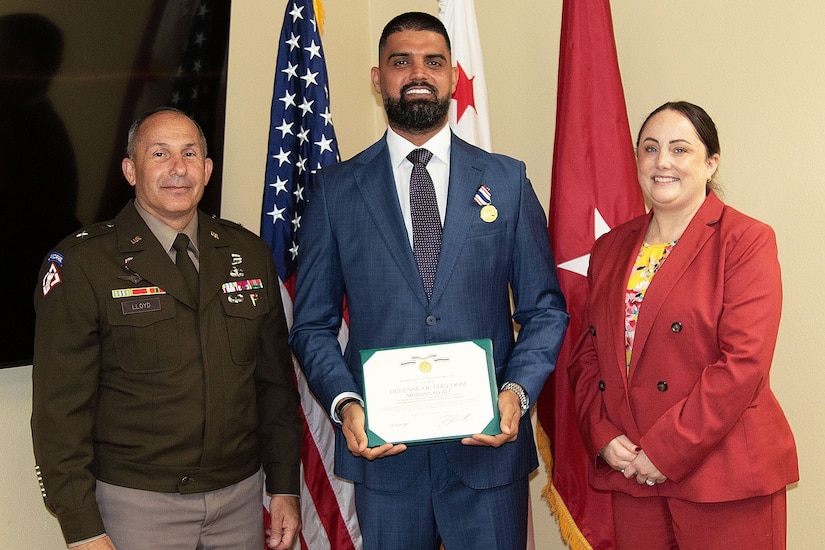
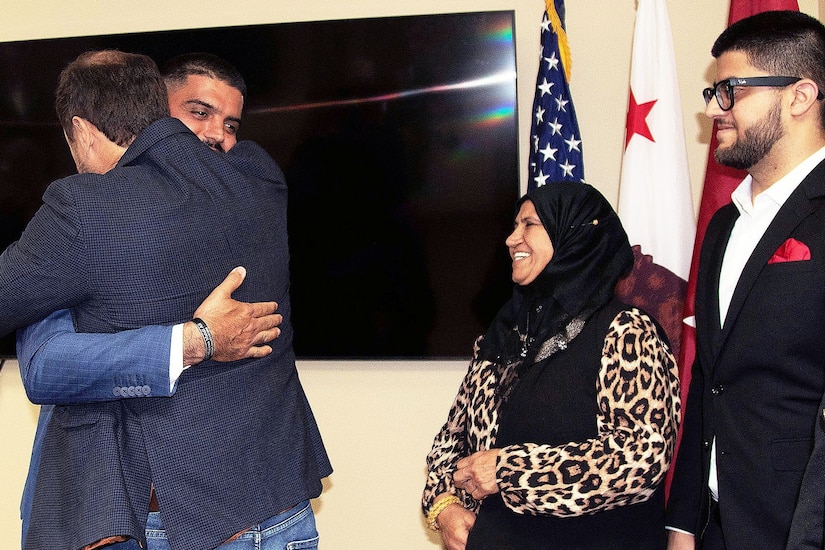
On Aug. 26, he was awarded the Secretary of Defense Medal for the
Defense of Freedom during a ceremony in San Diego for injuries sustained
in 2010 assignment as a contractor in Iraq for the U.S. Army Corps of
Engineers' Gulf Region District.
The medal, the civilian equivalent of the Purple Heart, honors
Defense Department civilian employees who are killed or wounded by
hostile action while serving in support of DOD. It serves as a reminder
of the contributions made by civilians who risked their lives in support
of these efforts.
Ali's story began in Baghdad, where he recalled the kindness and
professionalism of the U.S. military during the 2003 Iraq invasion,
known as Operation Iraqi Freedom, leaving a lasting impression on him.
"The treatment we received from the U.S. military was phenomenal,"
Ali said. "I remember meeting a linguist at the time whose job was to
assist, and he was so good at it. I remember thinking, I want to be just
like him. I want to help people."
Inspired by this encounter, Ali set his sights on becoming a
linguist, securing his first contracting job with the U.S. military at
the age of 18.
From the start, moments in Ali's career were marked by danger.
He was in a Chinook helicopter en route to Fallujah, Iraq, on his
first assignment with five other linguists when rocket-propelled
grenades struck the aircraft. While they safely landed, Ali described it
as his "wake-up call."
"You quickly realize how fragile life is in this line of work," he said.
Ali demonstrated his dedication to the mission and the U.S. military
early in his career. When he suspected a fellow linguist of being an
insider threat, he took matters into his own hands, exposing the
individual and possibly preventing U.S. casualties.
Then, in 2010, tragedy struck when an explosively formed penetrator tore through the vehicle he was riding in.
Ali vividly remembers the attack.
"It was pitch dark. I couldn't hear anything, and then I heard
prayers very loud and clear," he said. "I looked down and saw a hole in
our vehicle. I knew that was it, we'd been hit."
With the vehicle now far from the road, his team leader, Robbie,
unconscious, and his driver, Haider, severely wounded with shrapnel in
his face, Ali's instincts kicked in.
"I remembered knowing I needed to pull security like I had been
trained, administer medical aid to Robbie and Haider like I was trained,
but also thinking this is how I was going to die," he said.
Ali managed to call for help through the chaos, and a helicopter
arrived to extract them. Only after administering care to his team and
calling for help did he realize he was bleeding from a severe thigh
wound.
In agony from his own injuries, he listened to flight medics
unsuccessfully attempt to revive his team leader in the helicopter on
the way to the hospital.
"I will never forget that ride," Ali said.
After undergoing multiple surgeries, Ali learned that word of the
attack had spread quickly back home, and in the confusion, his family
was told he had been killed.
"I remember begging my dad not to tell my mom and reassuring him I was alive," he said.
The fear was compounded by painful memories from years earlier when
one of Ali's brothers was killed after neighbors discovered Ali was
working with the Americans. At the time, Ali was traveling to the "14th
of July Bridge" in the Green Zone to help recruit locals to work for
U.S. defense contractors when someone in the neighborhood recognized
him.
Ali's younger brother, who later became a linguist himself and served
alongside coalition forces and the Air Force in Iraq and Qatar, is
still alive.
Ali and Haider shared a hospital room in recovery for two weeks. On
the day Ali was scheduled to return to Baghdad, the team sent to pick
him up was attacked, wounding some of the personnel involved.
Despite the constant danger before, during and after the incident,
Ali remained committed to the mission. Just six months later, he
rejoined U.S. forces and continued his 20-year career with the same
focus and dedication.
"For 20 years, I dedicated my life to the teams I worked with," Ali
said. "I was surrounded by heroes, real heroes, and all I wanted was to
make sure they got home safe." He considered his fellow soldiers and
contractor families, saying, "I would've taken a bullet for any of them,
any day, without thinking twice."
The Gulf Region District, formed as part of USACE operations during
Operation Iraqi Freedom, provided full-spectrum construction management
to the United States Forces-Iraq command, the U.S. Embassy-Baghdad
Mission, and the Government of Iraq until its inactivation at the end of
2011.
In the intervening years, the GRD's soldiers and civilians, undaunted
by the dangers posed by the insurgency, delivered more than 5,100
projects valued at nearly $9 billion. They helped Iraq add 7,000
megawatts of electricity to its grid, supported and expanded oil
production capacity to 3 million barrels per day, and managed 1,200
school projects that served hundreds of thousands of children. Five
million people benefited directly from the GRD's water and sewer
projects, and millions more received treatment in medical facilities
that USACE helped build. The division also oversaw the construction of
hundreds of infrastructure projects, including roads, railroads,
aviation facilities and ports, and it supervised the building of
hundreds of vital national security and community safety structures,
such as border posts, entry facilities, courthouses and fire stations.
Now living in San Diego with his family, Ali works as the director of
operations, Middle East, for a national space company, but his bond
with those with whom he served remains strong. In 2014, Haider visited
Ali in San Diego, bringing his own Defense of Freedom Medal. Ali said
ever since seeing Haider's medal, he's thought about what this award
truly means and represents, which is the sacrifice and valor in service
to the nation.
For Ali, the Defense of Freedom Medal is deeply personal. It reflects
events of that day, but also the mission that guided his life, and the
heroes he has worked alongside.
"Thank you so much for this amazing award, it honestly means a lot to
me," Ali said. "To my beautiful family, I want to thank you guys for
all the support during the last 20 years."




 Posts

