Thursday, September 16, 2021

Pennsylvania Man Pleads Guilty to Attempting to Provide Material Support to ISIS

 A Pennsylvania man pleaded guilty today to one count of attempting to provide material support to the Islamic State of Iraq and al-Sham (ISIS), a designated foreign terrorist organization.

Mustafa Mousab Alowemer, 23, of Pittsburgh pleaded guilty to one count of attempting to provide material support to ISIS in relation to his plan to attack a church in Pittsburgh.

“The defendant, motivated by ISIS’s call to violence and hate, plotted a terrorist attack targeting a church in Pittsburgh,” said Acting Assistant Attorney General Mark J. Lesko of the Justice Department’s National Security Division. “With today’s guilty plea, he will be held accountable for his crimes. The Department of Justice is committed to identifying, disrupting and holding accountable individuals who seek to engage in such attacks. I commend the agents, analysts and prosecutors who identified the threat posed by this defendant and took action to protect the public from his plans.”

“Inspired by ISIS, Mustafa Alowemer devised and intended to carry out a deadly attack on a house of worship and its congregation,” said Acting U.S. Attorney Stephen R. Kaufman for the Western District of Pennsylvania. “If not for the tireless, multi-faceted investigation by the FBI and our partner agencies, the true depth of his determination to commit violence in the name of ISIS may not have been exposed until his deadly plans were achieved.”

“The guilty plea today by Mustafa Alowemer leaves no question about his intention to commit an act of terrorism against a place of worship,” said Special Agent in Charge Mike Nordwall of the FBI’s Pittsburgh Field Office. “Mr. Alowemer will now face the consequences of his elaborate plan to inflict harm on innocent people. I’m proud of FBI Pittsburgh and all of the personnel who worked countless hours to protect the community, and I want to thank all of the agencies that participate in the FBI’s Joint Terrorism Task Force. Together, we combine our resources to identify and disrupt threats to protect our communities and the nation.”

According to court documents, Alowemer plotted to bomb a church located on the north side of Pittsburgh using an explosive device. His stated motivation to conduct such an attack was to support the cause of ISIS and to inspire other ISIS supporters in the United States to join together and commit similar acts in the name of ISIS. Alowemer also targeted the church to “take revenge for our [ISIS] brothers in Nigeria.” Alowemer was aware that numerous people in the proximity of the church could be killed by the explosion.

In furtherance of the plot to bomb the church, in May 2019, Alowemer distributed multiple instructional documents related to the construction and use of explosives and improvised explosive devices (IEDs) to an individual Alowemer believed to be a fellow ISIS supporter, but who was in fact an FBI employee. Alowemer distributed these documents with the intent that the information be used in the assembly of a destructive device and in furtherance of conducting an attack in support of ISIS. In or around June 2019, Alowemer purchased several items, including nails and acetone (nail polish remover) with the belief that they were necessary to assemble a destructive device and with the intention they be used to construct the explosives that would be detonated in the vicinity of the church.

Between April 16 and June 11, Alowemer met four times in person with an FBI Undercover Employee (UCE) and/or an FBI Confidential Human Source (CHS). At the June 11 meeting with the UCE and CHS, Alowemer provided additional details about the bomb plot and provided the materials, including boxes of nails, he had purchased for construction of the device. Alowemer provided printed copies of detailed Google satellite maps, which included hand-written markings identifying the church and routes of arrival and escape. Alowemer also wrote and provided a 10-point handwritten plan outlining details related to his plot to personally deliver explosives in a backpack. Alowemer expressed a desire to meet one more time to conduct planning and coordination prior to carrying out the attempted bombing in July 2019. That meeting was later scheduled for June 19 in the Pittsburgh area, at which time Alowemer was arrested.

Alowemer is scheduled to be sentenced on Jan. 26, 2022. He faces a maximum of 20 years in prison, a fine of $250,000.00, or both, and a lifetime term of supervised release. A federal district court judge will determine any sentence after considering the U.S. Sentencing Guidelines and other statutory factors.

Pending sentencing, the court ordered that Alowemer remain detained in the custody of the U.S. Marshals.

Assistant U.S. Attorney Soo C. Song of the Western District of Pennsylvania and Trial Attorney Brenda Sue Thornton of the National Security Division’s Counterterrorism Section are prosecuting this case on behalf of the government.

The FBI’s Joint Terrorism Task Force members who were directly involved in this investigation include: FBI, U.S. Immigration and Customs Enforcement (ICE), U.S. Citizen and Immigration Services (USCIS), Homeland Security Investigations (HSI), IRS – Criminal Investigation, U.S. Secret Service, U.S. Postal Inspection Service, Pennsylvania State Police, Allegheny County Police Department, Pittsburgh Bureau of Police, Allegheny County Port Authority Police, Allegheny County Probation, University of Pittsburgh Police Department and UPMC Police Security.

Wednesday, September 15, 2021

Join S&Ts Insights Outreach Webinar on October 5: R&D Addressing DHS Missions | Priorities, Partnerships, and Demand Signals


Want to learn how S&T sets R&D priorities?

S&T’s Office of Industry Partnerships (OIP) is here to help you navigate  the Department of Homeland Security (DHS) resources and learn how to work with S&T to get your innovative solutions into the hands of DHS end users and to the commercial market.

Join us on October 5, 2021, from 2-3 p.m. ET for the next Insights Outreach webinar: R&D Addressing DHS Missions | Priorities, Partnerships, and Demand Signals.

REGISTER

S&T works closely with DHS operational components to identify capability gaps and meet technology needs by utilizing a variety of funding opportunities and commercialization mechanisms.


During this live webinar, you will hear from S&T’s Office of Requirements and Analysis, the DHS Countering Weapons of Mass Destruction Office, and Industry Partnerships about how S&T works with innovators throughout the R&D lifecycle to help develop technologies and deliver solutions that address DHS priorities.

Learn more about how to discover opportunities to adapt, develop, and commercialize your technologies in support of DHS missions at the Insights Outreach series webinars on the first Tuesday of each month.

DHS Science & Technology, Office of Industry Partnerships

SandT.Innovation@hq.dhs.gov
www.dhs.gov/science-and-technology/work-with-st

Tuesday, September 14, 2021

Home Builders


Marines construct living quarters for incoming Afghan families at Marine Corps Base Quantico, Va., Sept. 9, 2021.

All Aboard


Afghan families board a C-130H at the Philadelphia International Airport in Philadelphia, Pa., Sept. 11, 2021. The families were flown to Camp Atterbury, Ind., as part of Operation Allies Welcome.

Building Lodging


An airman helps build partitions for living quarters for Afghan evacuees at Holloman Air Force Base, N.M., Sept. 6, 2021.

High Fives


Air Force Airman 1st Class Gabrielle Ivey gives high fives to an Afghan child during Operation Allies Refuge at Ramstein Air Base, Germany, Sept. 13, 2021.

Guantanamo Periodic Review Board Media Invitation Announced September 21, 2021

 Sept. 14, 2021


The Department of Defense will allocate seats for news media at the Pentagon satellite viewing location on September 21, 2021, to cover unclassified portions of the Guantanamo Periodic Review Board for Mohammed Abdul Malik Bajabu (ISN - 10025).

Due to limited space availability, selection is not guaranteed. Upon selection, additional information on meeting time and location will be provided.

Media desiring to observe the hearing should send requests via email to osd.pentagon.pa.mbx.gtmo-press@mail.mil.

All requests must be received no later than 10 a.m. ET September 17, 2021. Media members should include their name, position, sponsoring organization and contact information (cell phone and email address) in their request. Multiple names from the same organization may be submitted.

Further information, including media ground rules, can be viewed at the Periodic Review Secretariat website at https://www.prs.mil/.

Dar al-Farooq Mosque Bomber Sentenced to 53 Years in Prison

 ST. PAUL, Minn. – Emily Claire Hari, 50, f/k/a Michael Hari, was sentenced to 53 years in prison for the August 5, 2017, bombing of the Dar al-Farooq (DAF) Islamic Center in Bloomington, Minnesota.

On December 9, 2020, following a five-week trial, Hari was convicted by a federal jury on all five counts of the indictment, including intentionally defacing, damaging, and destroying religious property because of the religious character of that property; intentionally obstructing, and attempting to obstruct, by force and the threat of force, the free exercise of religious beliefs; conspiracy to commit federal felonies by means of fire and explosives; carrying and using a destructive device during and in relation to crimes of violence; and possession of an unregistered destructive device.

In handing down the sentence, United States District Judge Donovan W. Frank described the attack orchestrated by Hari as a highly sophisticated and premeditated act of domestic terrorism.

“Hari sought to terrorize an entire faith community. Today’s sentence makes clear that such acts of hate-fueled terror will not be tolerated,” said Deputy Attorney General Lisa O. Monaco. “The Dar al-Farooq community has shown powerful strength and resolve during this case. As demonstrated by this verdict and sentence against Hari, the Justice Department will prosecute hate crimes to the full extent of the law, including those that target places of worship and other religious sites.”

“Today, the person responsible for the 2017 bombing of the Dar al-Farooq mosque has been sentenced to 53 years in prison. Through our system of justice, the Minnesota community has collectively condemned this hate-fueled attack and decisively upheld every individual’s Constitutional right to live and worship free from violence and intimidation,” said Acting United States Attorney W. Anders Folk. “As we mark the closing of a painful chapter, it is my hope that the members of Dar al-Farooq and the broader faith community impacted by this attack will continue to heal and regain a sense of safety and security.”

“Acts of violence, motivated by hatred toward individuals simply based on their faith, will not be tolerated by the FBI or our Minnesota law enforcement partners,” said Michael Paul, Special Agent in Charge of the FBI's Minneapolis division. “Violent criminals such as those responsible for this cowardly act, will be held accountable for their hate crimes and disgraceful attempts at intimidation. This sentence demonstrates our continued commitment to the FBI’s core mission – to defend all communities and to protect the rights of all Americans.”

As proven at trial, during the summer of 2017, Hari established a terrorist militia group called “The White Rabbits” in Clarence, Illinois. Hari recruited co-defendants Michael McWhorter and Joe Morris to join the militia, which Hari outfitted with paramilitary equipment and assault rifles. On August 4 and 5, 2017, Hari, McWhorter, and Morris drove in a rented pickup truck from Illinois to Bloomington, Minnesota, to bomb the DAF Islamic Center. Hari targeted DAF specifically to terrorize Muslims into believing they are not welcome in the United States and should leave the country.

As proven at trial, Hari, McWhorter, and Morris arrived at DAF on August 5, 2017, at approximately 5:00 a.m. At Hari’s direction, Morris used a sledgehammer to break the window of the Imam’s office at DAF and threw a plastic container with a mixture of diesel fuel and gasoline into the office. Then, also at Hari’s direction, McWhorter lit the fuse on a 20-pound black powder pipe bomb and threw it through the broken window. McWhorter and Morris ran back to the truck where Hari was waiting in the driver’s seat. The three men sped away from the building and drove back to Illinois. When the pipe bomb exploded, the blast caused extensive damage to the Imam’s office. It also ignited the gasoline and diesel mixture, causing extensive fire and smoke damage. At the time of the bombing, several worshipers were gathered in the mosque for morning prayers.

On January 24, 2019, McWhorter and Morris pleaded guilty to their roles in the bombing. Their sentencing hearings are yet to be scheduled.

This case is the result of an investigation conducted by the FBI.

Acting United States Attorney Folk thanks Assistant United States Attorneys Allison Ethen and Timothy Rank, Justice Department Civil Rights Division Trial Attorney Timothy Visser, Lead Paralegal Specialist Lynette Simser, Community Affairs Director Angie LaTour, Witness Specialist Selina Kolsrud, former Assistant United States Attorneys John Docherty and Julie Allyn, Assistant United States Attorney Eugene Miller, of the Central District of Illinois, and the special agents of the FBI’s Minneapolis and Springfield Divisions, the Bureau of Alcohol, Tobacco, Firearms and Explosives, the Bloomington Police Department, and the Bloomington Fire Department for their hard work and commitment to the pursuit of justice. Acting United States Attorney Folk further thanks the Justice Department’s Civil Rights and National Security Divisions, the United States Attorney’s Office for the Central District of Illinois, and the FBI’s Springfield Field Office for their collaboration and partnership.

Monday, September 13, 2021

COVID-19 Vaccine


Army Pfc. Riley Tiedt with the 2-127th Infantry Regiment, 32nd Infantry Division, Wisconsin National Guard, administers a COVID-19 vaccination to an Afghan evacuee during Operation Allies Welcome at Fort McCoy, Wi., Sept. 3, 2021. The Defense Department through Northern Command, and in support of the Department of Homeland Security, is providing transportation, temporary housing, medical screening, and general support for at least 50,000 Afghan evacuees at suitable facilities, in permanent or temporary structures, as quickly as possible.

Ramstein Air Base: Setting Up an Instant City for Afghan Evacuees

 Sept. 12, 2021 | BY Jim Garamone , DOD News

Young Abdul was teething and letting his grandfather know that he wanted attention.

His grandfather searched through the bags surrounding the family of 12 until he found the binky and quieted his young charge. ''He is not afraid to speak up,'' Grandfather said. ''He will be a good American.''

The family was waiting in a massive hangar designed to service the U.S. Air Force's largest aircraft – the C-5 Galaxie. They were beginning the next step of the journey that began in Kabul, moved through Doha, Qatar to Ramstein Air Base, Germany. Later that evening the family boarded a Civil Reserve Air Fleet plane to fly to Washington, D.C.

Two young boys smile while standing in a crowded room.

The family were citizens of an instant city that sprang up on the flightline of America's largest air base in Europe. They had lived in a tent while they completed processing to reach their new country. 

Air Force Col. Amy Glisson is the mayor of this instant city, which did not exist on August 21. A week later, there were 21,500 Afghan travelers living in the various pods that airmen and soldiers constructed along the flightline. 

Glisson detailed how the city grew during an interview with Pentagon reporters. Glisson's regular job is as commander of Ramstein's Mission Support Group. The airmen and civilians of the group formed the nucleus around which the support to the Afghans grew. Airmen from all over the U.S. Air Forces Europe and Air Forces Africa augmented the effort as did soldiers from Army bases in Germany.

The tents are grouped into pods. The colonel said the effort represents ''hope in a pod.'' 

The logistics behind this effort is extraordinary. It is not just putting up war reserve material tents, but it's also getting and setting up the sanitary facilities, it's getting food, it's getting bedding and clothing for many people who escaped the Taliban with the clothes on their backs. It's providing medical care to those who need it. It's getting diapers and formula for infants, and wheelchairs for handicapped travelers. It's thousands of details that must be considered as the instant city grows and functions. 

It is also establishing the procedures that guide the processing system so the Afghan travelers can complete their journeys to the United States.

Finally, it is taking U.S. military and civilian agencies and building a team even as the mission begins and grows.

''To date we have processed over 35,000 Afghans through our system here,'' Glisson said in the interview. ''We're a learning organization, so procedures have changed as we learned.''

Such as dealing with families. ''In Afghanistan, the Air Force was mostly on bases,'' she said. ''Our Army friends were out in the communities and know much more about the families and they have been a tremendous help in that. Afghan families here, can be anywhere from two to 22 members. The first few days our inclination was to put women and children into hard facilities – like our hangars – and then put the men into tents. The families did not like that and that quickly changed.''

Glisson and crew learned the Afghans didn't like it because she instituted meetings with elders in the pods. 

Food was another problem that the Americans had to deal with. ''Getting halal food is tough. This is Germany: Pork and schnitzel is everywhere, as are potatoes. Afghans don't eat any of those things,'' she said. ''We had to find a supply chain that could supply a lot of chicken and noodles with curry, and we had to do it right away.''

A long shot of many Afghan refugees gathered for a flight to the USA.

They only serve two meals a day – breakfast and dinner. But now they serve bags with fruit in them for children and they are serving tea to the travelers. ''The elders always said they wanted tea and finally we've been able to produce enough tea for 10,000 people,'' Glisson said. ''Again, our Army compadres at Rhine Ordnance Depot knew the importance of tea to the Afghans, and we did make that a priority.''

The pods are just a way stop for the Afghans. It is a place where they complete the processing needed for entry to the United States. Personnel from the States Department, TSA, Customs and Border Patrol, federal law enforcement and more join in processing the Afghans. They perform full biometric work-ups of all people. The process seems pretty seamless.

The mammoth C-5 hangar is the goal: This is where Afghans gather to load aircraft. Once they have done all the paperwork, once they have had the biometrics completed, once they have processed through the medical screening, they get the call to report to buses that take them to the departure area.

If only one airplane goes out a day with 250 souls aboard, that doesn't make that big a difference in a 10,000-member population. ''Throughput'' is the word Air Force personnel use, meaning they number of people the system can accommodate. There are plenty of aircraft and aircrews, but the system itself must be able to flow the people through. If there is a blockage in the United States, it doesn't make sense to keep shipping people. Recently throughput has been a problem and shipping the refugees from Ramstein has slowed. 

It has actually stopped with the discovery of measles among some Afghans that arrived in the United States.

The Afghans fly out on Civil Reserve Air Fleet airliners. These are regular civilian airliners that are mobilized for the effort. The first time there was a CRAF mobilization was during Desert Shield in 1990.

United, American, Eastern, Delta and others fly the refugees mostly to Dulles Airport outside Washington, D.C., where their processing continues.

Ramstein is just one part of this effort in Europe. Personnel at Sigonella Navy Air Station in Italy and in Rota, Spain are performing the same mission.

Some 124,000 Afghans were evacuated from Kabul International Airport through August 31. Many arrived at the airport just ahead of the Taliban, and many suffered wounds trying to get onto the airport. 

One man had been an interpreter for the U.S. Army in Kabul for years. As Kabul fell to the Taliban, he gathered his wife and two young sons. With the clothes on their backs they managed to get onto the airport and flew aboard an Air Force C-17 to safety in Qatar. After two days in the Arabian Gulf nation, he boarded another aircraft for the trip to Ramstein. Now he and his family wait to board the plane to the United States. ''I want to live in Ohio,'' he said. ''I have a good friend I worked with in Kabul who lives there. He owns his own business.''

Stacks of diapers and other supplies for Afghan families gathered at a military base.

All the travelers worry about family left in Afghanistan. Another man – who served as an interpreter for a non-governmental agency – said there has been limited access to the internet at Ramstein and he does not know what is happening with family outside Kabul. ''The Taliban came through the neighborhood and seemed to know just where to go,'' he said. 

One woman was a police officer in Afghanistan. ''There is no future for women in Kabul under the Taliban,'' she said.

The number of refugees coming to Ramstein is falling, but the mission is not done. The base is starting to send airmen and soldiers who augmented the force back to their home stations. Glisson praised the airmen, soldiers and civilians who put the effort together. ''I have aircraft crew chiefs helping clean port-o-johns,'' she said. 

In another tent, an aircraft safety inspector and a special weapons expert put together the boxed dinner the travelers will receive on the flight to America.

''This is a 'whole of Ramstein' approach,'' she said. ''I am so proud of the way our people are working together.''

Saturday, September 11, 2021

Nation Remembers Courage of Heroes Killed on Flight 93 on 9/11

 Sept. 11, 2021 | BY David Vergun , DOD News

Sailors of the amphibious transport dock (LPD) USS Arlington, LPD USS New York, and LPD USS Somerset, as well as others, attended an observance today at the Flight 93 National Memorial near Shanksville, Pennsylvania, for the heroes of United Flight 93, which crashed at 10:03 a.m., Sept. 11, 2001.

The Somerset was named for the county in which Flight 93 crashed and the other two vessels were named for the locations of the other 9/11 attacks.

The silhouette of a memorial with a sunrise in the background.

Forty passengers and crew, not including the four terrorists, lost their lives.

The names of the passengers and crew members were read by the family members of the survivors with the ringing of the Bells of Remembrance.

Navy Capt. Dave Kurtz, commander of the USS Somerset, spoke. 

The story of Flight 93 is one of 40 people brought together by circumstance, most of whom knew no one on board, banding together in a time of crisis, he said. 

Visitors walk along a memorial wall adorned with flower bouquets.

"I could think of no greater act of service, no higher calling, than prioritizing the lives of others when one's very existence is at stake. Defying comprehension, these unsuspecting people, suddenly thrust into an extraordinary situation, acted with complete selflessness," he said.

Kurtz noted that some of the sailors and Marines aboard the Somerset were not even born on 9/11. He said that every shipmate is provided with an education of what happened that day and is told the significance that their work means for freedom.

They are reminded that it is their solemn duty to carry on with the legacy of those 40 heroes, he added.

George W. Bush, who was president on 9/11, also spoke.

The events of 9/11 changed Americans' lives forever, he said.

A memorial visitor center sits in the middle of a green field.

"We saw that Americans were vulnerable, but not fragile; that they possess a core strength that survives the worst that life can bring. We learned that bravery is more common than we imagined," he said.

Bush also spoke to those in uniform and military veterans, who he said have answered the call of duty, the noblest America has to offer.

"You have shielded your fellow citizens from danger and advanced the rights of the downtrodden. You have been the face of hope and mercy in dark places. You have been a force for good in the world. Nothing that followed, nothing, can tarnish your honor, or diminish your accomplishments. Our country is forever grateful," he said.

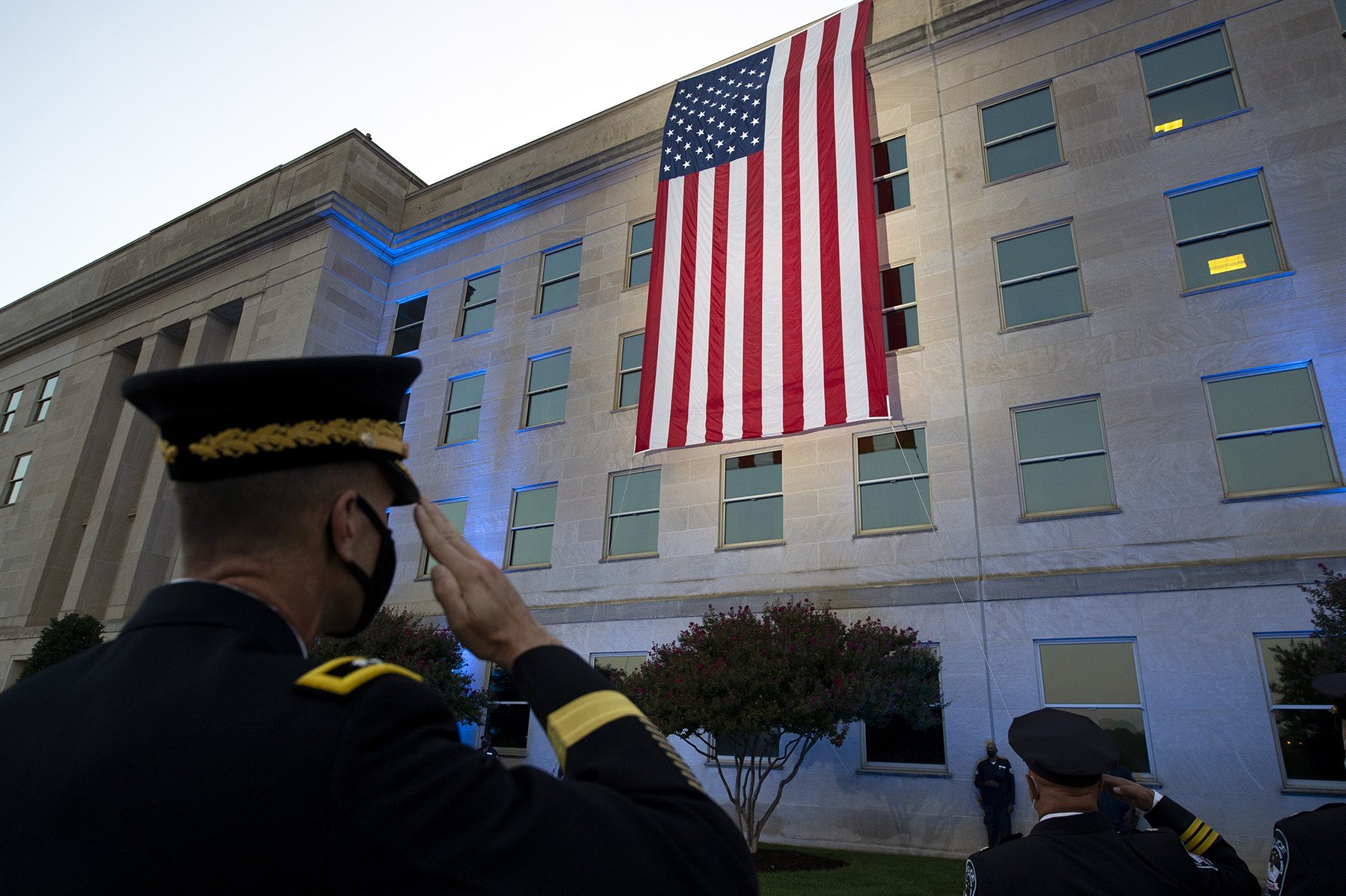
9/11 Flag Observance


Officers salute an American flag unfurled over the side of the Pentagon at sunrise on the 20th anniversary of the 9/11 terrorist attacks at the Pentagon, Sept. 11, 2021.

Friday, September 10, 2021

Attorney General Merrick B. Garland Delivers Remarks Honoring the 20th Anniversary of the September 11 Attacks

 Washington, DC

~
Friday, September 10, 2021

Remarks as Delivered

Thank you very much for joining me this morning to commemorate the 20th anniversary of the attacks of September 11, 2001. It is an important time to be among friends and colleagues.

That day is forever seared into all of our memories. The pain, the terror, the tremendous loss. And also, incredible displays of courage.

I’d like to start by honoring those who lost their lives on 9/11 – and the many who have died of 9/11- related illnesses since – with a moment of silence.

Nothing can change the profound way the events of September 11 affected us – individually, as a department and as a nation.

Nothing we can do or say can replace the loss so many endured that day. As we have changed as a nation and as a federal government since 9/11, at the Justice Department we mark this anniversary by remembering that we evolve most successfully when we build on our core foundations.

We do this by adhering to the values that the Justice Department represents, chief among them the rule of law, the pursuit of justice, and the protection of civil rights and civil liberties.

The tree we are standing before is a living symbol of our values and our refusal to bend in the face of terrorism. It embodies our nation’s spirit of hope and healing, strength and resilience in the wake of the 9/11 attacks.

This Callery Pear tree is a descendent of a tree at Ground Zero that became known as the “Survivor Tree” after standing through the terror attacks on the World Trade Center.

Each year, the National September 11 Memorial and Museum gives seedlings from the Survivor Tree to three communities that have endured tragedy in recent years.

In 2015, the department dedicated the planting of this Survivor Tree seedling. The following year, Attorney General Loretta Lynch dedicated a commemorative plaque for the tree.

And today, I am humbled to have the honor of announcing the permanent installation of this plaque.

This plaque reminds us that the threat from foreign terrorists like those involved in the September 11 attack is one we must constantly guard against.

As I said yesterday, we rededicate ourselves at the Justice Department to doing all we can to protect the American people from terrorism in all its forms – whether originating from abroad or at home – and to doing so in a manner that is consistent with our values and the rule of law.

What we must do – what we have done – is to learn from the past to better anticipate and prepare for the next threat and to seek to disrupt it.

It is an awesome responsibility. But it is one that we undertake together, and that, in and of itself, gives us strength.

Thank you.

Guard Pilot Who Flew Over D.C. Following 9/11 Likened Attacks to Modern-Day Pearl Harbor

Sept. 10, 2021 | BY C. Todd Lopez , DOD News

Two decades ago, Air Force Lt. Gen. Marc H. Sasseville, now the vice chief of the National Guard Bureau, was a lieutenant colonel with the D.C. Air National Guard. When aircraft hit the World Trade Center towers in New York City and the Pentagon in Washington, the nation went on alert — and so did he.

A man in a military uniform stands among trees and benches in a memorial area.

"As a military pilot, I had a couple thoughts," he said. "Short term, [we] need to get in the air — we're under attack. All I could think about was Pearl Harbor, to December 7, 1941, and showing some kind of ability to respond. We didn't know what was behind these initial hits on America. There could have been multiple waves."

He also realized that something big had happened — a game-changing event for the United States that would alter its course for a long time.

"This was the start of something that was going to be much bigger and which was going to last much longer," he said. "We had clues about our enemy before then, but we really hadn't put the picture — the gravity of the situation — together until 9/11. And then we realized that we're on to something that was going to take us decades, if ever, to resolve."

By the time Sasseville and fellow F-16 pilot Heather R. Penney — then a first lieutenant — got into the cockpits of their F-16 aircraft at Andrews Air Force Base, they already knew that hijacked aircraft had hit the Pentagon and the towers in New York. Their mission was to prevent further damage — in particular from that posed by United Airlines Flight 93.

When Sasseville and Penney left Andrews, their aircraft launched without any missiles on board. They had embarked on what amounted to a suicide mission. Without missiles, the two pilots were prepared to ram their own aircraft into Flight 93 in order to keep it from causing any damage to the nation’s capital.

A collapsed building is shown. Smoke rises. Fire trucks are nearby.

Flight 93 was originally supposed to go from Newark International Airport in New Jersey to San Francisco International in California. Just 45 minutes into that domestic flight, hijackers took control of the plane and redirected it toward Washington. The goal of the hijackers still remains unknown, perhaps it was to crash the plane into either the U.S. Capitol Building or the White House. Sasseville and Penney were supposed to prevent something like that from happening.

"We had gotten a call from the White House Joint Operations Center, and they could see the picture," Sasseville said. "They knew that Flight 93 had turned back. And they had basically asked if we had any airplanes that could go up the river."

It made perfect sense what they were being asked to do, Sasseville said. The hijackers might not be able to fly by instruments and get the aircraft where they wanted it. But if they looked at the ground — at the Potomac River — they could use that as a guide to get them where they wanted to be.

"You call them geographic references," Sasseville said. "Flying down a river, flying down a highway or a power line is a great way to help guide you to a certain point. That's what it looked like on the radar scope, that there was an airplane flying down the river."

Resistance from passengers aboard Flight 93 eventually thwarted the hijackers' plans; and ultimately, the plane crashed into a field near Shanksville, Pennsylvania, about 130 miles northwest of Washington. All of that happened before Sasseville and Penney even got into the air — though they didn't know it at the time.

While neither pilot saw Flight 93 on that mission, they did see the results of American Airlines Flight 77 — which had crashed into the Pentagon.

"The piece that I remember most was being at 6,000 feet, right there, smelling the fumes from the fire and looking down and seeing chaos, and just feeling sick to my stomach," Sasseville said. "I wasn't sick because of the fumes. I was sick because I knew that we had been attacked."

Sasseville said the United States had been attacked that day because it failed to see such a thing coming. He called it a "failure of imagination." The United States must ready itself for another attack, he said, because America's enemies will try again.

Smoke emanates from a burning building. Firetrucks are in a parking lot.

"The next one won't be like this one was, but there will be another attack. There are still people out there that do not want us to have the liberties and freedoms that we enjoy today," he said. "We need to thoroughly examine our vulnerabilities and our weaknesses ... and we need to shore up those vulnerabilities and expect the unexpected and not be surprised by it."

On the morning of Sept. 11, 2001, Sasseville had been attending meetings at the 113th Wing, part of the D.C. National Guard. His unit had just come back from a training deployment, and manning was low.

"[It was a] skeleton crew because those same guardsmen ... go back to their normal jobs," he said. "We typically don't see them for a while. And so what we had there that day was a skeleton crew of the full-time operators and maintainers and logistics and support people inside the wing."

After the terrorist attacks, he said, things changed dramatically at the unit.

"It was an entire wing effort that really started to swing into motion," he said. "We started refueling airplanes, loading up airplanes with weapons, assembling the weapons, and we just got into [being like] a machine that went out and collected our part-timers that had gone back to their employers, to bring them back to begin to set alert, because we knew we were going to need a lot more help and this was going to go on for some time."

One big change for the 113th Wing at Andrews was that it became part of Operation Noble Eagle, part of which is to protect the skies over the Nation's Capital.

A collapsed building is shown. Smoke rises.

"We became part of the air defense structure," he said. "And everything started to set into motion that kicked off almost 90 days of 24/7 airplanes continuously in the air defending the nation's capital. So that was our reaction. We became part of Noble Eagle -- we became part of the air defense structure overnight."

Following the Sept. 11 terrorist attacks, the 113th Wing changed in another big way as well — along with the rest of the National Guard. It grew and developed in importance and how it can be used to carry out the defense of the nation.

"We have this duality of mission where we go to fight the nation's wars, and we support our communities back home," Sasseville said. "These two decades-plus have really reinforced the professionalization and the operationalization of the National Guard to make us the most ready we have probably ever been in our history."

After 20 years of growth and development through participation in and planning of combat operations in Iraq and Afghanistan, that growth is something Sasseville said he hopes the National Guard will never lose.

"We need to be incorporated in all the training, and we need to be used as part of the joint force, so that we don't lose that investment, that muscle memory," he said. "I know that there's plenty of desire for, on the part of our guardsmen, to continue to serve in that capacity."

Thursday, September 09, 2021

Having a Ball


Marine Corps Cpl. Hunter Degnan interacts with Afghan children at Marine Corps Base Quantico, Va., Sept. 7, 2021.

Task Force Construction


Airmen assigned to Task Force Holloman finish the construction of walls for lodging areas for Afghan evacuees at Holloman Air Force Base, N.M., Sept. 6, 2021, in support of Operation Allies Welcome. The Defense Department, through U.S. Northern Command and in support of the State Department and Department of Homeland Security, is providing transportation, temporary housing, medical screening and general support for at least 50,000 Afghan evacuees at suitable facilities, in permanent or temporary structures, as quickly as possible.

Memorial Display


Wreaths of remembrance are displayed at the entrance of the National 9/11 Pentagon Memorial at the Pentagon, Sept. 8, 2021.

DHS to Increase Civil Penalties for Violations of the Federal Face Mask Requirement

 WASHINGTON - Today, the Department of Homeland Security’s Transportation Security Administration (TSA) will increase the range of civil penalties that may be imposed on individuals who violate the federal mask mandate at airports, on commercial aircraft, and in various modes of surface transportation, including passenger railroads, intercity bus services, and other public transportation.  The federal mask mandate for transportation, which was implemented by TSA on February 2, 2021, will remain in effect until January 18, 2022.

The new range of penalties, which take effect Friday, September 10, 2021, will be $500-$1000 for first offenders and $1000-$3000 for second offenders.

“Wearing a mask protects the traveling public and all of the personnel who make the travel experience safe, secure, and comfortable,” said Secretary of Homeland Security Alejandro N. Mayorkas.  “We will continue to enforce the mask mandate as long as necessary to protect public health and safety.”

“We appreciate the majority of travelers each day who voluntarily follow the requirement, but find this action necessary to maximize the protections for those who use and work within the transportation system, and to contain COVID-19,” said TSA Administrator David Pekoske. “By doubling the range of penalties, we seek to reinforce the importance of voluntary adherence.”  

TSA will provide updated signage at airports regarding these increased civil penalties.  For more information about the federal face mask requirement, visit the TSA Coronavirus webpage.

These federal mask mandate-related civil penalties are separate from the civil penalties the Federal Aviation Administration (FAA) issues for individuals who engage in unruly and unsafe behavior.

Wednesday, September 08, 2021

9/11 Remembered


Sailors and Marines pay tribute to the victims of the 9/11 attacks on the flight deck of the USS Arlington, Sept. 6, 2021. Arlington is named after Arlington County, Va., and honors the victims of the terrorist attack on the Pentagon.

Happy Hands


An airman plays with an Afghan child at Holloman Air Force Base, N.M., Aug. 31, 2021.