Showing posts with label egypt. Show all posts

Monday, September 17, 2012

Dempsey: U.S. Must Remain Engaged with Muslim World


By Jim Garamone
American Forces Press Service

ABOARD A U.S. MILITARY AIRCRAFT  – The recent anti-American demonstrations that have occurred in many Muslim countries “demands for us to be more engaged, not less engaged,” the chairman of the Joint Chiefs of Staff said today during an aircraft flight from Sibiu, Romania, to Ankara, Turkey.

Army Gen. Martin E. Dempsey said the situation is the most complex he has seen since becoming chairman.

In Libya, a coordinated attack on the U.S. Consulate in Benghazi resulted in the deaths of four Americans including the U.S. ambassador to the country. There have been anti-American demonstrations in Egypt, Yemen, Tunisia, Pakistan and many others.

While the spark that ignited the demonstrations was a crude video that denigrated Islam, there are several factors that have contributed to rage against the United States, the chairman said.

The chairman wants to learn from the situation. “At some level, I think what we are seeing are societies that have been suppressed,” he said. “They have not had anything like freedom of speech or even the ability to congregate.”

Security forces in these countries are for the first time under civilian rule, and are less likely to intervene unless directed by political leaders, the chairman said.

And, he said, there are often power struggles within the countries.

“Some of those groups are truly anti-American and radical and violent,” Dempsey said. “Certainly you have these groups that are anti-American, who are extreme, who are competing for power in the country.”

These extremist groups often did not accumulate the number of votes they’d thought they would get in free elections, Dempsey said. Such groups that experienced failure at the ballot box, he added, could “now try to gain some traction around the idea of being anti-American in order to gain influence for themselves. These groups are trying to manipulate the population.”

Now is not the time for the United States to withdraw from these countries, the chairman said.

“It demands for us to be more engaged, not less engaged,” he said, “so that we can counter that message of extremism that is being propagated by these violent, extreme organizations.”

Monday, March 05, 2012

Brooklyn Man Sentenced to 27 Years in Prison for Conspiring to Kill U.S. Soldiers Abroad and Attempting to Provide Material Support to al Shabaab

Betim Kaziu was sentenced today to 27 years’ imprisonment for conspiring to kill U.S. soldiers abroad and related terrorism charges. On July 7, 2011, following a two-week trial before United States District Judge John Gleeson in Brooklyn federal court, the defendant was convicted of conspiring to commit murder overseas, conspiring to provide material support to terrorism, attempting to provide material support to a foreign terrorist organization, and conspiring to use a machine gun in furtherance of those crimes.

The sentence was announced by Loretta E. Lynch, United States Attorney for the Eastern District of New York.

The evidence at trial established that the defendant traveled from Brooklyn to Cairo, Egypt in February 2009 in order to wage violent jihad against United States troops in the Middle East and the Balkans. While in Cairo, the defendant also attempted to acquire automatic weapons and to travel to Somalia to join al Shabaab, a Somali terrorist organization allied with al Qaeda. Ultimately, the defendant traveled to Kosovo in an effort to target American troops stationed there or to travel onward to Pakistan to join al Qaeda. The defendant also recorded a martyrdom video on the Albanian coast of his “last few moments” before he expected to depart for jannah, or paradise, reserved for martyrs. Shortly thereafter, on August 27, 2009, the defendant was arrested in Kosovo by the Kosovo Police Service. He was then transferred to the custody of agents and detectives of the New York Joint Terrorism Task Force to face terrorism charges filed in the Eastern District of New York. At the time of his arrest, the defendant had already purchased a ticket to travel to Pakistan on September 15, 2009.

Testimony at trial established that Kaziu had been radicalized, in part, by Internet speeches by Anwar al-Awlaki and propaganda videos produced by al Qaeda and al Shabaab. The government also introduced at trial evidence from the defendant’s social networking website, including quotes by Osama Bin Laden.

United States Attorney Lynch thanked the New York Joint Terrorism Task Force, the government of Kosovo, the U.S. State Department, the Department of Justice Office of International Affairs, and the New York City Police Department for their assistance.

The government’s case was prosecuted by Assistant United States Attorneys Shreve Ariail, Seth D. DuCharme and Ali Kazemi, with assistance provided by Joanna Baltes of the National Security Division.

The Defendant

BETIM KAZIU

Age: 23

Monday, October 24, 2011

National Guard uniquely suited to peacekeeping operations

By Army National Guard Staff Sgt. Jim Greenhill
National Guard Bureau

THE SINAI PENINSULA, Egypt (10/23/11) – The National Guard is playing a critical role supporting desert peacekeepers at a critical moment in the Middle East, the director general of the Multinational Force and Observers said here Sunday.

The National Guard is a perfect fit for peacekeeping and stability operations such as the MFO's mission here, Ambassador David Satterfield said.

"I know what the Guard can do," said Satterfield. "I have watched the Guard in action in Iraq. I have seen the superb work which the Guard performs under the most challenging of circumstances. You have proved yourself in the most challenging of combat situations around the world, and you are proving yourself in this non combat but still extraordinarily challenging mission."

Satterfield hosted a Middle East troop visit and fact-finding mission led by Air Force Gen. Craig McKinley, the chief of the National Guard Bureau, with other senior National Guard leaders, including the adjutant general and the command sergeant major of the Maryland National Guard, whose Citizen-Soldiers are currently deployed here. Missouri National Guard members also are currently deployed here.

"This is not in the Sinai a kinetic undertaking," Satterfield said. "It requires a different set of skills. I believe – and the government of Egypt believes – the Guard has performed superbly. You are ideally suited to this Citizen-Soldier mission. … You make the MFO possible," Satterfield said.

"The National Guard has had a long partnership [with the MFO], and we are grateful for that relationship," McKinley said. "We are proud to be a part of this."

A peace treaty between Egypt and Israel – the Camp David Accords – was negotiated in 1979. The United Nations balked at providing peacekeepers. A U.S.-led international coalition took the baton in 1982 and – sharing the cost with the treaty signatories – has been carrying it for the almost 30 years since.

The National Guard has made the lead American contribution to the MFO for almost a decade, after a gradual transition from active duty forces that began in 2002.

The MFO is a partnership between the United States, Egypt, Israel and state Army National Guard units, Satterfield said.

"There is no better force, no better multinational cooperation … anywhere in the deployed world," Satterfield said. "It is a tribute to the preparations and the leadership which the states have provided us, which the Army National Guard and the National Guard Bureau have given us – your support has been invaluable."

About 7,500 National Guard members from 16 states and Puerto Rico have rotated through here since the Guard became the predominant contributor.

The National Guard's assets include the maturity and life experience of its troops, who are Citizen-Soldiers who bring civilian-acquired skills to their military mission, Satterfield said.

The MFO's mission is to monitor, verify and report the compliance of Egypt and Israel with the peace treaty terms. The desert peacekeepers help to sustain and build confidence, trust and security between two critically important nations, Satterfield said.

"It has never been more important, it has never been more immediate, it has never been more vital than it is today," he said. "Egypt since January has undergone revolutionary changes.

"The last nine months have been for Egyptians as well as for the MFO a period of extraordinary transformation and extraordinary challenge.

"There has been one constant: … The commitment of the Egyptian military, the commitment of the government of Egypt to the treaty of peace."

The MFO has helped its partners to reaffirm peace and stability in the Sinai and between Egypt and Israel during a period of radical transition in Egypt and the wider Middle East, Satterfield said.

"The events in the Middle East, but particularly the events in Egypt since January this year, have … fundamentally transformed what is going on here – here in the Sinai, the region as a whole and Egypt in general," Satterfield said.

Satterfield's career has focused on the Middle East for 32 years. Sharp differences continue between Egypt and Israel, Satterfield said, but:

"Never has there been a moment where the military-to-military dialog and relationship between Egypt and Israel has been as close, as strong, as frank as it has been since January."

One measure of that was the recent mutually agreed deployment of Egyptian military forces and equipment to areas of the Sinai they have not entered as an operational force since 1967, Satterfield said.

"That's a tribute to both sides, it's a tribute to the MFO and to the interest of peace each party displays."

Their leadership's enthusiasm for the mission is shared by the troops on the ground.

Maryland Army National Guard 1st Sgt. Peter Polaski Jr. first deployed here in 1995 for a pilot initiative that tested the Guard's ability to fulfill a mission previously tasked to the active duty component.

"We proved that we could," Polaski said. "We've definitely established that we can maintain continuity. That's the most important piece."

Sixteen years later, after a decade of Guard rotations here, "It's very rewarding to come full circle and be here again and assist … Egypt and Israel," he said. "We bring a lot of talent to the table – that's one of the strong suits of the National Guard."

Maryland Army National Guard Spc. Denise Wright calls her decision to enlist in 2009, "The best decision I ever made." Wright said she is proud her first overseas deployment is here, where she serves as a radio specialist. In down time, she is continuing to pursue her college computer engineering studies and learning to swim. She said the Guard and her role in this mission have helped her grow.

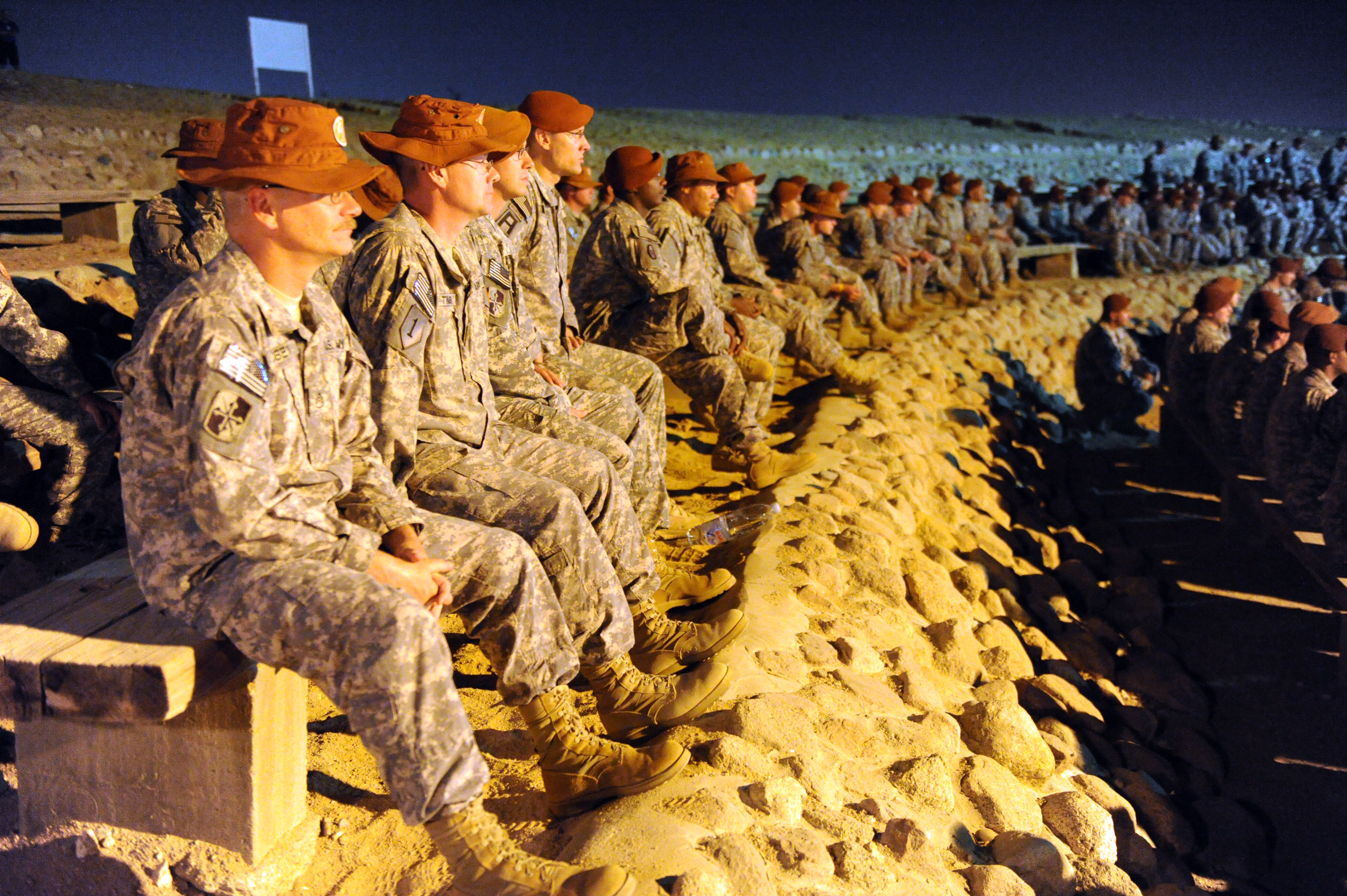
Army Maj. Gen. Jim Adkins, the adjutant general of the Maryland National Guard, met with deployed Guard members at a town hall meeting in an amphitheater on the Red Sea.

"This nation asks more of the Guard today than it did when this battalion went ashore at Normandy Beach in 1944," Adkins told troops. "Our nation asks more of you than any generation since … World War II."

Maryland and Missouri Guard members are performing one vital mission among many the Guard is conducting in the United States and overseas, Adkins said.

"You are at a place and time in history … that tremendous actions are taking place in this area. We don't know how it's going to end up, but for the rest of your career you will be able to say that you participated – you were there for this change in world history."

Satterfield praised Maryland and Missouri Guard members for their work here.

"You guys are superb," he told troops. "With every successive state deployment, we get better and better troopers. The Egyptians and the Israelis see it. They express their appreciation to me."

Monday, March 28, 2011

America Must Not Be Afraid to Lead, Obama Says

By Jim Garamone
American Forces Press Service

WASHINGTON, March 28, 2011 – The lesson of Libya is that America should not be afraid to lead, President Barack Obama said during a speech at the National Defense University here today.

The action to set up a no-fly zone and protect the Libyan people from Moammar Gadhafi says much about “the use of America’s military power, and America’s broader leadership in the world, under my presidency,” Obama said.

His responsibility as commander in chief is to keep America safe. No decision, he said, weighs on him as heavily as when to deploy servicemen and women.

“I have made it clear that I will never hesitate to use our military swiftly, decisively, and unilaterally when necessary to defend our people, our homeland, our allies and our core interests,” he said. “That is why we are going after al-Qaida wherever they seek a foothold. That is why we continue to fight in Afghanistan, even as we have ended our combat mission in Iraq and removed more than 100,000 troops from that country.”

But there are times when even if the United States is not directly threatened, the values and ideals of America are, he said.

“Sometimes, the course of history poses challenges that threaten our common humanity and common security – responding to natural disasters, for example; or preventing genocide and keeping the peace; ensuring regional security, and maintaining the flow of commerce,” the president said. “These may not be America’s problems alone, but they are important to us, and they are problems worth solving.”

America should not be afraid to act, but the burden shouldn’t rest on American shoulders alone. With Libya, the United States mobilized for collective action to enforce United Nations Security Council Resolution 1973.

“Real leadership creates the conditions and coalitions for others to step up as well; to work with allies and partners so that they bear their share of the burden and pay their share of the costs; and to see that the principles of justice and human dignity are upheld by all,” he said. “That’s the kind of leadership we have shown in Libya.”

America standing by its values is an important example to a part of the world undergoing incredible change. The people of the Middle East and North Africa refuse to be denied their rights and opportunities any longer.

“Yes, this change will make the world more complicated for a time,” Obama said. “Progress will be uneven, and change will come differently in different countries. There are places, like Egypt, where this change will inspire us and raise our hopes. And there will be places, like Iran, where change is fiercely suppressed. The dark forces of civil conflict and sectarian war will have to be averted, and difficult political and economic concerns addressed.”

The United States will not be able to dictate the pace and scope of this change, that is up to the people of the region.

“But we can make a difference,” he said. “I believe that this movement of change cannot be turned back, and that we must stand alongside those who believe in the same core principles that have guided us through many storms: our opposition to violence directed against one’s own citizens; our support for a set of universal rights, including the freedom for people to express themselves and choose their leaders; our support for governments that are ultimately responsive to the aspirations of the people.”

The United States of America was born in a revolution. “We welcome the fact that history is on the move in the Middle East and North Africa, and that young people are leading the way,” he said. “Because wherever people long to be free, they will find a friend in the United States. Ultimately, it is that faith – those ideals – that are the true measure of American leadership.”

Wednesday, March 23, 2011

Gates Discusses Libya, Middle East Turmoil

By Cheryl Pellerin
American Forces Press Service

CAIRO, March 23, 2011 – Operations in Libya and instability in the Middle East dominated a news conference with Defense Secretary Robert M. Gates here today.

Gates met with reporters after a meeting with Prime Minister Essam Sharaf and other Egyptian leaders.

U.N. Security Council Resolution 1973 called for establishing a no-fly zone in Libya and preventing Libyan leader Moammar Gadhafi from killing his own people, Gates said. It does not provide for eliminating Gadhafi as Libya’s leader, he added.

“We will be assessing this as we go along in terms of when his capabilities to [slaughter] his people has been eliminated,” the secretary told reporters. “But I think no one was under any illusions that this would be an operation that would last one week or two weeks or three weeks.” No timeline exists for ending coalition activities, he said.

The widespread unrest throughout the Middle East and North Africa is extraordinary because of the speed with which it has spread across region, “regardless of the diversity of the governments involved,” Gates said.

The entire phenomenon is less than three months old, the secretary added, “so in a way, one looks on it with some wonder.”

But a need exists, he said, “to try and work with the governments of the region -- with interim governments, with new governments, with existing governments -- to bring about change, but … in a way that is stabilizing in the region and not destabilizing.”

Meanwhile, Gates said, the situation in Yemen remains unsettled. “I think it’s too soon to call an outcome,” he said.

The United States has had a good working relationship with Yemeni President Ali Abdullah Saleh in the counterterrorism arena, Gates noted.

“But clearly, there’s a lot of unhappiness inside Yemen,” he said. “I think we will basically just continue to watch the situation. We haven’t done any post-Saleh planning.”

In Bahrain, the secretary said, the opposition and the government should sit down together and talk about the long-term relationship between the government and the Shiia Muslim majority. Gates, who recently traveled to Bahrain, said he did so “to see what the prospects were that the two sides could come together.”

Gates visited Bahrain, he said, to express U.S. support for the government and to encourage the government to reach out to the opposition, start negotiations and begin a process that would resolve some of the issues.

Monday, March 14, 2011

Pentagon Official Discusses Libya No-Fly Zone

By Jim Garamone
American Forces Press Service

WASHINGTON, March 14, 2011 – Amid reports from Libya that indicate Moammar Gadhafi’s troops are gaining the upper hand over the opposition, Pentagon Press Secretary Geoff Morrell spoke during an MSNBC interview today about the situation in Libya and possible responses.

Morrell, who has just returned from accompanying Defense Secretary Robert M. Gates to NATO for discussions on the situation in North Africa, said NATO defense ministers agreed “to continue planning for any and all military options, including a no-fly zone.”

What happens with the no-fly zone will depend on a political decision that has not been made yet, Morrell said.

“However, as we saw over the weekend, now the Arab League is calling for it,” he added. “So that will undoubtedly factor into the decision-making of the president and other European leaders as they go forward.”

Three American ships remain off the Libyan coast: the USS Kearsarge, the USS Ponce and the USS Barry. Other NATO nations also have positioned ships in the Mediterranean.

“But remember,” Morrell said, “this is to monitor the arms embargo that the U.N. put in place, as well as to provide humanitarian assistance if needed.”

If the decision is made to establish a no-fly zone, the U.S. military can make it work, Morrell said.

“I don't think this has ever been a question of can we do this,” he said. “I mean, this is the United States military. Even though we have significant commitments in Iraq and Afghanistan and elsewhere around the world, Secretary Gates has made it abundantly clear we can do this.”

NATO allies would help, Morrell noted. “It’s important that we not do it alone,” he said. “But this is not a question of ‘can.’ It’s a question of whether we should. And that’s a decision that the president will make at some point.”

Meanwhile, two more U.S. military flights flew Egyptian civilians home from Tunisia over the weekend, Pentagon spokesman Marine Corps Col. Dave Lapan said today.

A March 12 flight out of Djerba airlifted 60 Egyptians back to Cairo, and a flight yesterday had 79 passengers. The Egyptians escaped fighting inside Libya and were stranded in Tunisia.

To date, 13 such flights have airlifted 982 passengers, Lapan said. The C-130 flights began March 5, and there are none scheduled today, he added.

Marines Airlift 45 Egyptians Home From Tunisia

By Jim Garamone
American Forces Press Service

WASHINGTON, March 11, 2011 – A Marine Corps KC-130 aircraft has airlifted 45 Egyptians from Djerba, Tunisia, to Cairo in the latest transport of refugees from Libya, Pentagon spokesman Marine Corps Col. Dave Lapan said today.

This brings the total number of Egyptians transported by the American military to Cairo to 835 in 11 flights.

The Marine aircraft flew from Sigonella Naval Air Station, Italy, to Djerba, where it loaded the passengers.

The Egyptian government has a standing request with the United States to help in transporting Egyptians who fled the fighting in Libya back to Egypt. Air Force and Marine Corps planes are standing by in Italy and Greece to aid that effort.

The first flights began March 5. DOD officials said the U.S. planes will fly Egyptians home as long as there is a need, and that no other country has requested this help.

United Nations officials said more than 250,000 people have fled the fighting in Libya since it began last month, estimating that roughly 6,000 people leave the nation each day.

Sunday, March 13, 2011

Gates Visits Bahrain to Urge Reform Dialogue

By Karen Parrish
American Forces Press Service

MANAMA, Bahrain, March 11, 2011 – Defense Secretary Robert M. Gates arrived here today to meet with Bahraini leaders and urge dialogue and a process of reform in response to weeks of protests in this country and across the region.

Pentagon Press Secretary Geoff Morrell said the secretary believed it was important to engage with King Hamad bin Isa Al Khalifa and Crown Prince Salman bin Hamad bin Isa Al Khalifa about the situation in Bahrain and elsewhere in the region.

Gates has two messages, Morrell said: “A reassurance of our support, as well as encouragement of the national dialogue, which is in its nascent stages now.”

This visit will see the secretary, as the first U.S. Cabinet member to visit the kingdom since protests began, in more of a diplomatic role than on previous visits, the press secretary noted.

“These are … clearly political issues,” Morrell said. “But [Gates is] very much looking forward to the opportunity to convey these messages on behalf of the United States government.”

Morrell said Gates will return to Washington after this visit, completing a week that took the secretary to several locations in Afghanistan, as well as to Stuttgart, Germany, and Brussels, Belgium.

“The secretary wishes to and is planning to call upon other governments in this region in the weeks ahead, and will have similar discussion with their leadership as well,” Morrell said.

A senior defense official traveling with Gates told reporters en route to Bahrain the country is an important strategic partner, both as home to the U.S. Navy’s 5th Fleet and as an important regional balance to Iran.

A stream of protests has been under way in Bahrain since mid-February, with more planned for today, the official said. Opposition leaders are Shiia Muslims, as is 70 percent of Bahrain’s population, the official added. Bahrain’s royal family and the remaining population are Sunni Muslims.

Opposition leaders have not yet listed their conditions for a national dialogue, but the United States anticipates progress toward that end soon, the official said.

Gates is in Bahrain not to take sides, the official said, but to urge a methodical and substantive reform process. The secretary will “encourage the national dialogue, which the crown prince is heading up, and also encourage the royal family to come into a genuine process for reform,” the official added.

The U.S. message to friends and allies is, “All of the … deep strategic interests we have with them remain the same as they were six months ago,” the official said. “But one of those interests is … stability.”

Protests in Bahrain have been largely peaceful, but U.S. government leaders are closely monitoring events, the official said.

Gates’ position in Bahrain is consistent with the U.S. approach to unrest in the region, the official said.

“Where we’ve been consistent in all these places – Tunisia, Egypt, now Bahrain, Yemen and elsewhere –- is standing up for the universal principles -- freedom of assembly, freedom of speech, freedom of access to information, [and] a commitment by all sides to nonviolence,” the official said.

Wednesday, March 02, 2011

Shift in Middle East Requires U.S. Engagement

By Karen Parrish
American Forces Press Service

WASHINGTON, March 1, 2011 – The United States must remain engaged in the broader Middle East, where recent events have altered the strategic landscape, a senior military commander told the Senate Armed Services Committee today.

Marine Corps Gen. James N. Mattis, commander of U.S. Central Command, testified before the committee today on conditions within Centcom’s area of responsibility, which encompasses not only Afghanistan and Pakistan but 18 other nations including Bahrain, Egypt, Iran and Yemen.

Popular uprisings in Egypt, Tunisia, Libya and elsewhere, Mattis said, demonstrate “the aspirations of people seeking improved economic and social conditions.”

“While the long-term impact of this unrest is unknown, it presents as many opportunities as it does challenges,” the general said. “The changes that we are seeing will manifest differently in each country. People are seeking their rights, and for the most part doing so peacefully and bravely.”

Sustained military-to-military engagement is essential to the United States building common cause with its friends in the region, Mattis said.

“It is important that we work today with the people and the governments throughout the region,” he said. “We don’t want to see this change slide into a new form of authoritarianism.”

While each nation marked by recent civil unrest is different, the Centcom commander said, “We remain committed to strengthening our military bonds and advancing our mutual interests in peace and opportunity for all.”

Egypt has proven the benefit of mature military-to-military relationships, he said.

“The Egyptian armed forces continue to demonstrate exceptional discipline and restraint under trying circumstances,” Mattis said. “As [Navy Adm. Mike Mullen, chairman of the Joint Chiefs of Staff] recently noted, our assistance has helped the Egyptian military become the professional force that it is today, just as our military has learned a great deal from our Egyptian counterparts, who have contributed a stabilizing influence in this time of transition.”

The United States cannot achieve its broader objectives in the Middle East through military means alone, Mattis told committee members.

“Our efforts require coordination and a spirit of collaboration between highly integrated civilian-military teams,” he said. “Our civilian colleagues need your full support, even in this difficult fiscal environment, to undertake their essential role in today’s complex environment.”

The general said robust resourcing for the State Department is an investment in reducing the need for military forces.

“Together, our military leaders and our diplomats not only represent a symbol of America’s enduring commitment to the region, but they also build trust through partnerships that have an important stabilizing effect when trouble looms,” Mattis said.

Tuesday, March 01, 2011

Middle East Revolutions Undermine al-Qaida, Iran

By Jim Garamone
American Forces Press Service

WASHINGTON, March 1, 2011 – Al-Qaida and Iran are the biggest losers in the wave of reform sweeping North Africa and the Middle East, top Defense Department leaders said here today.

Defense Secretary Robert M. Gates and Navy Adm. Mike Mullen, chairman of the Joint Chiefs of Staff, said at a Pentagon press briefing that they are optimistic about the changes taking place in the region.

“I think, first of all, the revolutions in Tunisia and Egypt and the protests elsewhere that are leading to reforms for a number of governments are an extraordinary set back for al-Qaida,” the secretary said. “It, basically, gives the lie to al-Qaida’s claim that the only way to get rid of authoritarian governments is through extremist violence.”

The people of the region are proving this is not the case, he said.

Gates went on to say he believes the wave of reform is a set-back for Iran. “The contrast of the behaviors of the militaries in Tunisia and Egypt and, except for a brief flurry of violence, in Bahrain, contrast vividly with the savage repression that the Iranians have taken against anyone who dares to demonstrate in their country,” he said.

It will take months or years before the full consequences of the revolutions are known, Gates said.

Still, a “process of change has begun,” he said. “And the prospect for that change, particularly if it is carried out without violence, as has been the case in several of these countries, and gives rise to democratic governments, I think it is a gain, first of all, for the peoples of the region, but ultimately a gain for everybody.”

The admiral said he shares Gates’ optimism because he saw the effect first hand last week when he visited seven countries in the Arabian Gulf region. “One of the reasons I share the optimism is because in each country, it is clearly about the people of that country,” he said. “It’s been about change inside those countries.”

All nations will have to adjust to these changes, the chairman said, and the relationships will change too. “I’m optimistic that there is a chance for stability and opportunity that just didn’t exist as recently as four weeks ago,” he said.

Still, Libya remains a problem and the U.S. military is working to give President Barack Obama options as Libyan leader Moammar Gadhafi attempts to end the revolt by killing demonstrators, Gates said.

The secretary has ordered the USS Kearsarge and the USS Ponce – now in the Red Sea – to the Mediterranean. The Navy vessels “will provide us with capability for both emergency evacuations and humanitarian operations,” he said.

The Kearsarge delivered 1,400 Marines to Afghanistan and was serving as the U.S. Central Command reserve force. To augment the Marines remaining on the ship, Gates ordered 400 Marines from the United States in support of the Kearsarge’s mission.

“We are obviously looking at a lot of options and contingencies, but no decisions have been made on any other actions,’ the secretary said. “I would note that the U.N. Security Council resolution provides no authorization for the use of armed force, and there is no unanimity within NATO for the use of armed force.”

Monday, February 21, 2011

Mullen Continues Middle East Trip in Qatar

By Donna Miles
American Forces Press Service

DOHA, Qatar, Feb. 21, 2011 – The top U.S. military officer arrived here in the Qatari capital today, continuing his weeklong trip through the Middle East after concluding what he called frank, reassuring talks with leaders in Saudi Arabia about widespread regional unrest.

Navy Adm. Mike Mullen, chairman of the Joint Chiefs of Staff, told reporters concern about violence surrounding many of the pro-democratic movements that have rippled through the region – and how Iran might exert its power in the process – dominated his talks today with Saudi political and military leaders.

The chairman emphasized that he does not believe Iran played a role in toppling the regimes of Tunisian President Zine al-Abidine Ben Ali and Egyptian President Hosni Mubarak or in stirring up other protest movements. “These are, by and large, internal issues, as opposed to issues fomented by some external force,” he said.

But nonetheless, Mullen said, the United States and its allies in the region are wary that Iran might use the upheaval as a chance to exert influence. He called Iran “a country that continues to foment instability in the region and take advantage of every opportunity.”

“There are always concerns in this region with Iran. Certainly the United States has them, as well as all the regional players,” he told reporters after concluding today’s meetings in Riyadh. “Certainly that was part of the discussion today with the Saudis.”

In the Saudi capital of Riyadh, the chairman met with Prince Mohammed bin Niyif, assistant interior minister for security affairs; Prince Miteb bin Abdullah, commander of Saudi Arabia’s national guard; Prince Khalid bin Sultan bin Abdul Aziz al-Saud, assistant defense and aviation minister for military affairs; and Lt. Gen. Qubail, deputy chief of the general staff. He also met with U.S. Ambassador to Saudi Arabia James Smith and his staff.

Mullen said his talks focused largely on the tumult in Bahrain, where a violent weekend left many anti-government protestors dead. “Obviously the Saudis, in particular -- but everybody in the region -- is watching what’s happening in Bahrain very closely,” he said.

The Saudi government, concerned that whatever happens there could spill over to Saudi Arabia’s eastern province, has expressed support for Bahrain’s ruling Khalifa family and sent a warning to Iran.

“The kingdom of Saudi Arabia stands with all its capabilities behind the state and the brotherly people of Bahrain,” the government-run Saudi Press Agency announced in a statement. Saudi Arabia expressed “absolute rejection” of foreign tampering in Bahrain’s affairs.

Mullen credited Crown Prince Salman bin Hamad al-Khalifa’s decision not to use force against the protestors and to begin a national dialogue to address their issues with bringing about an apparent reduction in violence iover the last 36 hours in Bahrain. “He has taken some significant, positive steps from a leadership standpoint … to resolve the grievances and the concerns,” the chairman said.

The chairman arrived here today for the second leg of a trip that also includes stops in United Arab Emirates, Djibouti and Kuwait, and possibly Bahrain.

Tonight in Doha, Mullen will be the guest of honor at a dinner hosted by Maj. Gen. Hamad bin Ali al-Attiyah, the Qatari armed forces’ chief of staff. He has meetings slated tomorrow with Sheikh bin Hamad al Thani, ruling emir of Qatar since 1995.

From there, Mullen is slated to travel to United Arab Emirates, where he will meet with leaders and attend the International Defense Exposition and Conference in Abu Dhabi. Later this week, he will visit Djibouti on the Horn of Africa, then will conclude his trip in Kuwait with ceremonies marking the 20th anniversary of its liberation during Operation Desert Storm.

Although the visit had been long-scheduled, Mullen told reporters traveling with him, its context changed dramatically in light current events. He dismissed the notion that his trip shows the United States is taking sides in regional conflicts, emphasizing the importance of peaceful resolution to the current situation in the strategically important Gulf region.

“We have a longstanding relationship with the leaders in these countries,” he said, noting his own close ties with their military leaders. “That doesn’t mean we don’t all share concern about what has happened and look to the future,” he said. “It is really important that we reaffirm the relationship” and evaluate “what has occurred and how we are going to look to the future together.”

The chairman said he would press throughout his trip for all sides in these situations to show restraint as they work through their differences.

“We certainly would like to see whatever happens happen in a nonviolent way -- that where there are differences, they be resolved nonviolently, and that governments and their people figure this out,” he said.

Meanwhile, in response to a reporter’s question, Mullen expressed no particular concern about Egypt’s decision to allow Iranian warships to pass through the Suez Canal. Noting that he has transited the canal himself more than once, the chairman said it’s an issue for Egypt, which controls the canal, to address.

“It is really for the government of Egypt and the government of Iran to work that out,” he said.

Sunday, February 20, 2011

Mullen Launches Middle East Trip in Saudi Arabia

By Donna Miles
American Forces Press Service

RIYADH, Saudi Arabia, Feb. 20, 2011 – Navy Adm. Mike Mullen, chairman of the Joint Chiefs of Staff, arrived here today for the first leg of a sweep through the Middle East to reassure friends of the U.S. commitment to regional stability, acknowledging he’s been “stunned” by the pace of the upheaval here.

“The speed with which this has happened has really taken me aback,” Mullen said of unrest that has moved through the region, domino-like, in recent weeks. “And I think this speed is going to continue.”

Mullen left Washington yesterday to confer with international and U.S. officials during stops in Saudi Arabia, Qatar, United Arab Emirates, Djibouti and Kuwait. Although the trip has been in the planning stages for some time, he said, its nature has changed dramatically based on the current tumult.

Talks are expected to address uprisings that have toppled the presidents of both Tunisia and Egypt and continue to ripple through the region. As during his trip last week to Israel and Jordan, Mullen said, he plans to “reassure our friends and just listen to what’s on their minds” about the situation and to get their views firsthand, particularly concerning Egypt.

Mullen said he comes to the region bringing no message to any particular group, but rather to reiterate the U.S. interest in seeing differences resolved peacefully. “We would certainly like to see what happens happen in a nonviolent way,” he told reporters traveling with him.

Emphasizing the importance of the Gulf region, the chairman said its stability is in everyone’s best interest.

Mullen has office calls scheduled here with Prince Mohammed bin Niyif, Saudi Arabia’s assistant interior minister for security affairs; Prince Miteb bin Abdullah, commander of the Saudi Arabian national guard; Prince Khalid bin Sultan bin Abdul Aziz al-Saud, assistant defense and aviation minister for military affairs; and Lt. Gen. Qubail, deputy chief of the general staff.

He also will meet with U.S. Ambassador James Smith.

The United States and Saudi Arabia have had strong military-to-military relations since World War II. U.S. advisors continue to help in training the Saudi military and national guard. The U.S. military training mission to Saudi Arabia and a U.S. program managers’ office for the Saudi Arabian national guard work to help in increasing Saudi military capabilities.

Saudi Arabia is one of the largest customers for U.S. defense goods.

The trip is expected to wrap up next weekend in Kuwait City, where a month-long commemoration is observing the 50th anniversary of Kuwait’s liberation and the 20th anniversary of Operation Desert Storm. Coalition forces liberated Kuwait from Iraqi occupation forces on Feb. 26, 1991, at the end of Operation Desert Storm. Iraqi forces invaded Kuwait Aug. 2, 1990.

The chairman’s last extended visit to the region was in February 2010, when he made stops in Egypt, Israel, Saudi Arabia, Jordan and the United Arab Emirates.

Wednesday, October 10, 2007

Egypt: Security, Political, and Islamist Challenges

This monograph approaches three issues in contemporary Egypt: failures of governance and political development, the continued strength of Islamism, and counterterrorism. The Egyptian government forged a truce with its most troublesome Islamist militants in 1999. However, violence emerged again from new sources of Islamist militancy from 2003 into 2006. All of the previously held conclusions about the role of state strength versus movements divisions that led to the truce are now void as “Al-Qa’idism” continues to plague Egypt. The even more pressing need for democratization has been setback by the security situation. Yet political pressures might threaten the country's stability more thoroughly, in the longer run, than the sporadic terrorist attacks. Widespread political discontent has been expressed for the last several years and, unless uneven economic conditions improve and greater consensus is achieved, Egypt could move in one of three different directions.

READ THE REPORT